

There is a strange alchemy in social media that transforms ordinary people into thrill-seekers, and sometimes the transformation happens with nothing more than a smartphone, a wetsuit, and a rented boat. The latest manifestation is as terrifying as it is predictable: content creators are swimming with sharks, not simply to observe them but to get as close as possible, often with no regard for the creature’s wildness. Marine researchers say they are seeing videos every single week now of people touching sharks, pulling their fins, following them through coral reefs, and even attempting to ride them. The videos rack up millions of views, but experts see something else: a mounting list of close calls and injuries that are only going to get worse. The warning is not subtle. Safety instructions exist for a reason, and in the ocean, there is no second chance. A shark can move from calm to violent in less than a heartbeat, and its jaws are designed to crush, tear, and hold. Unlike a roller coaster, there is no harness, no rail, no operator to shut the ride down. The influencers who approach these animals are betting their bodies against an apex predator’s instincts, and the house always wins. Scientists are speaking out now, not because they want to ruin anyone’s content, but because they are watching people make the same mistake over and over again: treating a wild animal like a theme-park attraction. “We’re talking about a true apex predator, a very large wild animal,” says one shark scientist. “You wouldn’t walk into the Serengeti and try and put your hand on the face of a lion.” And yet that is exactly what influencers are doing, with fins and gills instead of fur and claws, and the ocean is becoming a stage for bad decisions. The most sobering part is that none of this is entirely new. It is just being broadcast to millions now, and every near-death experience is being monetized. The stage is set for a tragedy that no algorithm can undo.
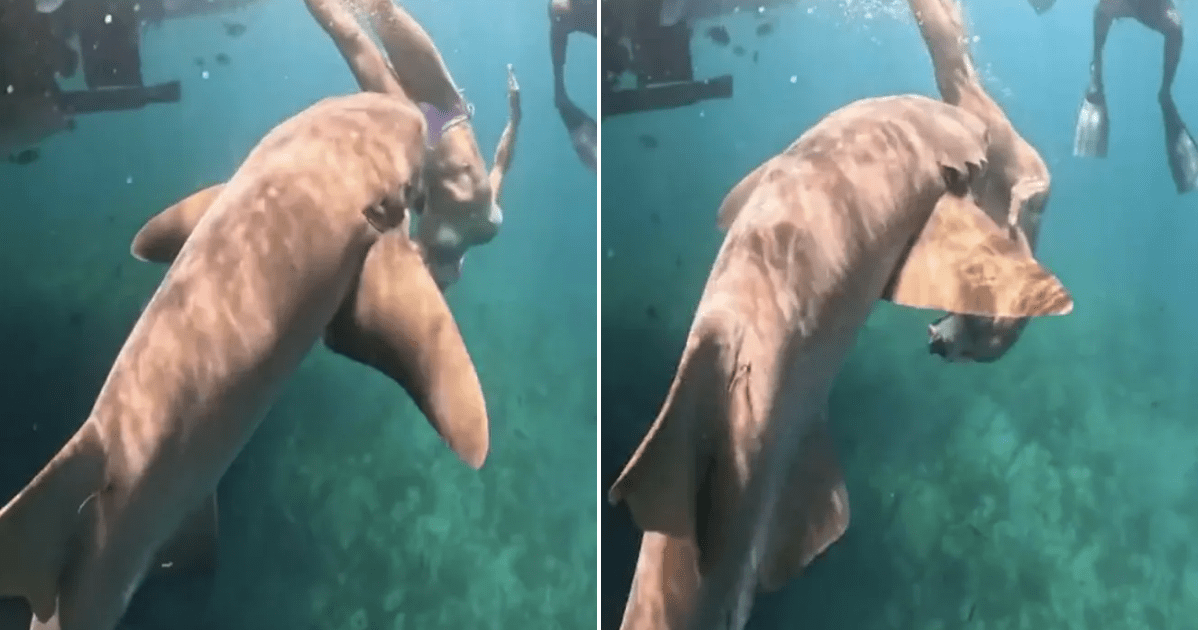
The story of Tayane Dalazen is a perfect illustration of how quickly a supposedly magical encounter can turn into a nightmare. In April, the 37-year-old lawyer from São Paulo was on a shark-diving trip off the coast of Brazil. She did not go there with the intention of making content, which makes her story all the more chilling. She was simply in the water, surrounded by nurse sharks, when a seven-foot animal clamped its jaws around her thigh and held her underwater for several seconds. Later, she discovered that the tour organisers had been feeding the sharks to encourage interaction with tourists, a practice that teaches sharks to associate humans with food and dramatically increases the risk of a bite. Dalazen remembers feeling strong pain and the weight of the shark pulling her down. She knew she had to stay calm, because panic would only make things worse. She could not fight the animal off; she could only wait. When the shark finally released her, she surfaced with lacerations on her thigh, lucky to still have her leg. “It was very frightening,” she later told the BBC. The footage of her near-miss has been viewed millions of times, and she has been honest about her own responsibility, saying she should have kept a safer distance. But the most disturbing detail is the feeding. This was not a wild encounter in the purest sense. It was an engineered interaction, a staged event designed to put humans and sharks in the same frame, and it nearly cost Dalazen her leg. Her story should be a cautionary tale, not a viral clip. Instead, it has become part of a growing pattern in which sharks are treated as props and the people who film them treat survival as a bonus. The line between a respectful dive and a reckless stunt is being erased, and Dalazen is one of the lucky ones who lived to tell the difference.
The incident with Dalazen happened in April, but it was far from isolated. Just last month, another influencer nearly lost his leg after being attacked by a reef shark while spearfishing. In December, a Chinese content creator was bitten in the Maldives. In the span of less than a year, at least three influencers have been bitten by sharks on camera, and those are only the cases that made the news. The casualty list extends beyond social media creators, too. Last year, a woman in her fifties was on holiday in the Turks and Caicos Islands when she waded into hip-deep water to take a photo of a bull shark. The shark circled her, bit her leg, and when she tried to protect herself with her hands, it severed both of them, one at mid-forearm and the other at the wrist. Her husband managed to wrestle the shark away, but the attack was described as a “living nightmare.” Two months later, a 40-year-old father of four was snorkelling in Israel when he encountered sharks. He had hoped to feed them from a distance, but he was dragged out to sea, using his GoPro to try to fend them off. An eyewitness watched in horror, screaming, “They’re eating him!” The man did not survive. These are not anonymous statistics. They are people with families, friends, and dreams, caught up in a moment where human and animal worlds collide. And in each case, the human element is the same: a failure to respect that a shark is not a creature to be approached, fed, or filmed in a way that alters its natural behaviour. The ocean does not issue warnings, and it does not care how many followers someone has. It simply delivers the consequences, and for some, those consequences are permanent.
Kristian Parton, a shark scientist and host of the Shark Bytes YouTube channel, has been monitoring this phenomenon with growing alarm. He says he is seeing cases of dangerous shark-human interactions “way more” than ever before, and he predicts that the trend will only get worse. “We’re going to see people ending up in really serious incidents with sharks,” he warned. Parton’s message is not about demonising sharks. It is about acknowledging what they are: true apex predators, powerful and unpredictable. He draws a simple analogy that cuts through the hype: “You wouldn’t walk into the Serengeti and try and put your hand on the face of a lion.” And yet people are doing the underwater equivalent, often while filming. Parton also points out that sharks become stressed out when humans invade their nursery habitats, breeding grounds, and feeding areas. These are not just places where sharks happen to swim; they are critical to the species’ survival. By crowding into those spaces, especially to create content, humans are depriving sharks of areas they need, and that has broader consequences for marine ecosystems. The expert’s concern is twofold: the immediate physical danger to humans, and the long-term harm to animals that are already vulnerable. Every time an influencer touches a shark, chases a shark, or feeds a shark to get a reaction, they are not just risking their own safety. They are also teaching sharks that humans are either a threat or a food source, both of which are recipes for disaster. Sharks do not bite out of malice. Most bites are believed to occur out of confusion, fear, or curiosity. But a shark’s curiosity is expressed with teeth, and its fear response is just as dangerous. When a shark is pushed into a stressful situation, it will do what any predator would do: defend itself. The humans who choose to ignore this are not brave. They are gambling, and the house is very, very large.
For all the fear surrounding sharks, the reality is that they pose very little threat to humans. According to Save Our Seas, only about a dozen of the more than 500 known shark species have ever fatally injured a human being. Most sharks are simply not interested in people. However, sharks that grow to around six feet and are considered predatory have the teeth and jaws capable of inflicting severe injury, and three species in particular, the white shark, tiger shark, and bull shark, are responsible for the majority of bites on humans. The International Shark Attack File, which has been compiling data since the 1500s, reports that between 70 and 100 people are bitten by sharks each year. Some of those bites are fatal, but most cause only minor injuries. To put that in perspective, far more people are killed every year by lightning, bees, or even vending machines. Yet the image of the shark as a ruthless man-eater persists, fed by movies, sensational headlines, and, increasingly, by viral videos that show humans swimming with them. The irony is that the humans in those videos are often the ones doing the provoking. When tour guides feed sharks to attract them to tourists, they are not giving visitors a chance to admire nature; they are creating a conditioned reflex that could end in tragedy. The sharks are not villains. They are wild animals acting on instinct. And the more humans encroach on their habitats, the more often those instincts will bring them into conflict with people. The experts’ advice is simple: give sharks space, do not feed them, and never attempt to touch or ride them. But in a world where content is king, simple advice is often ignored. The result is a cycle of violence that harms both species. Sharks are already threatened by overfishing, bycatch, and habitat destruction. Now they are being put in the position of having to defend themselves against camera-wielding humans who should know better. The ocean is not a studio. It is not a background for likes. It is a living, breathing ecosystem, and sharks are one of its most important inhabitants. Treating them as attractions is not just dangerous; it is an act of arrogance.
What is at stake here is not just a limb or a life, though those are certainly precious enough. It is also the way we relate to the natural world. There is something profoundly sad about a culture that values a few seconds of adrenaline over the wellbeing of another living creature. The influencers who survive these encounters often express regret, saying they should have stayed farther away. But the damage has already been done, both to themselves and to the sharks. A shark that has bitten a human is often labelled a danger and killed, even though the bite was a response to being harassed. The very people who risk their lives for content are the same people who, directly or indirectly, put sharks at risk. The solution is not to stop filming the ocean. It is to film it with respect. Get in the water, yes. Observe from a distance. Use a telephoto lens. Let the shark make the first move. If a shark is curious, give it an avenue to leave. Never block it, never chase it, never feed it. Most importantly, remember that this is a wild animal, not a co-star. The experts are not trying to ruin anyone’s fun. They are trying to prevent a tragedy that they see coming in real time. “We’re going to see people ending up in really serious incidents with sharks,” Parton said, and the only way to prove him wrong is to change the behaviour that got us here. No like, no share, no viral moment is worth a father being eaten alive while his family watches on a phone screen. No thumbnail is worth a woman losing both hands in water shallow enough to stand in. The ocean has existed for billions of years, and it does not owe us content. It owes us nothing. We are the ones who owe it something: humility, respect, and the simple wisdom to know when to stay away. The next time you see a video of someone swimming too close to a shark, do not be impressed. Be warned. It might take a tragedy to make this message stick, but it does not have to be yours.