

Josephine Harris was not a person anyone would have expected to become a symbol of the September 11 attacks. She was a 59-year-old widow and grandmother from Brooklyn, a bookkeeper who had worked for the Port Authority of New York and New Jersey for only six months before that bright, terrible Tuesday morning. She was also, at that point, still recovering from a car accident that had left her with injuries to her leg and back. Characteristically stubborn and determined, she had signed herself out of the hospital on the day of the accident and tried to return to normal life, wearing a leg brace and refusing to let pain slow her down. But on September 11, 2001, her body had limits she could not push past. When American Airlines Flight 11 slammed into the North Tower of the World Trade Center at 8:46 a.m., Harris was at her desk on the 73rd floor. The impact sent shockwaves through the building, and like thousands of others, she joined the slow, frightened river of people streaming down the stairs. Smoke and dust filled the air, and every instinct told her to keep moving, to get out before it was too late. Somehow, despite her injured leg and back, she managed to descend fifty floors. But by the time she reached the 20th floor, exhaustion had caught up with her. Her leg throbbed, her back screamed, and her lungs burned. She could barely walk, let alone continue down what seemed like an endless staircase. She was, by her own account, spent. It was at that moment that six firefighters from FDNY Ladder Company 6 appeared, coming down from the upper floors after being ordered to evacuate following the collapse of the South Tower. They saw a woman who could not go on, and they made a choice that would define the rest of their lives.
The firefighters were Captain Jay Jonas, Sal D’Agostino, Matt Komorowski, Mike Meldrum, Bill Butler, and Tommy Falco. They had been heading up into the building, toward the impact zone, when the South Tower collapsed at 9:59 a.m., sending a signal that the North Tower might not be far behind. The order came to evacuate, and they turned around, moving quickly down the stairs. But when they reached the 20th floor and found Harris, everything changed. Firefighter Tommy Falco looked at Captain Jonas and asked what they should do. Jonas did not hesitate. “We cannot leave her behind.” It was a simple statement, but in that moment, it carried the weight of everything firefighters believe about their job and their duty. They were exhausted too, having climbed dozens of flights in full gear, carrying equipment, knowing that their brothers were dying in the ruins outside. Yet they refused to let this woman die alone in a stairwell. Bill Butler put her arm over his shoulder and helped support her weight as they trudged toward the exit. The group moved at her pace, which was slow, agonizingly slow. Every step was a negotiation between her pain and their urgency. They guided her down Stairwell B, near the center of the tower, trying to reassure her, telling her they were almost out, even as the building groaned and shook around them. Harris, meanwhile, was not thinking about heroism or miracles. She was thinking about her family, about the grandchildren she wanted to see again, about the unfairness of being trapped so close to safety. She apologized for slowing them down. They told her not to apologize. They told her she was going to make it. They did not know if that was true, but they said it anyway, because that is what you do when someone is about to give up.
Eventually, on the lower floors, between the second and fourth floors, they stopped to rest. Harris was completely spent. She told them to go on without her, that she could not take another step, that they should not risk their lives for her. It was a moment of profound selflessness, and it almost cost them everything. Moments later, at 10:28 a.m., the North Tower collapsed. The sound was apocalyptic: a deep, roaring, grinding roar of concrete and steel twisting and breaking apart. The ground shook violently, and the air filled with choking dust and debris. Captain Jonas later described the tower “peeling away like a banana” around the staircase. But the staircase where they had stopped was the only part of the structure that remained intact. It was as if the building had chosen that exact spot to protect, or as if something larger than chance was at work. The group huddled together, buried in the rubble, unsure whether they were alive or dead. Dust filled their lungs, and darkness closed in around them. They were trapped there for five hours, not knowing if rescuers would find them, not knowing if the rest of the tower would come down on top of them. When they finally managed to attract the attention of rescue workers, they emerged into a world that had changed forever. The story became known as the Miracle of Stairwell B. The firefighters would later insist that Harris had saved their lives, not the other way around. Her slow pace had kept them in that stairwell at the moment of collapse. If they had continued at their own speed, they would have been in the lobby or outside the building, directly in the path of the falling tower. She was, in their eyes, their guardian angel. “We considered Josephine our guardian angel,” Sal D’Agostino said. They had set out to save her, but in the end, she had saved them all.
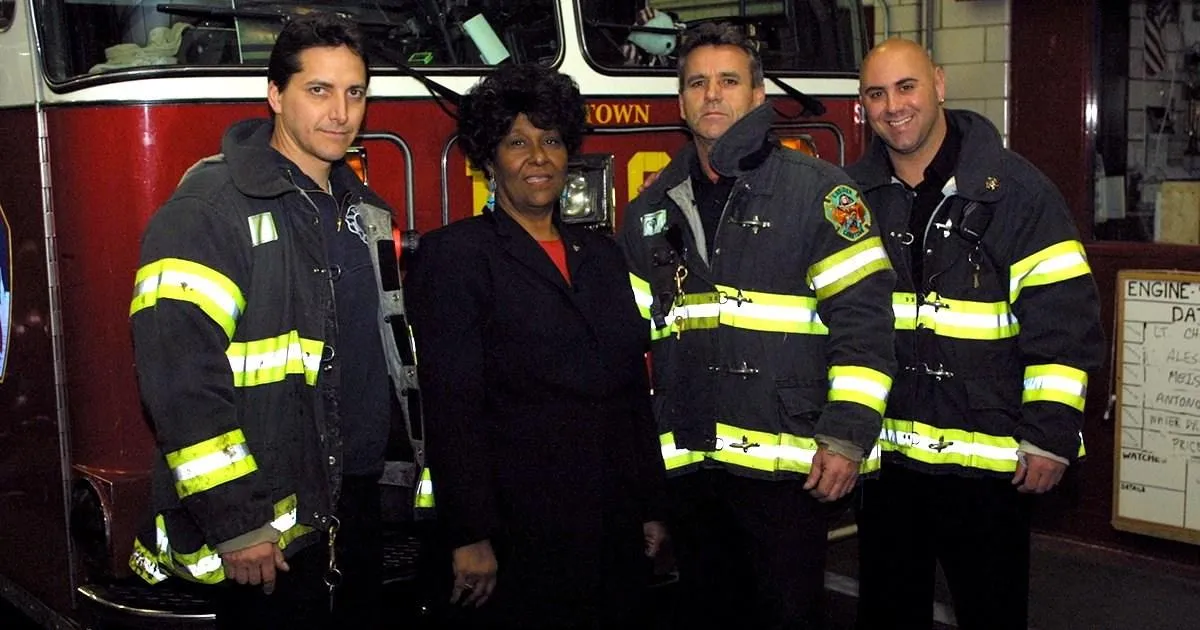
The bond between Josephine Harris and the firefighters of Ladder 6 did not end when the dust settled. It grew deeper over the years. They stayed in touch, visited her, and made sure she knew she was part of their extended family. They presented her with an FDNY jacket embroidered with the words “Our Guardian Angel,” and she wore it proudly. She appeared alongside them at events marking the anniversary of the attacks, a small, determined woman surrounded by strong men who treated her with a tenderness that was almost paternal. For Harris, the friendship was a lifeline. She had lost so much on 9/11, not just her sense of safety but, eventually, her ability to work. She returned to her job after the attacks, but her injuries from the car accident, compounded by the ordeal of the stairwell, made it impossible to continue. She had to give up her bookkeeping position and lived in Brooklyn on disability support. Still, she never lost her spirit. She remained grateful for the men who had refused to leave her, and they remained grateful for the way her struggle had kept them alive. The jacket became a treasured possession, a symbol of an unbreakable link between a bookkeeper from Brooklyn and a group of firefighters who had seen the worst of humanity and chosen compassion instead. When Harris died of a heart attack in 2011, at the age of 69, the six firefighters who had carried her down Stairwell B were called upon one final time. They served as her pallbearers at her funeral. It was a scene that captured the strange and beautiful symmetry of their story: the woman they had carried out of the burning tower, now carried by them one last time. They did not see it as a burden. They saw it as an honor, a final thank-you to the woman who had given them their lives back. “It felt like losing a member of the family,” Captain Jonas said. And in a way, she was.
There is a painful irony in the fact that Josephine Harris’s injury may have saved more lives than any single act of heroism that day. If she had not been hit by a car months earlier, if she had not been wearing a leg brace, if she had not slowed the firefighters down, they would have descended the stairs at their own pace, likely reaching the ground floor or the lobby just as the North Tower began to collapse. The very thing that made her vulnerable, the injury that caused her so much pain and frustration, became the instrument of survival for seven people. It is a reminder that our weaknesses are not always what they seem. Sometimes the obstacle in our path is actually the thing that saves us. The firefighters understood this better than anyone. They did not see Harris as a burden or a hindrance. They saw her as a partner in survival, a woman whose struggle gave them the gift of time. She, in turn, insisted she had done nothing special; she was just trying to get out alive. But the men who were there knew the truth. Her decision to keep going, to keep putting one foot in front of the other despite the pain, was an act of courage. Her refusal to let them risk their lives for her, telling them to go on without her, was an act of love. And their refusal to listen was an act of devotion. In the chaos of 9/11, when the world seemed to be coming apart, this small group of strangers formed a bond that transcended fear and death. They held onto each other, literally and figuratively, and that is why they walked out of the rubble. Their story reminds us that heroism is not always about charging into danger; sometimes it is about staying with someone who cannot run, matching your pace to theirs, and refusing to let go. It is about the quiet, unglamorous choice to be human in the face of inhumanity.
Twenty-five years have passed since the September 11 attacks, and the names of the dead are read aloud every year, a solemn roll call of nearly three thousand souls. But among the stories of loss and devastation, the Miracle of Stairwell B stands out as a testament to the power of human connection. It is a story that does not end with the collapse of the towers, because the people who lived through it carried its lessons with them for the rest of their lives. Josephine Harris lived for another decade after that terrible day, long enough to see her grandchildren grow, long enough to stand beside the firefighters at memorial services, long enough to know that her life mattered in a way she could never have imagined. When she died, the firefighters carried her to her final rest, completing the circle that began on a smoke-filled staircase. Their story has been told in books, documentaries, and articles, but it never loses its power. It speaks to something deep inside us: the hope that even in the worst moments, we are not alone. It reminds us that ordinary people, a bookkeeper from Brooklyn and a handful of exhausted firefighters, can become extraordinary simply by choosing to care for one another. In a world that often feels fractured, their story is a reminder that compassion does not require superhuman strength; it only requires a willingness to stop, to look at another person, and to say, “I will not leave you.” The tower fell, but the stairwell stood. And within that stairwell, a group of strangers became family. That is the miracle. That is what we remember. That is what we carry forward, not as a relic of the past, but as a living example of what it means to save a life, and in doing so, to be saved ourselves.