

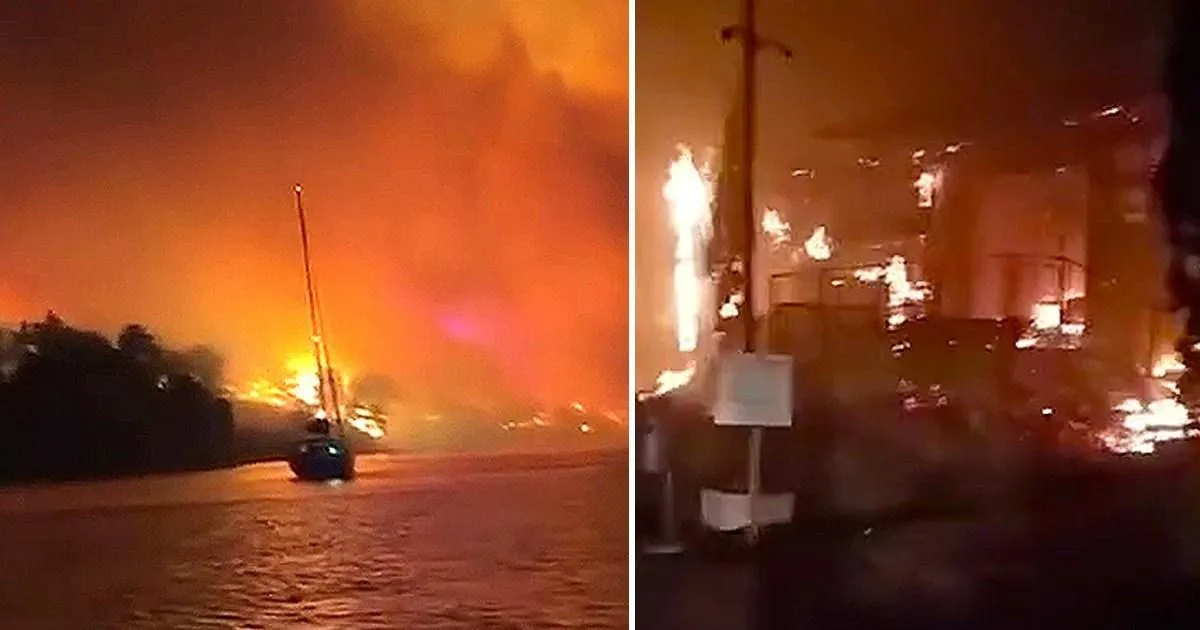
On a warm Sunday evening, the island of Brac in Croatia should have been the setting for nothing more than relaxed holiday conversations, the clink of glasses and the gentle sound of waves against the shore. The Gava Waterman Milna Resort, a hive of summer activity, was full of guests from across Europe, many of them British families who had paid handsomely for all-inclusive comfort and the promise of an idyllic Adriatic escape. But as darkness fell, that promise was torn apart by an advancing wall of fire. A wildfire, which had been smouldering in the dry brush and pine forests for days, suddenly surged toward the resort, turning a peaceful night into a terrifying scramble for survival. Holidaymakers found themselves running through smoke and heat, their bare feet on burning sand, their lungs filled with ash, desperately seeking safety. What made the ordeal even more shocking for many was the way the danger was initially dismissed. Guests claim that staff told them to calm down, that the fire was no real threat, and that they should simply return to their rooms and perhaps even “relax with a drink.” Those words would soon feel like a cruel joke, as flames appeared just metres away, forcing people to flee for their lives into the dark sea.
Among those caught in the chaos was Josh Robbins, a 26-year-old guest who later described the scene with raw emotion. He had been reassured by staff that everything was under control, but five minutes after being told to go back inside, he stepped outside again and saw something horrifying. The flames had travelled to within twenty feet of the building, and the air was filled with burning embers. “It was terrifying,” he said. “We were left to run for our lives as a wall of flames closed in as we were showered by burning embers.” The heat was intense, the smoke thick enough to sting the eyes and make every breath painful. Guests began to panic, and the sense of order collapsed. One elderly couple became trapped inside the resort when the power failed at around 9.35pm local time. The sudden blackout caused the building’s sliding doors to lock shut, sealing them inside as the fire approached. It took the strength and desperation of other guests, who rushed to the doors and yanked them open with all their might, to free the couple. In that moment, there was no time for politeness or procedure, only instinct. Men and women screamed for their loved ones, parents clutched children, and strangers grabbed each other’s hands as they fled through the darkness, unsure whether they would make it out.
The disaster had been building for days, though few holidaymakers could have known it. A wildfire broke out on Thursday after lightning strikes in the area, and it spread slowly at first, creeping through the dry Mediterranean vegetation. By the following day, the flames had shifted east, moving in the direction of Milna, the small town that gave the resort its name. Hundreds of firefighters were called in to battle the blaze, and their efforts were heroic, but they were fighting an unpredictable and merciless enemy. The terrain was rough, the wind was changeable, and the fire had a hunger that seemed impossible to satisfy. By Sunday night, it had reached the resort, and the situation quickly became desperate. To make matters worse, guests at the Gava Waterman Milna Resort claimed that some staff members, rather than helping to evacuate people, got into their cars and drove down the resort’s single narrow access road, causing a massive traffic jam. That road was the only way in and out, and it was now clogged with vehicles, blocking the fire crews who were trying to reach the property. The very people who should have been guiding guests to safety were, in the eyes of many, making the danger even greater. With the road impassable and the flames closing in, there was nowhere left to go but the water. Guests ran down a path to a wooden dock and threw themselves into the sea, wading out as far as they could, watching in disbelief as their holiday destination burned before their eyes.
Help eventually came, but not from the tour operator or the resort management. It came from ordinary people, local residents who saw the flames and heard the cries for help. Around fifty private boats, fishing vessels and pleasure craft, were launched by people from Milna and nearby towns, and they sped across the dark water toward the shoreline. These local men and women, many of whom had no formal training in rescue operations, risked their own lives to pull terrified holidaymakers from the water and off the burning docks. They ferried people to safety in the middle of the night, their boats packed with shivering, shocked and grateful survivors. It was around 11pm when the first local boats arrived, about half an hour before TUI, the tour operator that had arranged many of the guests’ holidays, sent out an evacuation alert to their phones. For many of the rescued holidaymakers, that alert felt not like help but like a reminder of how abandoned they had been. In total, almost 700 people were saved, and, miraculously, no one was seriously injured. All of the evacuated guests were taken to the mainland, to the city of Split, where they were given shelter, clothing and medical attention. Croatian authorities later confirmed that the open flames on the island had been extinguished, but the emotional scars would take far longer to heal.
Around a third of the guests staying at the resort were British, and many of them had booked all-inclusive packages through TUI, paying around £1,800 per week for what should have been a carefree holiday. For that kind of money, they expected safety, organisation and support. Instead, they said they were abandoned by the very people who should have been looking after them. There was no clear evacuation plan, no guidance from hotel staff during the critical first minutes, and no communication from the tour operator until long after the rescue had already been carried out by local volunteers. The criticism was fierce and, in many ways, justified. People spoke of running for their lives while being told to relax with a drink, of being trapped in a burning resort while staff saved themselves, and of receiving text message alerts only after they had already been pulled from the sea. TUI, for its part, issued a statement expressing sympathy and emphasising that safety was its highest priority. “We know this will have been a distressing experience for those affected by the wildfire on the island of Brac,” a spokesman said. “The safety of our customers is our highest priority and our local teams have been supporting those impacted and working closely with the hotel and local authorities.” But for many guests, those words felt hollow. They had lived through a nightmare, and no press release could undo the terror of that night.
In the days after the fire, as the smoke cleared and the island of Brac began to recover, the true weight of what had happened began to sink in. The Gava Waterman Milna Resort was damaged but still standing, and the surrounding hillsides were blackened and scarred. The tourists who had escaped returned home with stories that would stay with them forever. Some felt anger, others felt grief, and many felt a profound sense of gratitude to the local people who had saved them without hesitation. The fire was a reminder of how fragile life can be, and how quickly a holiday can turn into a disaster. It also raised urgent questions about the responsibilities of hotels and tour operators in an age of increasingly extreme weather and unpredictable wildfires. Climate change is making such events more common, and the tourism industry must adapt. Evacuation plans need to be more than words on a page. Staff need to be trained to act calmly and effectively under pressure. Communication systems need to be robust enough to reach every guest, even when the power fails and panic sets in. Most importantly, the voices of guests must be heard and taken seriously. When someone says a fire is dangerous, it should not be dismissed with a suggestion to relax and have a drink. The people who survived this night were lucky. They were saved by the courage of strangers, by the kindness of a community that refused to let them face the flames alone. But their experience should serve as a powerful lesson, not just for Croatia, but for every holiday destination in the world. Safety cannot be an afterthought. It must be the very foundation on which hospitality is built. And in the end, the most important thing that was rescued from that burning shore was not luggage or property, but human life itself.