



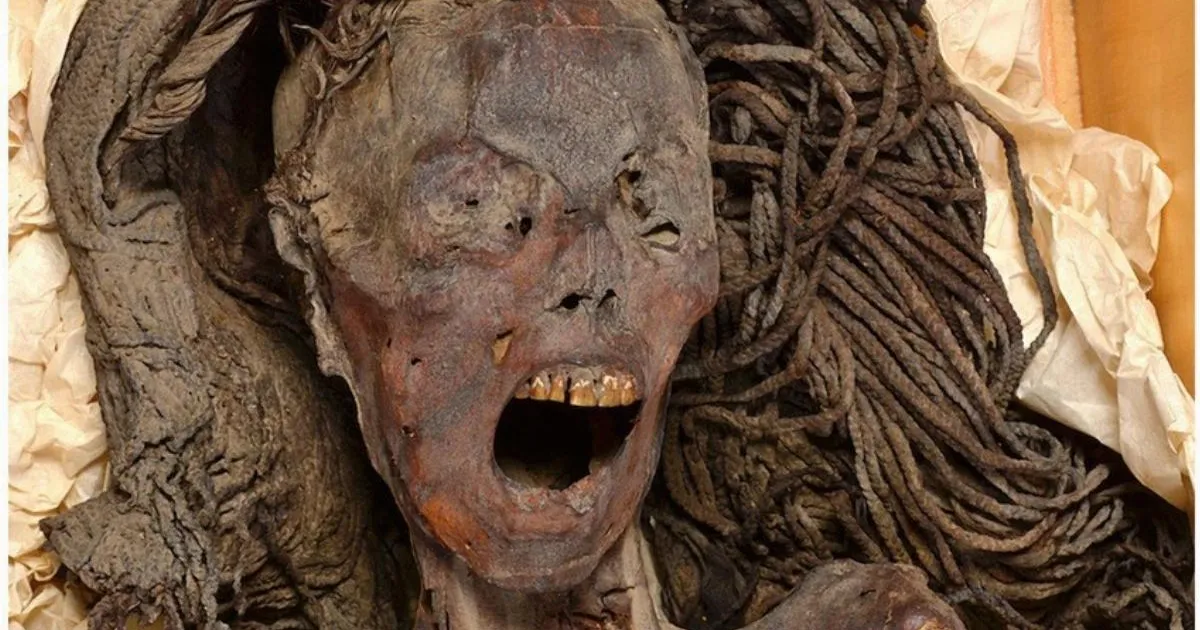
For more than ninety years, archaeologists have looked at the same unnerving face and wondered what could have caused it. The woman now known as the “screaming mummy” was discovered in Thebes in 1935, among the tombs of the family of Senmut, a royal architect and close confidant of Hatshepsut, the queen who became pharaoh during Egypt’s 18th dynasty. But while her burial was clearly important, her expression was anything but serene. Her mouth is frozen open, her jaw appears strained, and her face seems permanently twisted into a silent scream, as if the last moment of her life had been captured in flesh and linen and kept for millennia. For decades, experts assumed this was simply the result of careless mummification. The thinking was that the embalmers had likely not bothered to close her mouth, maybe because they had done a rushed or poorly executed job. Yet the more researchers studied the items buried with her, the less that explanation made sense. Her grave was not a cheap or hurried one. It contained expensive, imported materials and all the signs of a well-respected burial, which made the horror frozen on her face all the more baffling. It seemed as if the ancient Egyptians had deliberately preserved a scream. Now, using modern technology, scientists have finally begun to understand this remarkable and tragic woman, and their findings suggest that her expression was not an embalming mistake at all, but the preservation of a truly agonizing death.
The new research, carried out by Sahar Saleem, a specialist in mummy radiology at Cairo University, together with Samia El-Merghani of Egypt’s Ministry of Tourism and Antiquities, used a range of non-destructive scientific methods to look inside the mummy without causing any damage. With X-rays, CT scans, scanning electron microscopy, and other advanced techniques, they were able to learn an extraordinary amount about this ancient woman. She stood about one and a half meters tall and was probably around forty-eight years old when she died. Instead of being a badly prepared body, her remains showed the hallmarks of careful, deliberate embalming. Her linen wrappings had been coated with imported resins, including frankincense and juniper, which were costly and highly valued in the ancient world. Even her wig was a remarkable work of craftsmanship. It was not made from human hair but from date-palm fibers, carefully shaped and dyed with reddish henna, then coated with a crystalline powder containing quartz, magnetite, and albite. All of this points to a ritual that was carried out with care and skill, not a hasty or botched procedure. The expensive materials and the careful preparation of her body suggest that those who buried her respected her and wanted to preserve her properly for the afterlife. That makes the frozen scream on her face even more striking, because it cannot be dismissed as the sloppy omission of an exhausted embalmer. Instead, the researchers came to a much darker conclusion: the woman’s expression likely reflects the way her body reacted to an intensely painful or terrifying death.
The key to understanding the screaming mummy lies in something called a cadaveric spasm. Unlike rigor mortis, which gradually stiffens the entire body after death, a cadaveric spasm is thought to affect specific muscles at the exact moment of passing. It is a rare and poorly understood phenomenon, but it can happen when a person dies under extreme physical or emotional stress. In such cases, the muscles used in the final moments of life may lock in place instantly, as if the body itself is frozen in a snapshot of its last experience. The woman’s face, with her mouth wide open and her jaw clenched in that position, could be exactly this kind of spasm. According to the scientists, her expression may indicate that she died screaming, perhaps in agony or panic, and that her facial muscles contracted so suddenly that the body could not relax afterward. When the embalmers received her, they may have found it impossible, or at least very difficult, to close her mouth, because the muscles had already stiffened in that position. Rather than fighting against her body, they apparently preserved it as it was. The result is that the final, terrible seconds of her life have remained visible for more than three thousand years. It is a haunting thought: the face of a woman who suffered so intensely that even death could not smooth away the evidence of her pain.
The new study also revealed other important details about her identity and the nature of her burial. Her arms were placed by her sides, with her hands almost meeting in her lap. To specialists in Egyptian funerary customs, this is a meaningful clue. Royal mummies were usually posed with their arms crossed over their chests, a posture intended to reflect their elevated status. The screaming woman’s pose suggests that, despite being buried in an important location with lavish goods, she was probably not a member of the royal family. She may have been a person of some standing, perhaps connected to the senmut family, but not of the highest rank. There is also the strange fact that her internal organs were still inside her body. By the time she lived, Egyptian embalmers had developed sophisticated methods for drying organs and wrapping them separately, sometimes placing them back inside the body in a symbolic manner. But in her case, researchers found no incision on the body, none of the usual cuts that would have been made to remove the organs during mummification. This is another layer of mystery. It is possible that the embalmers, faced with the unusual condition of her contracted muscles, chose to take a different approach. Or perhaps her body was mummified in a way that did not require the standard procedures. Either way, the evidence points to a person whose death was so unusual that even the ritual preparations had to be adapted.
As for what actually killed her, the researchers cannot be certain. There are no obvious wounds, no signs of violence, and no clear cause of death written into the bones or tissues that remain. But several possibilities have been proposed. A sudden and severe medical event, such as a heart attack or a stroke, could have caused intense pain and brought on the spasm. A ruptured aneurysm in the brain could also produce sudden agony and death, and might explain the expression frozen on her face. Another theory is that she was bitten by a venomous snake. In ancient Egypt, where snakes were both feared and revered, this was a real danger. A snakebite can be profoundly painful and often kills quickly, and the body’s reaction to the venom might easily trigger the kind of muscle spasm the researchers believe they see. Yet no bite marks were identified on the mummy, and the scientists are careful to stress that none of these possibilities can be proven. The cause of her death remains unknown. What the evidence strongly suggests, however, is that her face is not the result of sloppy workmanship. It is the result of an involuntary, agonizing moment that her embalmers inadvertently preserved. They may have moved quickly to mummify her before her body relaxed, perhaps because her contracted muscles made it difficult to position her properly, or perhaps because they wanted to maintain the exact posture in which she died. Whatever their intentions, they ended up freezing a single instant of human suffering in a way that would last for millennia.
The story of the screaming mummy is a reminder that ancient Egypt, for all its grandeur and ritual, was still a place of very human drama. Behind every carefully wrapped body lies a life that ended in a particular moment, often in pain, sometimes in fear. The woman whose face we can still read today was not a queen, as far as we know, and her name has been lost to history. Yet her final expression has made her unforgettable. Modern science has not solved every mystery about her. We still do not know exactly who she was, what she endured in her life, or what caused her last moments to be so awful. But we do know that her scream was real enough to leave a mark that no amount of time could erase. The embalmers who prepared her body for eternity probably never imagined that their work would one day be scanned and studied by curious minds thousands of years later. They were doing their job, preserving a body for the afterlife, and in doing so they preserved the final, desperate expression of a human being. It is not a comfortable image. It is a face that asks us to think about the fragility of life and the mystery of death. But it is also a kind of testimony. The screaming mummy is still telling us, in her own silent way, that she was here, that she suffered, and that she was not forgotten. And that, perhaps, is the most human story of all.