


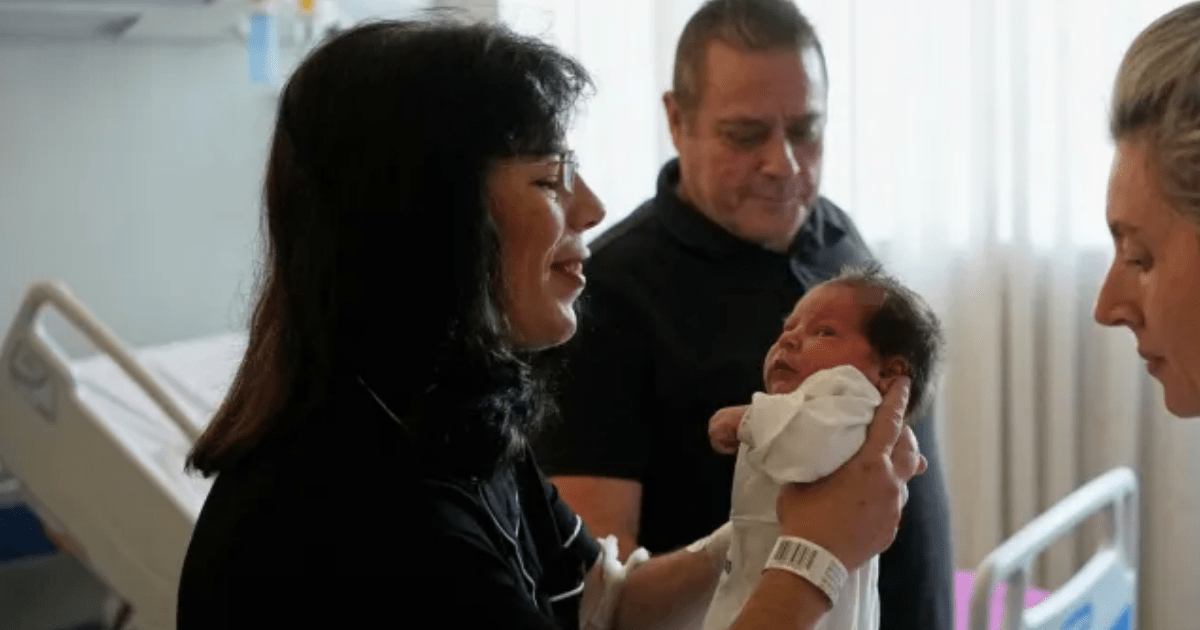
In a sun-drenched hospital room in Athens, where the crisp, clinical air of the maternity ward was softened by the sweet scent of pink balloons and vibrant flowers, a miracle lay sleeping. Cristina Rapti-Tzelepi, a woman of fifty-four years, looked down at her newborn daughter—a perfect 7-pound, 11-ounce bundle wrapped in a white bodysuit—and felt a profound sense of peace wash over her. Beside her, her husband, sixty-year-old Constantinos Raptis, gently took the baby from her arms, holding the tiny girl against his broad chest as she slept soundly on his shoulder. The room was thick with emotion—not just the typical elation of new parenthood, but a staggering, hard-won joy that had been forged in the darkest valley of their lives. This was not merely the birth of a child; it was the triumphant resurrection of a family shattered by tragedy, a testament to the indomitable human spirit, and a monumental medical and legal miracle. This baby girl, whose arrival on Wednesday felt like a personal victory against the very concept of despair, represented a fresh start for a couple who had lost everything, and her very existence was a daring challenge to the biological limits of time itself.
The road to this blissful scene was paved with unthinkable heartache. Just last October, the couple’s world was shattered when their beloved twenty-one-year-old son, Giorgos, was tragically killed in a devastating car crash. The loss was absolute and crippling, leaving a void in their home that seemed impenetrable. Their son had been the light of their lives, a young man who had filled their house with laughter and boundless energy. In the aftermath of this horrific tragedy, while most would have been paralyzed by grief, Cristina and Constantinos made a radical, defiant decision: they would give life a second chance. Rather than allowing their family’s story to end in despair, they chose to rewrite it, opting to pursue a new pregnancy as a way to honor their son’s memory and to find a reason to look toward the future again. “We decided to give life a second chance, to make a new start, bring new life into our home, and keep our family’s story going,” an emotional Rapti-Tzelepi recounted, her voice thick with the tears of a mother who had mourned one child while fighting to bring another into the world. It was a courageous leap into the unknown, fueled by a desperate need to reclaim the joy that had been brutally ripped away from them.
However, their path to parenthood was laden with a terrifying obstacle that had nothing to do with their fertility and everything to do with a strict legal deadline. In Greece, the law mandates that women must complete the in vitro fertilization (IVF) procedure—specifically, the embryo transfer—before the age of 54 years and 0 days. At the time they initiated the process, Cristina was already 53 and rapidly approaching this absolute cut-off. The couple found themselves locked in a frantic race against the clock, with only a narrow two-month window to navigate the complex bureaucratic and medical hurdles required to reach the point of transfer. They had to rapidly secure special approval from the national authority, a process that added immense pressure to an already emotionally charged situation. “I only had a two-month window,” she recalled, the stress of that period still evident in her voice. “It was stressful, but with inner strength and our doctor and his whole team by our side, we got through every obstacle.” The bureaucratic scramble was not just a formality; it was a high-stakes game where the prize was a potential life, and the penalty for being a day too late was the end of their dream.
The medical marvel at the heart of this story lies in the embryo itself, which had been cryogenically frozen for more than twenty-two years—a staggering duration that makes this birth a remarkable scientific achievement. While embryos can theoretically be frozen and stored indefinitely, with legal storage limits in the UK extending up to 55 years, the successful implantation and live birth from a fertilized egg that has been dormant for over two decades is highly unusual. It represents a triumph of reproductive technology, proving that time is not always an absolute barrier to life. This incredible case draws comparison to other rare examples, such as the couple in Ohio last year who welcomed a son from an embryo frozen thirty years earlier, recognized by Guinness World Records for the oldest known frozen embryo to result in a successful live birth. For Cristina and Constantinos, this 22-year-old embryo was a latent promise, a seed of life that had patiently waited for the right moment to sprout, perfectly timed to rescue them from their grief. It serves as a powerful reminder that hope, once frozen, can still thaw and flourish under the right circumstances.
The emotional resonance of the birth was profoundly amplified by the decision to name their daughter Georgia, a direct and loving tribute to their late son, Giorgos. The name is a bridge between their past and their future, ensuring that the memory of the son they lost will forever be carried in the identity of the daughter they have gained. In a poignant moment that captured the raw healing power of this new life, Constantinos held his daughter close, three days after her arrival, and spoke with overwhelming gratitude about their doctor. “He took us by the hand and pulled us out of our deepest darkness,” he said, his voice breaking with emotion. “We escaped from that darkness, and I believe we have a lot to live for now.” For Cristina, the wish for her daughter is simple and profound: that she would grow up to be as healthy and happy as their firstborn, who had filled their home with so much joy. The baby represents more than just a new family member; she is a living symbol of their resilience, a tangible proof that love can survive even the most devastating loss, and that the human heart has an incredible capacity to heal.
Looking ahead, the couple’s story is far from over, as they have hinted that they might not rule out expanding their family again, even considering travelling abroad to circumvent the restrictive laws of their home country. Their remarkable journey has also sparked a crucial conversation about the legal framework governing reproductive rights in Greece. Dr. Kostas Pantos, the couple’s gynaecologist and the head of the Hellenic Society of Reproductive Medicine, has done everything in his power to support them, even though he believes the system is fundamentally unjust. “The law is very strict: 54 plus one day is not allowed. Maybe it’s time for it to change,” he argued, noting that Greece only raised the age limit from 50 to 54 in July 2022. “I think it’s a right parents should not be deprived of.” In their journey, this couple has challenged the biological and societal norms, showing that the desire to nurture and love, to heal from profound trauma and embrace new life, does not simply disappear with age. As they left the hospital with their little girl, they carried not only a child but also a testament to the power of second chances—proving that even from the darkest depths of grief, one can find the strength to step back into the light and build a future filled with love, laughter, and infinite possibility.