


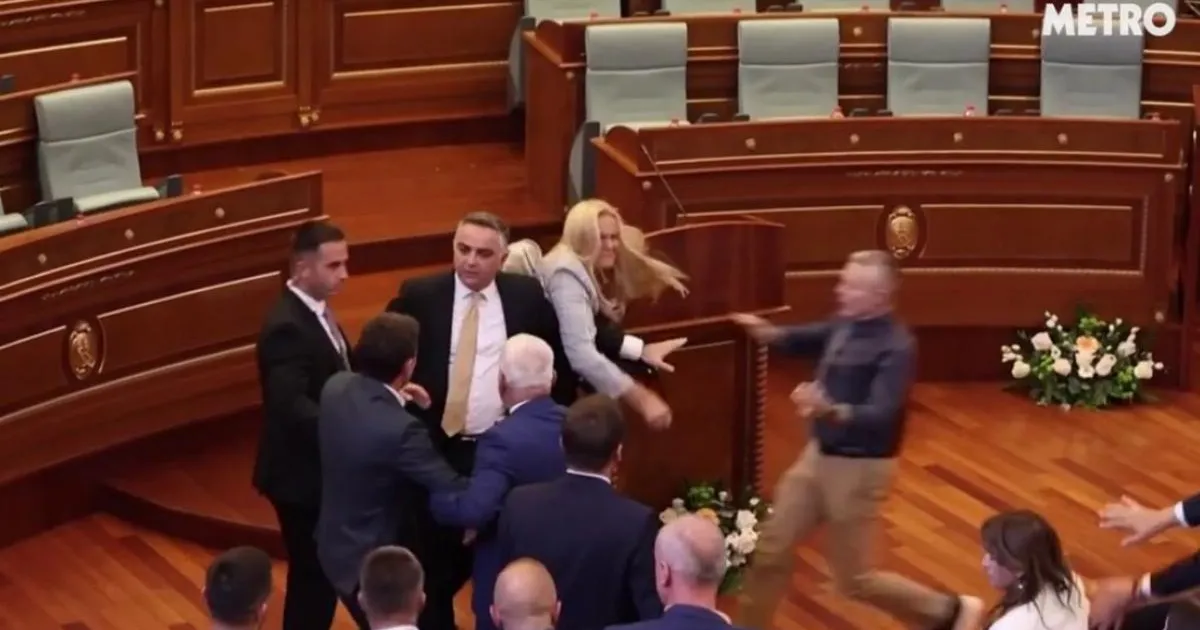
The political landscape in Kosovo has long been defined by high-stakes tension, but this past Saturday, the drama in the national parliament reached a bizarre and literal boiling point. During a tense legislative session, the proceedings were brought to a sudden halt when Time Kadrijaj, an opposition Member of Parliament from the Alliance for the Future of Kosovo (AAK), transformed the assembly floor into a chaotic scene of flying projectiles. Frustrated by the ongoing political gridlock and aiming her ire directly at caretaker Prime Minister Albin Kurti, Kadrijaj stood up, shouted “Shame on you!” and began hurling eggs across the chamber. The unexpected barrage forced security personnel to scramble to shield the Prime Minister, leaving the assembly halls splattered with the remnants of the protest as the session was suspended indefinitely.
This unconventional outburst serves as a vivid illustration of the fragility and exhaustion currently gripping Europe’s youngest democracy. Kosovo has been trapped in a relentless cycle of political instability, having weathered three separate national elections in just over two years, with the ominous specter of a fourth election looming on the horizon. The atmosphere in the chamber reflected this deeper fatigue; for many citizens, the inability of their elected officials to reach a consensus on basic governance has become a source of immense frustration. When politicians resort to throwing eggs rather than engaging in debate, it signals a breakdown in the parliamentary norms that are meant to keep a democracy functioning, highlighting the disconnect between the political elite and the needs of the public.
In the aftermath of the spectacle, Prime Minister Albin Kurti maintained an air of stoic, almost practiced, resilience. Rather than responding with retaliatory anger, he famously remarked that if enduring a barrage of eggs is the necessary price for maintaining political dialogue, he is more than willing to pay it. This measured response from the leader was not merely an attempt to appear composed; it was a nod to the irony of his own political history. Before he became the leader of the country, Kurti’s own left-wing party, Vetevendosje (VV), was notorious for employing radical obstructionist tactics—including the release of tear gas within the very same parliament building between 2015 and 2018. Having once been the architect of legislative chaos, Kurti now finds himself on the receiving end, offering a poignant look at how the tables often turn in the volatile world of Balkan politics.
The historical context of these protests reveals just how deeply polarized Kosovo remains regarding its path forward. When Kurti’s party previously disrupted parliament with tear gas, their target was a series of diplomatic agreements with Serbia and Montenegro. Those earlier protests were framed by the opposition as necessary acts of civil disobedience to prevent what they viewed as unfavorable concessions that threatened national sovereignty. At the time, the European Union sternly condemned the violence, asserting that such obstructionist tactics were unacceptable and incapable of solving the fundamental issues facing the Kosovar people. Today, however, the irony is not lost on political observers: the protesters have changed, the targets have shifted, but the fundamental gridlock remains as stubborn as ever.
The current crisis centers on the math of the parliamentary system, which has become a roadblock to progress. Following his recent electoral victory, Kurti’s party found itself without a sufficient mandate to unilaterally appoint a new president. Because the diverse political factions are unable to agree on a mutually acceptable candidate, the legislative process has ground to a complete standstill. When Kurti attempted to address the assembly to request additional time to negotiate a compromise, his plea was met with the very same vitriol that characterized his own time in the opposition. The egg-throwing incident was less about a specific policy grievance and more about the visceral reaction of an opposition party that sees its influence waning and its frustrations ignored in a system that currently lacks a clear path to resolution.
Ultimately, the egg-spattered halls of Kosovo’s parliament offer a sobering reminder that democracy is not merely about holding elections, but about the grueling, often unglamorous work of compromise. While the image of a politician hurling eggs provides a shocking headline, it is the underlying cycle of deadlock that truly demands attention. As Kosovo faces the possibility of yet another election, the people are left waiting for their leaders to look past their mutual animosities and move beyond the theatrics of protest. Until the political class can transition from a culture of obstruction—whether through tear gas or kitchen staples—to one of meaningful dialogue, the country remains stuck in a loop of instability that delays the development and stability its citizens so desperately deserve.