

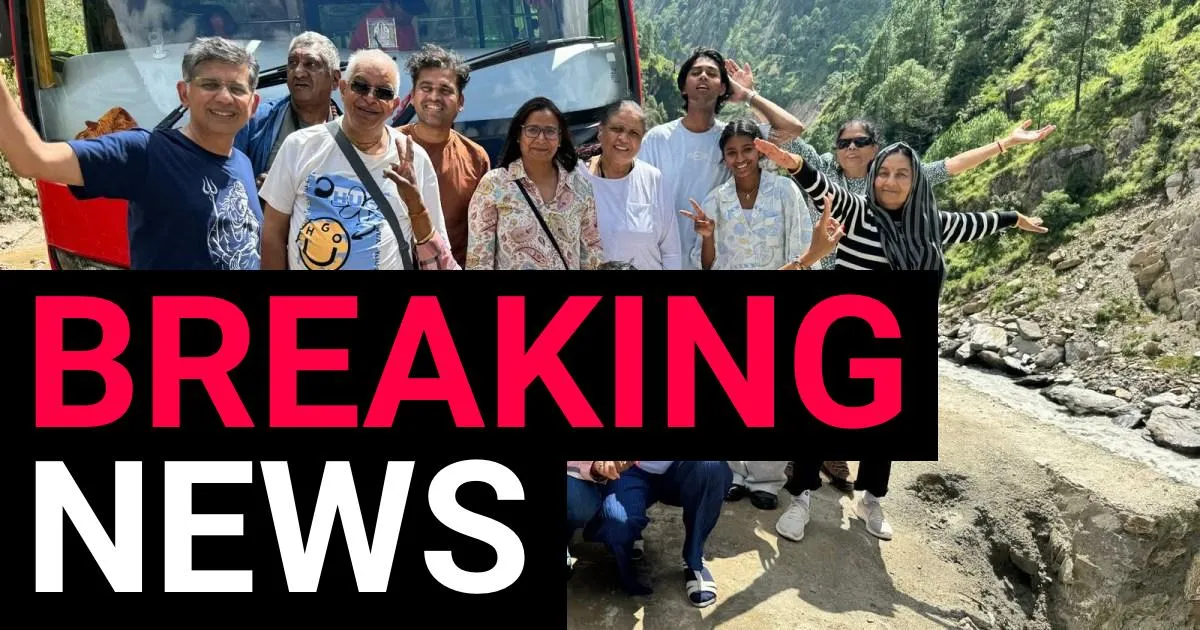
The last known photograph of the group shows them smiling and laughing in front of their bus, the kind of picture taken at the start of an adventure, when everything still feels possible. It was taken just before they crossed into Nepal, and it is now a haunting relic of a journey that ended in disaster. The pilgrims—worshippers from Britain, Ireland and South Africa—had come to the Himalayas for spiritual reasons. Some were making their way toward Gosainkunda, the sacred alpine lake that lies at more than 14,000 feet in Langtang National Park, while others were heading for Mount Kailash, one of the holiest sites in Hinduism. They traveled with tour companies, with prayer books, with families and friends, with the kind of faith that moves people to leave comfortable homes and walk into remote mountain valleys. But their path crossed with a catastrophe. A glacier collapsed high above the Bhote Koshi river, sending a violent surge of water, ice, mud and rock through the valley. Flash floods swept away homes, roads, bridges and people. At least 350 people have been confirmed dead, and the number of missing is still climbing. Among the unaccounted for are at least 33 British tourists. The smiling faces in the photograph have become part of that list, and for their families, the image is both treasured and unbearable. It is the last time anyone close to them saw them as they were—whole, safe, laughing, together. Since the moment they crossed the border, none of them have been heard from. The silence has become the defining feature of this disaster for those waiting at home. There are no phone calls, no messages, no updates from tour guides. The mountains have swallowed their voices. The photograph, once a cheerful postcard from the beginning of a journey, is now evidence of a vanished world.
The scale of the tragedy is almost too large to absorb, but the details make it human. The flash flood triggered by the glacier collapse has killed at least 350 people, and officials say more bodies are still being pulled from the debris by the hour. The number of missing in Nepal rose from 403 to 826 in a matter of hours, a number that grows with each new search. Among the missing are two teenagers—a 13-year-old girl and a 14-year-old boy. They are not abstractions. They are someone’s daughter and son, someone’s brother and sister, someone’s reason to keep hoping. The lack of information is a particular kind of torture. Families do not know whether their loved ones were washed away, took shelter in a building, or were walking above the flood line when the water came. The Bhote Koshi river, normally a mountain stream, became a raging monster that lifted boulders, snapped trees, and tore buildings from their foundations. The water moved with such force that it rearranged the geography of the valley. What was once a road is now the river. What was once a home is now a pile of rubble. The search teams face a scene that looks less like a natural disaster and more like a war zone. In such circumstances, the act of searching is slow, dangerous, and heartbreaking. Yet they continue, moving through the mud and wreckage, because somewhere in the silence there may still be a voice waiting to be heard. The missing include tourists but also local villagers, guides, porters, innkeepers, and children who were simply in the wrong place at the wrong time. This disaster does not discriminate. It has swallowed the rich and the poor, the pilgrim and the shopkeeper, the visitor from London and the child born in the valley. Every missing person has a story, and every story now hangs in the balance. For the international families, the distances are measured in kilometers and time zones; for the local families, the distances are measured in the hours it takes to walk over broken ground to find the nearest news. Everyone is searching for the same thing: certainty.
Among the families waiting in a state of dread, Sarisha Pillay has become a voice for many. Her sister-in-law, Janet Pillay, and brother-in-law, Vivagnathan Pillay, were a South African couple on the pilgrimage. They are the parents of four daughters, who are now desperately trying to reach them. Sarisha told Metro that the family had heard the couple had passed the border post at 8.30am. They were part of the Alpine Eco Trek & Expedition group, traveling toward Gosainkunda. Then the trail went silent. “Their children are worried sick here in South Africa,” Sarisha said. “We all are.” She spoke of trying to get clarity about where they were last seen, but there was no clarity to be found. The mountain region has little cellular connectivity even in the best of times, and after the flood, what little infrastructure existed has been torn apart. The phone that should have rung with a reassuring voice remains silent. The daughters have been left with a strange, suspended reality: they do not know if their parents are alive, injured, trapped, or dead. They cannot plan a funeral and cannot prepare a welcome. They can only wait, refresh news websites, and search for the faces of their parents in videos filmed from helicopters. The uncertainty is a wound that goes deeper than grief, because grief has a shape. This has none. It is just a blank space where answers should be, and every hour the blank space grows larger. Their story is one among hundreds, but it captures the essence of what this disaster has done: it has turned ordinary families into people wandering through a fog, reaching for a hand that is no longer there. Those waiting at home are not passive; they are contacting embassies, tour operators, other families, and anyone who might have been in the region. They are comparing notes, sharing names, trying to piece together what happened from contradictory reports. Sarisha’s plea was simple and direct: they want information. They want someone to tell them where their loved ones were last seen, what the conditions were, whether anyone in the group had made contact. The days are passing, and hope is becoming harder to sustain.
On the other side of the world, in Uckfield, East Sussex, Pramod Poudel was doing what he could to hold onto hope. His wife, mother, brother and uncle were all caught in the disaster. Poudel was due to fly to Nepal at 8pm on Thursday, a journey he had never imagined making under these circumstances. He told the BBC that there was no proper communication, and he guessed that the power supply had gone, so his family could not charge their phones. He was trying to reassure himself with practical explanations: maybe they are alive but simply unable to call. But his voice broke as he described what he had seen in pictures of his hometown. “I have seen pictures of where my home town used to be… and there is nothing there now,” he said. “Where my family used to live—my mum, my dad, my wife, where everyone used to live—there’s nothing there.” The words are so simple and so devastating. They strip away all the jargon of disaster management and leave only the raw truth: the places that held his family’s daily life have been erased. He was not talking about roads and bridges. He was talking about the kitchen where his mother cooked, the room where his wife slept, the street where his brother greeted neighbors. All of it, gone. Flying to Nepal is perhaps the only thing he can do. It will not bring the mountains back to life or make the river retreat. But it will put him in the same country as his family, in the same time zone, closer to any news. He called the moment “a very hard and difficult time.” That understatement is the way ordinary people survive the unthinkable: by breaking it into small words, small steps, one plane journey at a time. His story has become a symbol of the diaspora’s helplessness. Across the UK, South Africa, Ireland and beyond, families of the missing are separated from the disaster by thousands of miles and yet tied to it by every heartbeat. They are refreshing websites, checking WhatsApp groups, calling Nepal at odd hours, sending messages into the void. They are sleeping in shifts so that someone will be awake if news comes. The waiting is not a passive thing; it is an exhausting labor. Poudel’s decision to board a plane is an example of that labor, a refusal to sit still while the people he loves are missing.
Globally, the Hare Krishna community has been shaken by the loss of contact with a group of 17 devotees on a pilgrimage to Gosainkunda. The spiritual community of ISKCON Nepal issued an urgent public appeal, and the organization Dandavats announced it was still trying to trace the group. The missing pilgrims came from the United Kingdom, South Africa, and Ireland. “Due to the remote mountain terrain and a lack of cellular connectivity in the region, all direct communication with the group has been severed,” Dandavats said, asking authorities to help locate and ensure their safety. The names released by the community tell the story of a diverse congregation: Anitha Devi Maharaj, Surendranath Maharaj, Kavita Haldia, Pavan Haldia, Nabhi Nandan Das, Sunanda Manirajan, Hema Sunil Amin, Janet Pillay, Vivagnathan Pillay, Surabhi Manmath Padhy, Santosh Sahu, Syna Kumari Sahu, Spandan Sahu, Hemangini Patel, Bipin Patel, Mala Patel, and Veena Bhaskaran. They are not a single group of tourists; they are families, spouses, friends, spiritual siblings who gathered for one of the most meaningful journeys of their lives. The destination, Gosainkunda, is no ordinary lake. It sits at 14,100 feet in Langtang National Park, a turquoise jewel surrounded by high peaks, and it is sacred to Hindus, who bathe in its icy waters during festivals. The trek to reach it is difficult under the best circumstances, with unpredictable weather and long stretches of isolation. A single misstep or a sudden storm can be dangerous. A flash flood is a nightmare beyond imagination. The Nepalese tour operator The Trekkers’ Society added to the grim picture by reporting that nine British nationals on one of its tours to Mount Kailash were also unaccounted for. The group included four males aged 14, 50, 50, and 54, and five females aged 40, 46, 50, 50, and 53. General manager Roshan Basnet told the Press Association that when the flood happened, the group was still at the Chinese immigration at the border. “After the flood happened, we had no contact with our tour guide,” he said. He did not try to offer false comfort. He said that based on the video circulating online, the situation was “pretty difficult.” Their spiritual community has responded in the only way it knows, with prayers, with vigils, with appeals to every institution that might help. But prayer does not replace information. The devotees and their families are waiting for any sign, any voice, any message from the mountains. The silence is unbearable, and yet they have no choice but to bear it.
Rescue efforts are now a desperate race against the terrain itself. Bridges have been destroyed, nearly 25 miles of roads have been damaged, and the damage to infrastructure is so extensive that only helicopters can reach the site of the disaster. This means that search and rescue teams are working in small, contained pockets, unable to cover the entire valley quickly. Villages that once stood along the Bhote Koshi river are now either underwater or gone. The river, swollen with debris, continues to complicate every attempt to reach survivors. The president of the Nepal Centre for Disaster Management, Bishal Nath Upreti, warned that the scene resembles a “tsunami from the sky” and that villages have been “completely wiped out.” For rescuers, this is not hyperbole. They are walking through valleys where the ground is unstable, where the smell of mud and fuel mixes with the smell of death, where entire sections of mountainside have slid away. They are also carrying the weight of the families’ expectations. Everyone wants the same thing: a name crossed off the missing list, a report that someone has been found alive. But the hours are passing, and the window for survival is shrinking. Still, the search continues. It continues because the families of the missing refuse to give up. It continues because the smiling faces in that last photograph deserve more than resignation. It continues because every person out there is someone’s mother, father, daughter, son, brother, sister, friend. The world is watching Nepal, sending condolences, promises of aid, and prayers. But what the families need most is information. They need someone to tell them where their loved ones are. Until that happens, the photograph of the group in front of the bus will remain a symbol of all that is beautiful and all that is fragile about human life. They set out in hope, and somewhere in those mountains, hope met catastrophe. Their families are waiting, with unbearable tenderness, for the ending of their story. We are all waiting with them.