



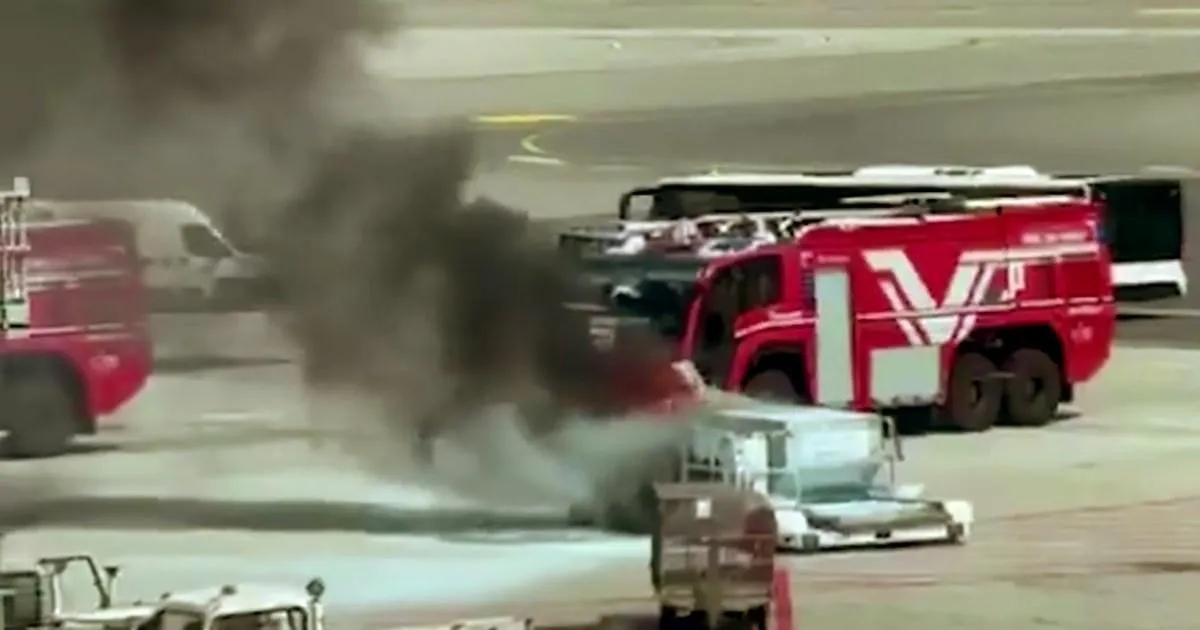
At first glance, it was a scene that could have come from a disaster movie, but it unfolded on a sweltering Sunday afternoon at Milan’s Malpensa Airport, where temperatures had climbed to 35 degrees Celsius. A British Airways Airbus A321neo had just touched down from London Heathrow, and ground crews were doing what they do a hundred times a day: unloading checked baggage from the hold and transferring it to the terminal. Then, within minutes of being placed on the tarmac, one of the grey baggage containers burst into flames. Footage captured the moment orange fire erupted from the container as thick black smoke began to pour from its metal shell. Fire crews rushed to the stand, and the area was quickly evacuated while emergency responders worked to bring the blaze under control. For passengers who had just stepped off the plane or were waiting at the airport, it was a visceral reminder that even the most routine parts of air travel can suddenly turn frightening. The immediate concern was for the luggage inside, and, more importantly, for the safety of anyone nearby. It was later confirmed that no one was injured, but the sight of smoke rising from a piece of equipment sitting right next to a passenger jet was enough to make everyone pause. The incident also delayed the return flight to Heathrow by nearly two and a half hours, leaving travellers with time to stare at the smouldering container and wonder what had gone wrong.
Initially, the suspicion fell on the most notorious villain of modern air travel: the lithium ion battery. These compact power sources, found in phones, laptops, and power banks, have a well-documented history of catching fire, and aviation regulators have long warned about the dangers they pose when packed into the dark, confined space of an aircraft hold. But as investigators began to piece together what happened, they discovered that the fire had nothing to do with any passenger’s electronic device. Instead, the cause was identified as a short circuit in the loading machinery itself, specifically a piece of equipment called a unit loading device, or ULD. This is the generic name for the containers and pallets used to bundle baggage and cargo together so that it can be efficiently moved between the terminal, the truck, and the aircraft. The machinery is operated by Avia, the handling partner appointed to serve British Airways at Milan Malpensa, and it is one of those indispensable but invisible pieces of airport infrastructure that most travellers never think about. A faulty electrical connection, perhaps in the motor or wiring of the loader, was enough to ignite a fire in a container full of bags. While the heat of the day was initially floated as a possible factor, the short circuit was ultimately deemed the culprit. For the small number of passengers whose bags were caught up in the blaze, the distinction may be cold comfort, but it does mean that this was not an example of a forbidden battery causing chaos. It was, rather, an accident involving ground equipment, the kind of mechanical failure that can happen anywhere a machine hums and clanks and works overtime.
The disruption caused by the fire was significant, but it could have been far worse. British Airways confirmed that a small number of checked bags were damaged, and the airline quickly moved to apologise and offer support to the customers affected. A spokesperson for the airline said: “We’re aware of a small number of checked bags that were damaged by fire while on the ground in Milan Malpensa Airport. The incident was quickly dealt with and there were no injuries or impact to any flights. We’ve been in contact with the small number of customers whose bags are affected to apologise and provide support. We are working closely with our partners and an investigation is underway to establish the cause.” For the passengers waiting to fly back to London, the delay must have felt endless, especially in the heightened anxiety that follows any airport emergency. There is something uniquely personal about losing your luggage; it is not just clothing and toiletries, but the carefully chosen souvenirs, the familiar shoes, the charging cables, the toothbrush, all of the small things that anchor you to your holiday. To know that those items were not merely lost in transit, but actually burned on the tarmac, is a particularly bitter pill to swallow. The airline’s rapid response and willingness to take responsibility may soften the blow, but for the unlucky few, the memory of seeing their belongings go up in smoke will not be easily forgotten.
This incident lands at a moment when the aviation industry is more alert than ever to the threat of lithium batteries. The concern is well-founded, given the terrifying prospect of a fire inside a pressurised cabin or cargo hold at 35,000 feet. A blaze that might be manageable on the ground can become catastrophic in the air, where there is nowhere to run and limited ability to fight the flames. Aviation regulations therefore prohibit loose lithium batteries in checked luggage, and airlines repeatedly remind passengers to carry their power banks, spare batteries, and electronic devices in their carry-on bags, where a fire can be detected and dealt with more quickly. The warnings are not theoretical. In January 2025, an Air Busan aircraft was destroyed at Gimhae Airport in South Korea after a power bank caught fire in an overhead locker. The plane was sitting on the tarmac when it was engulfed in flames, and the incident served as a stark reminder of how quickly these fires can spread. It also prompted the International Air Transport Association, or IATA, to launch a campaign encouraging travellers to “travel smart with lithium batteries.” The message, repeated at airports and in safety briefings, is simple: know what you are packing, keep your batteries with you, and never ignore the rules. The irony, of course, is that the devices we cannot live without are the same devices that carry a hidden risk. Every pocket-sized power bank is a tiny warehouse of stored energy, and when something goes wrong, it goes wrong fast.
But the Malpensa incident is also a reminder that not every fire is caused by a passenger’s gadget. The unit loading device that caught fire is part of a vast and complicated ecosystem of ground support equipment that keeps the world’s airports moving. These machines are reliable, but they are not indestructible. They are plugged in, unplugged, driven across concrete, loaded with heavy bags, exposed to heat and cold, and given only brief moments of rest between flights. A short circuit can happen in any electrical system, whether it is a washing machine in a family home or a baggage loader on an airport ramp. What matters is how quickly the problem is detected and how effectively it is contained. In this case, the emergency response was swift, and the fire was put out before it could spread to the aircraft or cause injuries. The fact that the incident happened on the ground, rather than in the air, was a stroke of luck. If the same fire had broken out in the cargo hold of that A321neo while it was cruising over the Alps, the consequences could have been unthinkable. Aviation safety is a system of redundancies and safeguards, and this episode will undoubtedly become part of the ongoing conversation about how to improve those systems further. For the ground crew at Milan Malpensa, the day was certainly a stressful one, but their quick thinking and professionalism likely prevented a much more serious outcome.
As the investigation continues, British Airways and its handling partner Avia will be looking closely at the machinery involved, the maintenance records, and the conditions that may have contributed to the short circuit. The results of that investigation will likely lead to new checks, new procedures, and perhaps new equipment. In the meantime, the affected passengers are left to recover as best they can, armed with the airline’s apology and the promise of support. For the rest of us, the incident is a quiet reminder of the many unseen hands and machines that make air travel possible. We step onto a plane, glance out the window, and rarely think about the baggage containers sitting on the tarmac, the loaders driving back and forth, the ground crews working in the heat. But every piece of luggage represents a life, a trip, a story, and every piece of machinery represents an opportunity for something to go wrong. The fire at Milan Malpensa was contained, and no one was hurt, but it will leave a mark on the people involved. It should also leave us with a slightly greater appreciation for the extraordinary complexity of modern aviation, and for the fact that, most of the time, it all works without incident. The next time you check a bag at the airport, you might not think about the journey it takes behind the scenes. But after this incident, you might spare a thought for the container that carries it, the machine that lifts it, and the people who make sure it arrives safely. That, perhaps, is the most human lesson of all.