


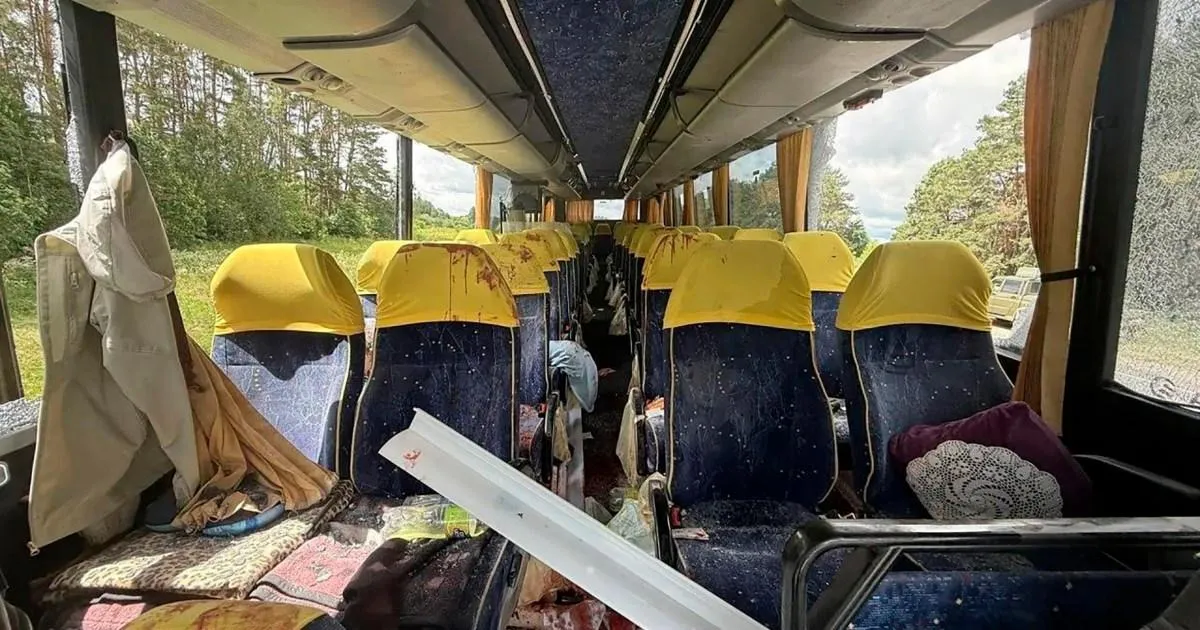
The recent drone strike on a bus filled with young Belarusian footballers has sent shockwaves through the region, transforming a tragic security incident into a volatile political powder keg. As the vehicle traveled from Homiel, Belarus, toward a holiday camp in Russia, it was intercepted by a swarm of drones, resulting in the heartbreaking death of the coach’s wife and injuries to six young athletes. This event has not only devastated the families involved but has also triggered a high-stakes standoff between Kyiv and Minsk. Ukraine has vehemently denied any involvement, characterizing the allegations as a cynical disinformation campaign orchestrated by the Kremlin to manipulate public sentiment and destabilize the border.
The complexity of the situation is compounded by the precarious position of Belarusian President Aleksandr Lukashenka. Caught in a delicate dance between his long-standing ally, Vladimir Putin, and the reality of the war on his doorstep, Lukashenka has adopted an uncharacteristically measured, if suspicious, tone. While he has publicly demanded the “truth” from Ukrainian officials and suggested that the drone was of Ukrainian origin—perhaps purchased by third-party provocateurs—he seems hesitant to use the incident as a formal reason to declare war. His rhetoric remains a careful balancing act, intended to calm a nervous Belarusian public while simultaneously signaling to Moscow that he is “investigating” a perceived act of aggression.
Within Belarus, the internal reaction has been chaotic, revealing deep fractures in the government’s narrative of a “peaceful, untouched state.” State officials have scrambled to account for the tragedy, with some even shifting the blame onto the parents who organized the private trip, accusing them of choosing a dangerous route near the frontlines. This finger-pointing highlights the pressure on the Belarusian administration to avoid public panic. The narrative that everything is fine is becoming increasingly difficult to maintain when citizens are suddenly becoming casualties of a war they have been told to ignore. Analysts suggest this detachment is exactly what the strike threatens to undo, as the reality of the conflict forces its way into the lives of everyday Belarusian families.
Geopolitical experts are now scrutinizing the strike as a potential “false flag” or a calculated provocation designed to force Belarus’s hand. For months, there have been credible reports that Vladimir Putin has been actively pressuring Lukashenka to abandon his tepid neutrality and commit Belarusian forces to the frontline. With satellite imagery and intelligence reports confirming the construction of new roads, artillery positions, and logistical hubs along the Belarusian border, the region is clearly being prepped for an escalation. Many analysts believe the Kremlin stands to gain the most if this strike drives a wedge between Minsk and Kyiv, pushing a reluctant Lukashenka into the fray.
The underlying fear is that Belarus is being systematically maneuvered into a role it has spent years trying to avoid. While Lukashenka has provided land and airspace for Russian drone and missile operations against Ukraine, he has thus far avoided sending his own troops across the border. Ukraine’s warnings regarding this military buildup are becoming more urgent, suggesting that Moscow is not merely asking for support, but orchestrating the conditions for a broader entry into the war. By turning the spotlight onto this bus attack, Russia may be attempting to manufacture the justification needed to formalize the union of their military efforts.
Ultimately, this tragedy is symptomatic of the fragile and dangerous state of Eastern European security. Whether the strike was an intentional provocation by Russia to “trap” Belarus into the conflict, or a grim escalation by other actors, its impact is undeniable. It serves as a cruel reminder that as the war grinds on, the buffer zones intended to keep nations safe are rapidly collapsing. For the families of the young footballers, the focus is on the loss of their loved ones; for the rest of the world, this incident stands as a harrowing example of how easily a localized tragedy can be weaponized to ignite a much wider, more catastrophic fire.