



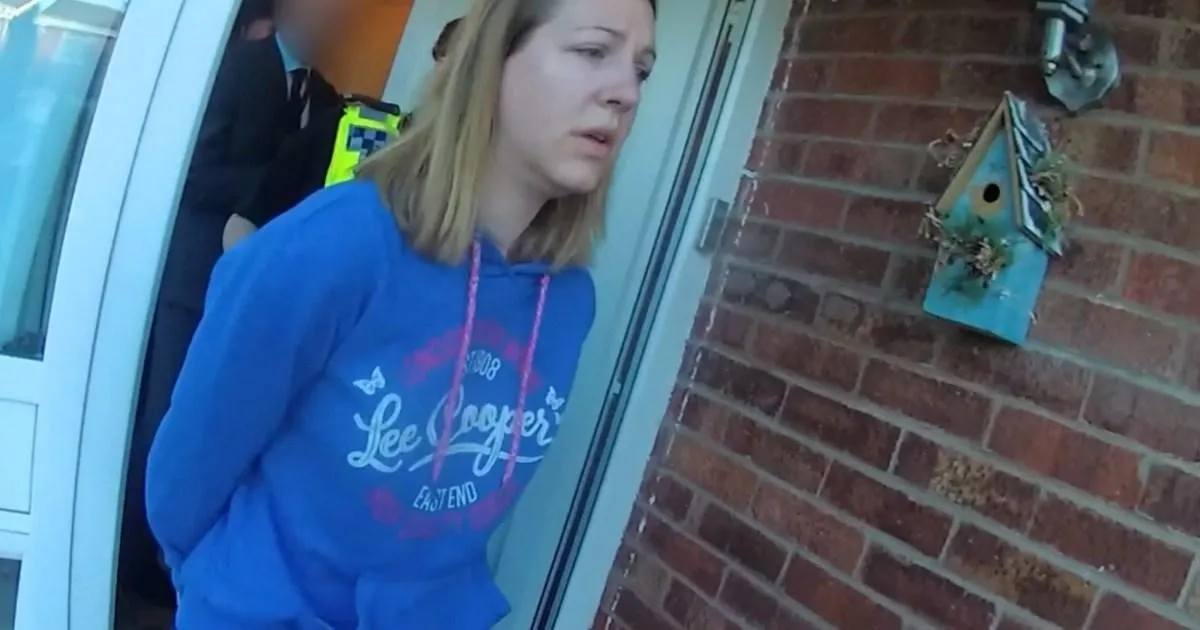
The case of Lucy Letby, the nurse revealed to be Britain’s most prolific child serial killer, has left the nation grappling with a dark and disturbing reality. While she was sentenced to 14 whole-life orders for the murder and attempted murder of vulnerable infants at the Countess of Chester Hospital, a small but vocal contingent of those who crossed her path remains deeply conflicted. Among them are Clare and Carl, parents of a daughter named Jessica, who was cared for by Letby a decade ago. For these parents, the image of the woman currently serving multiple life sentences for horrific crimes stands in stark, painful contrast to the nurse they remember—a woman they still credit with saving their daughter’s life on two separate occasions when she struggled to breathe.
Their testimony, shared on a podcast hosted by Amanda Knox, highlights the profound psychological dissonance experienced by families who were previously under Letby’s care. Carl recalled the seemingly mundane, tender moments—the times Letby would bring Jessica to their room, handing the baby over with a casual, warm, “She’s all yours.” For parents like Clare and Carl, these memories are not just fragments of the past; they are anchors of gratitude that make the subsequent legal reality almost impossible to process. This has culminated in a complex form of survivor’s guilt, where the relief of having a healthy child is now shadowed by the horrifying realization of what allegedly transpired in the very unit that saved their baby.
Beyond the personal grief, the couple has voiced a controversial perspective regarding the systemic failures at the Countess of Chester Hospital. Carl, in particular, has become a vocal critic of the narrative that places the entirety of the blame on a single individual. He suggests that the hospital administration may have seized a “scapegoating” opportunity, using Letby as a lightning rod to deflect from broader, institutional shortcomings in management, procedure, and unit operation. He remains firm in his conviction that the tragedy was not solely the work of a lone wolf, but rather the result of a collapsing health system desperately trying to hide its own systemic negligence behind the terrifying actions of a nurse gone rogue.
This skepticism from families, coupled with the complexities of the legal process, has kept the Letby case in a state of unresolved tension. Despite the severity of her convictions, the door to legal uncertainty has not been fully closed. After her initial application for appeal was rejected in 2023, a new development occurred in 2025 when a fresh application was submitted to the Criminal Cases Review Commission (CCRC) on her behalf. By early 2026, the commission confirmed that they were in possession of “additional material,” prompting a formal review. This, of course, does not imply a declaration of innocence, but rather reflects the judiciary’s duty to ensure that if there is even a sliver of new evidence or a valid argument for a miscarriage of justice, it must be thoroughly vetted.
The CCRC faces an immense challenge: they must navigate the high-stakes pressure of public opinion while remaining strictly evidence-based and impartial. Their role is not to judge the morality of Letby’s actions, which have already been decided by the courts, but to determine whether the integrity of the original trial remains intact. As the investigation into these new materials continues, it underscores the difficulty of delivering “justice” in a case so catastrophic that it defies simple explanation. For the families involved, every new legal development acts as a reopenable wound, forcing them to relive the terror of the neonatal unit while holding on to their own, private memories of the woman who provided care before she became a monster.
Ultimately, the story of Clare, Carl, and Jessica serves as a harrowing reminder that beneath the cold statistics of criminal trials lie human lives forever altered by ambiguity. Whether Letby was a singular force of evil or a symptom of a systemic collapse, the trauma for the families who trusted her remains undiminished. As the CCRC continues its review and Letby remains imprisoned at HMP Low Newton, the public is left to wonder if we will ever achieve full clarity. Until that day, those caught in the orbit of this tragedy are left to reconcile the impossible: the memory of a guardian who saved a life alongside the reality of a killer who took so many.