


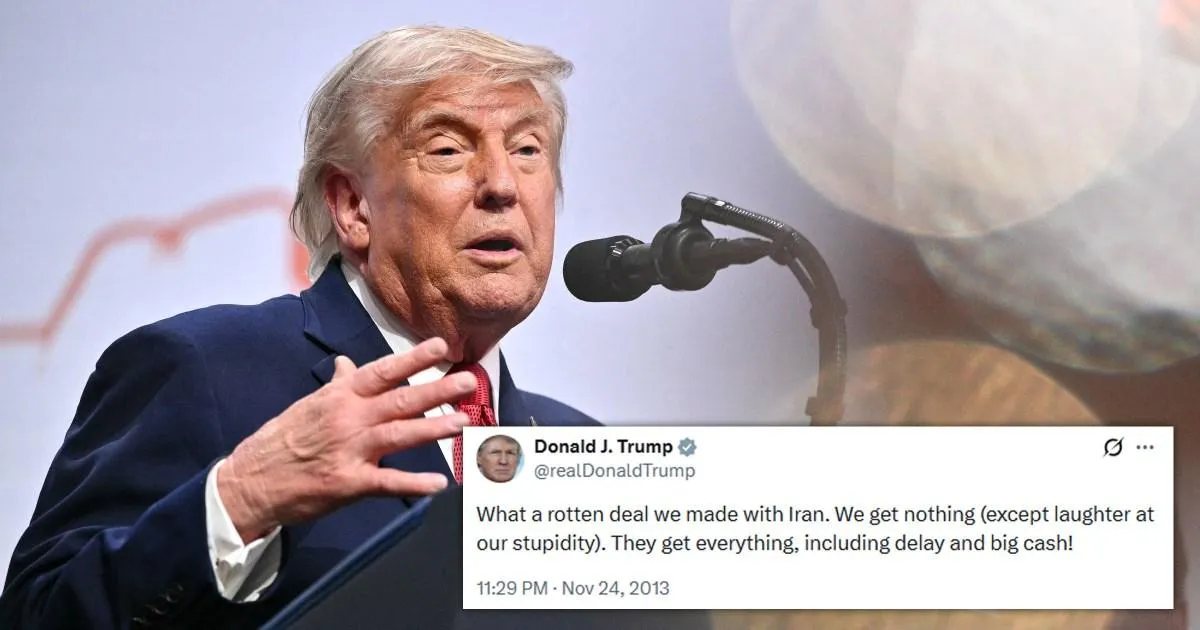
The landscape of international diplomacy is often marked by irony, a reality brought into sharp focus by the recent surfacing of a decade-old tweet from Donald Trump. Back in 2013, during the Obama administration, Trump famously decried a nuclear deal with Iran as a “rotten” compromise. At the time, he claimed the United States was being played for fools, arguing that while Iran received billions in unfrozen assets and a reduction in sanctions, the U.S. walked away with nothing but mockery. His assessment was blunt, characterizing the exchange as a lopsided victory for Tehran that left American interests vulnerable, a sentiment that resonated deeply with his base at the time and framed his long-standing critique of globalist foreign policy.
However, the political pendulum has swung in a way that few could have predicted, as the current administration finds itself championing a new peace agreement that mirrors the very structures Trump once dismantled. Following a period of intense volatility that escalated into direct military confrontation this past February, the two nations have signed a 14-point memorandum of understanding that bears a striking resemblance to the 2013 framework. This new initiative includes the lifting of broad reaching sanctions, the unfreezing of significant financial assets, and a renewed commitment to IAEA nuclear supervision. The move suggests a profound, albeit perhaps pragmatic, shift in Trump’s approach to Iranian relations as he pivots from aggressive containment to a comprehensive, albeit costly, peace strategy.
The scope of this new agreement is nothing short of historic in its ambition. Beyond the standard diplomatic niceties, the deal includes a gargantuan $300 billion reconstruction and economic development package, an effort intended to bolster Iran’s economy while firmly ensuring that no further nuclear weapons are procured. Crucially, the MOU mandates the total cessation of military operations on all fronts, most notably in Lebanon, and demands the removal of the American naval blockade. For sixty days, Iran has committed to allowing the safe passage of commercial vessels through the Persian Gulf, a temporary measure intended to stabilize the region while the finer details of a permanent, binding United Nations Security Council resolution are finalized.
Perhaps the most humanizing aspect of this development is the sheer complexity of the transition from open conflict to cooperation. We are witnessing a monumental bridge-building effort following months of tragic losses and regional instability. The agreement demands that both the U.S. and Iran respect each other’s territorial integrity, a principle that has been notably absent during the height of recent combat operations. By choosing to down-blend existing nuclear stockpiles under rigorous international supervision rather than continuing a cycle of strikes and counter-strikes, both parties are tacitly admitting that the cost of sustained warfare, in both human lives and global economic stability, has become unsustainable.
Despite the optimism inherent in such a document, the specter of past failed agreements looms large. Critics point out that Iran’s previous enrichment of uranium serves as a cautionary tale of how quickly diplomatic progress can unravel. Yet, the current framework attempts to bake in stronger safeguards, including an executive mechanism tasked with monitoring compliance and a step-by-step implementation process. By linking the removal of sanctions and the release of funds to concrete actions, the architects of this deal are attempting to replace simple trust with a system of verifiable, milestone-based cooperation. It is a calculated gamble, one that recognizes the “nasty” nature of war and prioritizes a tenuous peace over an indefinite, destructive stalemate.
Ultimately, this diplomatic maneuver marks a fascinating evolution in the career of a leader whose policy style is often defined by disruption. By transitioning from his fierce 2013 condemnations to the role of a peace broker in a remarkably similar framework, Trump is challenging the conventional boundaries of political consistency. Whether this deal serves as the foundation for lasting stability or merely a temporary reprieve remains to be seen. What is clear, however, is that the high-stakes chess match between Washington and Tehran has entered a new phase, one where the focus has shifted from the rhetoric of the past to a complex, billion-dollar commitment to the future.