

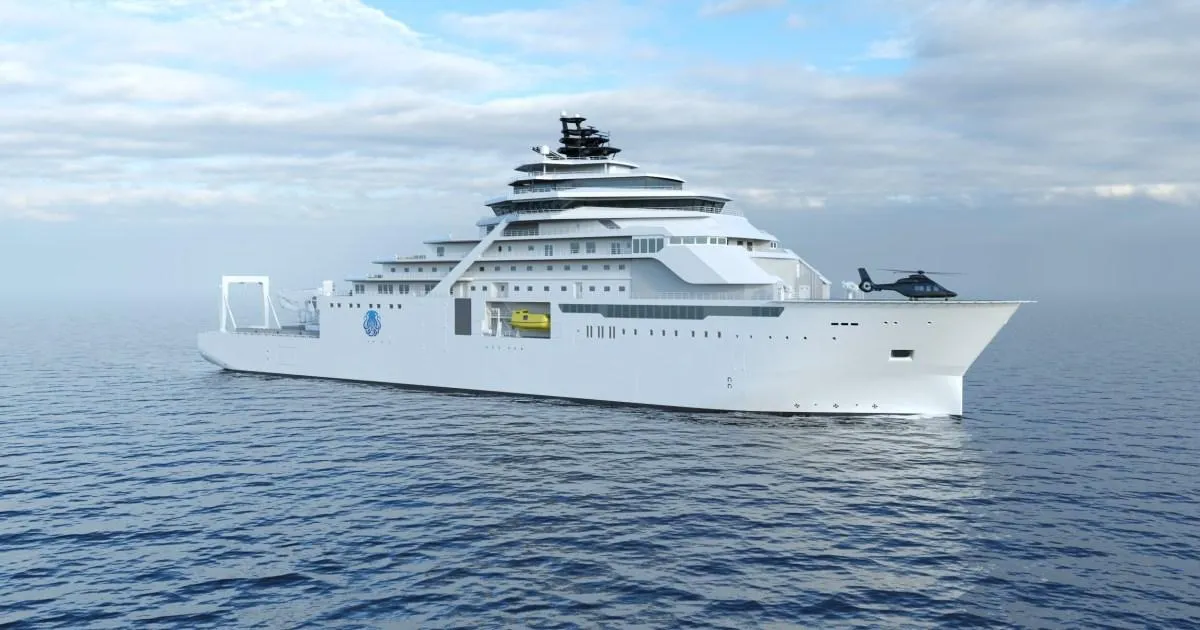
Gabe Newell, the visionary co-founder of Valve and a renowned figure in the gaming world, is making waves far beyond the digital realm. Through his marine research organization, Inkfish, Newell has commissioned the construction of the RV11000, a vessel that is set to become the most advanced and expensive marine research ship ever built. Contracted to the renowned Norwegian shipbuilder VARD for an eye-watering €700 million, this project represents the single largest order of its kind for the company. Far from being a typical yacht or simple research boat, the RV11000 is a marvel of modern engineering, designed specifically to reach the very deepest, darkest corners of our planet’s oceans.
At a massive 162 meters long and 28 meters wide, the RV11000 is a significant leap forward from the RV6000, another of Inkfish’s impressive deep-sea vessels. It is designed to operate at depths of up to 11,000 meters, which is essentially the deepest point on Earth. Rune Rødset, VARD’s Senior Vice-President, notes that this ship isn’t just another vessel; it is a unique platform that integrates an unprecedented range of high-tech gear into one hull. The ship’s primary purpose is to push the boundaries of what we currently understand about our oceans, serving as a beacon of discovery for the scientific community. It is a bold statement of human ambition, showcasing that the curiosity to explore “inner space” is every bit as compelling as looking toward the stars.
The technical specifications of the RV11000 are nothing short of breathtaking. Developed in Ålesund, Norway, with technical expertise from YTMC, the ship is kitted out with everything necessary to decode the mysteries of the seabed. It features a specialized 40-meter coring system for analyzing sediment, advanced oceanographic sensors, and a facility for launching and retrieving sophisticated submarines and ROVs. Perhaps most impressively, the ship leads in sustainability: it will house the largest battery installation ever fitted to a vessel. This allows for up to 12 hours of completely silent, emission-free scientific operation, ensuring that the researchers can study marine life without the interference of heavy engine noise or pollution.
What really makes this project shine is the collaborative spirit behind it. Stu Buckle, who oversees special projects for Inkfish, emphasizes that the vessel was designed with the scientists themselves at the table from day one. Instead of building a generic ship, the team focused on creating a flexible, high-utility space that meets the specific, demanding needs of marine research. Accommodating up to 130 people, including a crew of specialists and scientists, the ship offers private quarters and dedicated laboratories, workshops, and offices. It isn’t just a place to sleep and conduct experiments; it is a high-tech, floating home for the people who are dedicated to unlocking the deep-sea’s final frontiers.
The construction of this behemoth is a global endeavor that showcases the power of coordinated engineering. The vessel’s hull is set to be built in Romania before being transported to a VARD facility in Norway for a final, meticulous fitting. Various subsidiaries will contribute to the ship’s “brain” and “hands,” providing complex bridge controls, communication arrays, and specialized heavy-lifting equipment. Behind the scenes, the parent company Fincantieri provides the backbone of industrial expertise needed to make such a complex, first-of-its-kind machine a reality. The goal is to provide researchers with the most comprehensive deep-ocean dataset in human history, shedding light on the “uncharted” reality of our own world.
As we look toward its scheduled delivery in early 2030, the RV11000 stands as a bridge between the billionaire’s drive for discovery and the global scientific requirement for better data. By investing his resources into deep-sea exploration, Newell is effectively creating a mobile archive of our planet’s largely invisible history. The project reminds us that the ocean remains one of the last true mysteries of humanity, and through modern technology and human dedication, we are finally reaching a point where we can document it with precision. It is an inspiring commitment to progress, proving that when engineering ambition meets scientific curiosity, we can build the tools necessary to navigate the most difficult environments on Earth.