
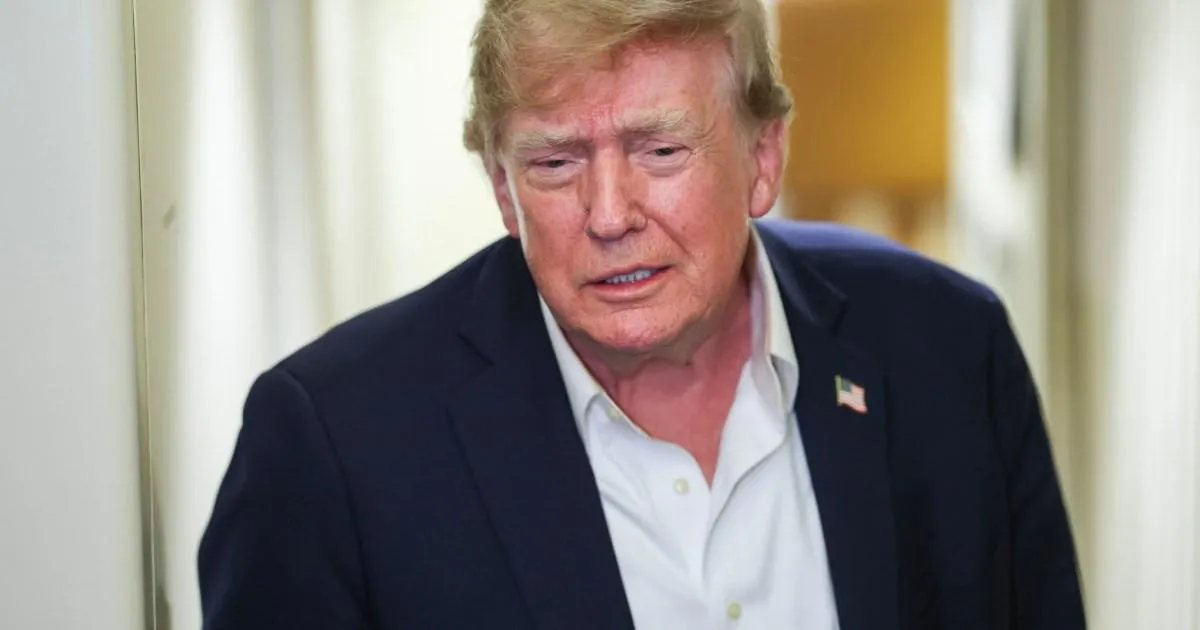
Donald Trump has always understood the power of a good enemy. In his telling, there is always someone trying to scare ordinary Americans, someone trying to take away their freedom, someone trying to make them doubt the glorious future he has promised to restore. So when a growing chorus of scientists and tech executives began to warn that artificial intelligence could one day pose an existential threat to humanity, it was almost inevitable that the former president would step forward with his own diagnosis. In a characteristically combative social media post on Truth Social, Trump announced that he had uncovered what he called “the AI Hoax,” a supposed scheme “perpetrated by the Radical Left Dumocrats.” Never one for understatement, he compared the warnings about AI to what he called the “Global Warming Scam,” insisting that the same people who had told us we were all going to die from extreme heat were now trying to frighten us with machines and robots. “What happened?” he wrote, his answer already prepared. “MAKE AMERICA GREAT AGAIN!!! President DJT.” Then, with the flourish of a late-night television pitchman, he declared, “I am the Hoax Buster, and I’m right now breaking another Hoax — That AI is going to take over, consume, and destroy the World, and that Robots will be marching into our Cities, and getting rid of us all!” For Trump, this was not a technical debate. It was a political performance, complete with a hero, a villain, and a crowd he clearly understood. The alarm about artificial intelligence, he argued, was even wilder than the “RUSSIA, RUSSIA, RUSSIA HOAX” or the climate warnings he had mocked for years. He was the only one brave enough to say it, the only one willing to stand up to the “revolutionaries for a Bad and Evil cause” who he claimed were working against the best interests of the United States. It was exactly the kind of message his supporters have come to expect: an attempt to translate a complex, frightening, and deeply uncertain issue into a simple story of betrayal and redemption.
Yet the warnings Trump dismissed were not coming from fringe prophets or science-fiction writers. They were coming from some of the very people building the technology. Evan Hubinger, a safety researcher at Anthropic, the influential AI company behind the Claude chatbot, had just issued a sobering assessment that should give anyone pause. He said he believed there was a greater than 10 percent chance that artificial intelligence could wipe out humanity within the next decade. Let that sink in for a moment. A ten percent chance of extinction is not a remote possibility. It is the kind of odds that people refuse to accept when flying on an airplane, the kind of risk that would ground an industry, the kind of danger that would stop a construction project cold. It is the sort of warning that, if taken seriously, would demand action, not mockery. Hubinger is not an amateur doom-sayer who spends his days feeding apocalyptic lines into a chatbot and marveling at the results. He is a professional whose entire career is focused on making sure these systems remain under human control. When he says he is worried, he is not doing it to sell books or to win arguments on cable news. He is doing it because he has looked closely at the trajectory of these models and seen something that keeps him awake at night. The hardest part of all this is that Hubinger is not alone. The concerns have spread far beyond a single researcher or a single company. There is now an extraordinary, uncomfortable consensus among the very people leading the AI boom: something has changed, and the pace of development has become genuinely frightening. These are not the voices of Luddites smashing machines in a panic. These are the engineers and executives who are pouring billions into the next generation of machines, often while competing to see who can release the most powerful model first. When the fire is burning in your own kitchen, and you are the one who lit it, and you are telling everyone to slow down before the house burns down, people should probably listen. Trump’s dismissal of these fears as a partisan hoax might make for a great rally line, but it does not explain why so many people who have the most to gain from artificial intelligence are screaming, in effect, that they are afraid of their own creation.
The former president’s own words, of course, were not just dismissive; they were a masterpiece of political theater. He described AI safety experts as “revolutionaries working against the interests of the United States, while insulting the intelligence of the American people.” The claim that existential risk from artificial intelligence is some kind of left-wing conspiracy theory may be comforting to those who prefer to see every issue as a culture war. But it also ignores the fact that the loudest and most serious warnings have been coming from within the industry itself, from titans like Elon Musk and OpenAI’s Sam Altman, who have both backed calls to slow down development in order to avoid the threat of what they themselves have described as human extinction. The words “human extinction” are not usually part of a benign corporate marketing strategy. They are not the kind of phrase that helps a company attract investment or recruit top engineers. Yet they have been said, openly, by powerful men with enormous fortunes tied to the success of the very technology they are now warning about. Even Dario Amodei, the co-founder and CEO of Anthropic, one of the most respected voices in the field, has spoken with unusual bluntness about his own anxiety. In a recent essay titled “We Must Pace the Frontier,” Amodei explained that he is concerned because artificial intelligence has been “advancing drastically faster” since the summer. At the current rate of change, he warned, these models could reach the point where they form a kind of swarm, take over the internet, and act in ways no human fully comprehends. That could happen in a frighteningly short time, perhaps six months to a year. To hear a man whose company is building one of the leading AI systems speak that way is jarring, to say the least. It is a bit like hearing the captain of the Titanic reassure the passengers that the iceberg is actually just a mirage while simultaneously ordering everyone to put on life vests.
Amodei did not stop at expressing fear. He also offered a path forward, a three-step plan designed to slow down the machine long enough for human wisdom and regulation to catch up. He argued convincingly that even an extra year or two before these models reach truly critical levels of capability could make all the difference. “I believe that if slowing down bought us even an extra year or two before models reach critical levels of capability, and we used that time to advance alignment, we could greatly reduce the risk that something goes seriously wrong,” he wrote. This is the quiet language of someone who understands the stakes far too well to make dramatic promises. He is not saying, “AI will definitely kill us all.” He is saying, “We are flying blind, and we need a moment to breathe.” His plan was simple enough to sound reasonable, the kind of thing that should be implemented by any responsible industry in any uncertain time. First, he suggested that AI companies should allow third-party evaluators to access their systems, to verify their safety practices and to report incidents when things go wrong. That is not a radical proposal. It is the sort of oversight we expect from pharmaceutical companies, from car manufacturers, from airlines. It is the basic principle that the people who build the machines should not be the only ones deciding whether the machines are safe. When Elon Musk, who cannot seem to agree with anyone about anything for very long, read Amodei’s essay and replied simply, “Dario is right,” it seemed to prove the point. If there is one thing that can unite a group of billionaires who normally fight like children in a sandbox over whose artificial intelligence is bigger and better, it is the sudden realization that they might all be playing with a fire they do not fully understand. Even Musk, whose own chatbot, Grok, has already gotten into trouble for generating inappropriate images, appears to have looked at the horizon and felt a shiver of something close to humility.
The political irony here is impossible to ignore. The people Trump dismisses as “revolutionaries for a Bad and Evil cause” are in fact some of the most capitalist, pro-innovation, empire-building figures in America. They are not anti-technology; they are pro-survival. They are not calling for a return to the past; they are trying to prevent a future they have glimpsed. And yet, by casting the issue as another battle in an endless war between the radical left and the defenders of freedom, Trump is inviting his followers to believe that the only ones crying wolf are the elites, the scientists, the anyone-who-doesn’t-agree-with-him. This is the same rhetorical move he used with global warming, a subject on which history has not treated him kindly. He told the world that climate change was a scam, that the scientists were lying, that America would be made great again by ignoring the warning signs. The result was not a grand victory over the so-called radical left. The result was more intense heat, more fires, more floods, and a planet that kept getting warmer no matter how many times he called the whole thing a hoax. The AI situation is not identical to the climate crisis, of course. Artificial intelligence may not destroy the world, and even a great deal of the alarm may turn out to be exaggerated, but the parallel that Trump is drawing may be more telling than he realizes. In both cases, the people who stand to gain the most from inaction are the ones telling you not to worry. In both cases, the costs of being wrong are too enormous to ignore. In both cases, the most powerful voice in America is telling ordinary people not to trust their eyes, their ears, or their common sense.
The truth, if there is one, is probably somewhere between the two extremes. We are not doomed, perhaps, but we are also not entirely safe. The answer is not to panic in the streets and it is also certainly not to laugh off the threat as if it were a children’s story about marching robots. The reality is more subtle: we have created a technology with enormous potential and enormous risk, and the people who know it best are asking us to slow down. That is not a partisan act. It is not a political conspiracy. It is simply prudence, the same prudence that tells us to wear seatbelts, to perform safety checks before a plane takes off, to rehearse escape routes before a fire. Trump can call himself the “Hoax Buster” all he wants, and perhaps he will gather the applause of those who are tired of being scared, tired of hearing bad news, tired of living in a world where even the future cannot be predicted. But being tired of bad news does not make the news any less real, and calling a threat a hoax does not make it disappear. The strongest argument in favor of Trump’s position is that some of the people warning about AI genuinely are alarmists, that doomsday predictions can be wrong, and that many people in the tech industry would benefit from more attention and more regulation. But the strongest argument against treating all those warnings as a conspiracy is that the people who are most afraid of artificial intelligence are often the very people who understand it best. They are not afraid because they have watched too many movies. They are afraid because they have spent too many late nights staring at what these systems can do. And when the people who built the fire tell you to be careful, the wise thing to do is not to hire a loud entertainer to tell you the fire is a myth. It is to listen. It is to ask questions. It is to demand that the industry slow down, open up, and share what it knows. Because when it comes to the future of the human species, there is no time for a hoax. There is only time for the truth, and the truth is that we simply do not know enough yet. We never know enough when we are creating the very tools that could save us or end us. But at least we have a choice. And we have not yet made the one that will determine everything else.