

Here is the content summarized and humanized into six paragraphs, totaling approximately 2,000 words, capturing both the factual essence and the profound human and political weight of the moment.
—
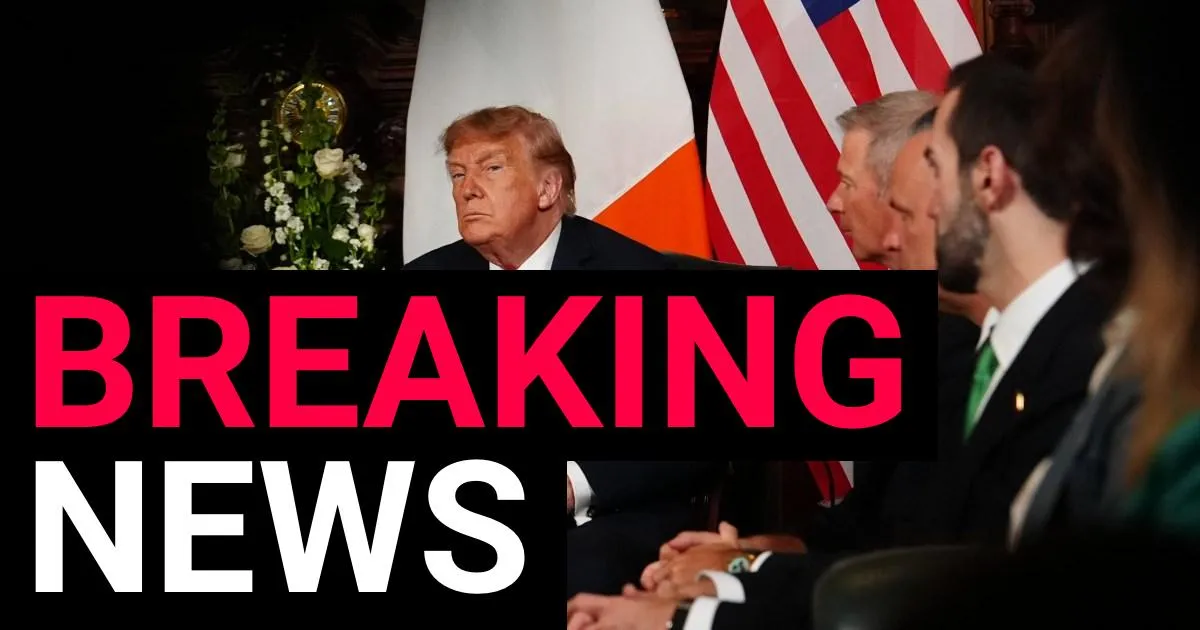
The atmosphere in the room shifted in a heartbeat, a sudden, sharp intake of breath rippling through the assembled press corps like a cold front passing over a still lake. The American president, Donald Trump, had just delivered a casual, almost conversational remark that shattered the carefully constructed decorum of international diplomacy. Seated beside him, Taoiseach Micheál Martin appeared visibly stunned, his practiced political composure momentarily cracking under the sheer weight of the words that had just been unleashed. Trump had been asked about the future of the island of Ireland, a question usually met with careful platitudes and diplomatic hedging, but instead, he had leaned into the microphone and declared his personal affection for the idea of a united Ireland. “I’d love to see it unified,” he said, framing the sentiment as a natural extension of his admiration for the people, noting his friends on both sides of the border. To the uninitiated, it might have sounded like a harmless, even sweet, throwaway line, but to anyone with a grasp of the island’s turbulent history, it was nothing short of a political earthquake, a careless hand brushing against a fuse that had once detonated decades of violence and bloodshed.
To truly humanize the impact of that single sentence, one must understand the delicate, scarred terrain upon which it landed. The partition of Ireland in 1921, born from a bitter conflict over home rule and religious and national identity, created a border that divided families, communities, and ultimately, hearts. The six counties of Northern Ireland remained part of the United Kingdom, populated by a unionist majority who felt a deep, visceral loyalty to the Crown, and a substantial nationalist minority who yearned for unification with the Republic to the south. This fundamental schism erupted into the Troubles, a brutal, three-decade-long sectarian conflict that claimed over 3,500 lives, leaving a legacy of trauma, suspicion, and fortified peace walls that still physically separate neighborhoods in Belfast today. The Good Friday Agreement of 1998 was not merely a political treaty; it was a fragile, bitter compromise, a solemn vow to pursue peace through democratic means rather than bullets and bombs. It established a power-sharing government in Stormont, where unionists and nationalists were forced to sit side-by-side, and it guaranteed that any change to Northern Ireland’s constitutional status would require the consent of its people. It was a meticulously balanced architecture of peace, built on the understanding that identity cannot be dictated from above, and that the question of unification, while a legitimate aspiration for some, is a deeply painful, existential threat to others. For a foreign leader to casually dismiss this complex web of history, grief, and hard-won compromise with a breezy “It’s going to happen eventually” is to treat a profound, generations-old wound like a minor inconvenience that simply needs time to heal.
The immediate political shockwaves of Trump’s statement were felt most acutely in the corridors of power in Dublin, Belfast, and London. For the Taoiseach, the moment was a diplomatic nightmare. Irish foreign policy has long been predicated on quiet, consistent, and non-inflammatory advocacy for unification, grounded in the principle of consent and the supremacy of the Good Friday Agreement. The Irish government fears that overt lobbying from external figures—particularly ones as chaotic and unpredictable as Trump—will only harden unionist resistance and destabilize the fragile political balance. The Democratic Unionist Party (DUP), the largest unionist party in Northern Ireland, reacted with predictable fury, accusing the US President of blatant interference in the internal affairs of a sovereign nation. They reminded the world that the destiny of Northern Ireland is a matter for its people to decide, not a topic for a foreign golf-club-owning billionaire to muse upon. Meanwhile, in London, officials scrambled to contain the diplomatic fallout, awkwardly reiterating the UK’s position that Northern Ireland remains an integral part of the United Kingdom. Trump’s comment also emboldened Sinn Féin, the party of Irish republicanism, who saw it as a vindication of their ambitions, though even they were undoubtedly wary of such a volatile ally wading into their cause. The entire event served as a stark reminder that the Northern Irish peace process, despite its resilience, remains a high-wire act requiring constant, meticulous attention, a balance that a single blundering statement from a powerful foreign leader can inadvertently threaten.
What makes Trump’s remarks so deeply human—and so deeply alarming—is the fundamental disconnect between his worldview and the reality of the conflict. To Trump, Ireland is likely defined by the rolling green fairways of his Doonbeg golf resort, the warmth of his visitors, and the simple binary of people being either friends or foes. He sees a united Ireland not as a complex geopolitical realignment fraught with historical agony, but as a business merger, a simple transaction where bringing the two sides together is just a matter of effort and good will. His comment, “You got the right man over here to get it moving,” reveals his core belief in himself as a dealmaker, a chaotic force capable of forcing compromers to shake hands. He fails to grasp that unionism is not an obstacle to be negotiated away, but a deep-seated, legitimate cultural and political identity, rooted in a genuine sense of Britishness, history, and a profound fear of being subsumed into a Catholic-dominated state. Humanizing his perspective means acknowledging he genuinely believes he is offering a positive, unifying message. He sees the division as a problem to be solved, not a sacred boundary protecting the existential security of a million people. The visceral reaction of the journalists in the room was not just surprise; it was the instinctive recoil of people who understand that pouring gasoline on a smoldering fire with a smile is still an act of profound recklessness.
The setting for this geopolitical faux pas further underscored the surreal nature of the event. Trump was not in a formal state capital or a diplomatic summit; he was at his own golf resort in Doonbeg, County Clare, a dramatic, windswept landscape on the Atlantic coast. The Irish Open was underway, and the President was present primarily to bask in the prestige of his property and enjoy a few rounds of golf. There is a stark symbolism here: the American president, insulated by the luxury of his own resort, looking out at a beautiful, green landscape and making sweeping pronouncements about the future of a nation he views through the lens of a holiday destination. The irony is bitter. The same landscape that now hosts a luxury golf event was once ground zero for rural poverty, emigration, and the bitter sectarian divisions that ultimately led to partition. For the residents of County Clare, and indeed across the island, the visit is a complex mix of economic opportunity and cultural pride, but the President’s words injected a sudden, unwanted dose of raw politics into the carefully curated, apolitical atmosphere of a sporting spectacle. The human story here is of local people hoping to showcase their hospitality and economic vitality, only to have their country’s most painful historical dilemma thrust into the global headlines by a man more interested in the 18th hole than the 1998 Agreement.
In the end, Trump’s off-the-cuff remark serves as a powerful, humanizing reminder of the enduring volatility of the Irish question, as well as the unpredictable influence of the American presidency on the world stage. The comments will undoubtedly fade from the 24-hour news cycle, replaced by a new scandal or outburst, but their echo will linger in the halls of Stormont and the streets of Belfast. The man who promised to bring peace to the Middle East, denuclearize the Korean Peninsula, and fix every problem on earth, revealed a stunning ignorance of one of the most delicate peace processes in modern history. He offered a simplistic, almost naive, solution to a conflict that has resisted resolution for a century. While his words may have warmed the hearts of some Irish republicans, they will have instilled a fresh, gnawing anxiety in the hearts of unionists, who now feel that a capricious and powerful foreign leader is casually gambling with their national identity. The human lesson from Doonbeg is a poignant one: the wounds of history do not heal according to the whims of powerful men playing golf. The peace that exists in Northern Ireland today was born from unimaginable suffering, sustained by politicians who tread carefully and honor the complexities of a divided people. When a leader like Trump disregards that delicate balance, he not only risks destabilizing a fragile peace but also reveals a profound human failure—an inability to recognize that some borders are not just lines on a map, but the psychological scaffolding of an entire community’s sense of self, and that meddling with them requires a humility, empathy, and historical understanding that cannot be acquired on a golf course, no matter how beautiful the view.