

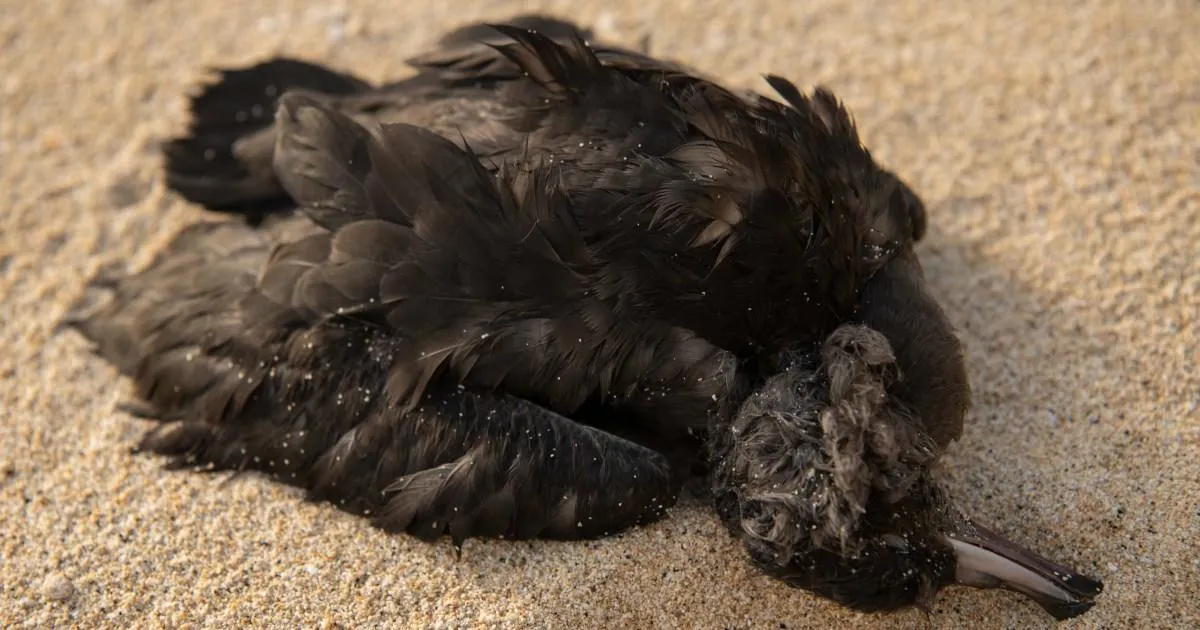
On a remote and seemingly pristine beach, a heartbreaking discovery revealed the devastating toll of our plastic addiction. A dead seabird, a sable shearwater, was found on Lord Howe Island, a small crescent of land off the east coast of Australia. Inside its stomach, researchers made a grim discovery: 894 individual pieces of plastic, a mass that accounted for a staggering 15% of the bird’s entire body weight. It was a record-breaking haul, but not the kind anyone would want to celebrate. This single, tragic creature had become a symbol of a global crisis, a feathered testament to the sheer volume of man-made waste choking our oceans and poisoning the wildlife that calls it home.
For over fifteen years, a dedicated team of scientists has been meticulously studying the seabird populations on Lord Howe Island, and their long-term investigation has painted a deeply alarming picture. The sable shearwater, a species that spends most of its life soaring over the open ocean, is particularly vulnerable to this type of pollution. These majestic birds, known for their graceful flight and long migrations, unknowingly become victims of a fatal case of mistaken identity. When they are out at sea, they encounter floating plastic debris that bears a striking resemblance to their natural prey, such as fish eggs, squid, and small crustaceans. Parents, in their quest to feed their hungry chicks, will scoop up these pieces of plastic and carry them hundreds of miles back to their nests on Lord Howe Island, unknowingly feeding their offspring a meal that is slowly killing them. The chicks, unable to digest or regurgitate the foreign objects, are left with stomachs full of waste, leaving no room for real food and leading to starvation, organ damage, and ultimately, a slow and painful death.
The researchers’ data, collected over more than a decade, reveals that the problem is not just persistent, but accelerating at a terrifying rate. In 2011, the team found what they then believed to be an absolute worst-case scenario: a single shearwater containing 276 pieces of plastic. It was a shocking number that stood as a grim benchmark for over a decade. However, the unthinkable soon became the new normal. In 2023, the record was shattered when more than 400 pieces were recovered from another fledgling. Since then, the record has been broken year after year, culminating in the 894 pieces found in the latest victim. Dr. Alex Bond, the Principal Curator of Birds at the Natural History Museum and a co-author of the study, expressed his disbelief and concern, noting that in 2012, they thought a bird couldn’t survive with 276 pieces in its system. They were proved devastatingly wrong, with the record for the most plastic ingested being broken annually from 2023 onwards, highlighting that the crisis is only worsening while global action remains insufficient.
To truly grasp the severity of this discovery, one can imagine the scale in human terms. For an 80-kilogram person, 894 pieces of plastic weighing 64.2 grams would be the equivalent of swallowing around 12 kilograms of plastic. Imagine ingesting the weight of a large bowling ball made of non-biodegradable trash. The thought is not only nauseating but also highlights the immense suffering these birds endure. Their stomachs, which should be filled with nutrient-rich fish and squid to fuel their growth into adulthood, are instead packed with an indigestible, toxic cocktail of bottle caps, resin pellets (known as nurdles), and countless unidentified fragments of broken-down plastic. This constant feeling of fullness mimics satiation, so the chicks are not motivated to beg for food, leading to severe malnutrition and starvation even as their parents continue to bring more plastic to the nest. The physical damage is also immense, as sharp plastic edges can lacerate internal organs, and the chemicals leached from the plastic can disrupt hormones and impair development.
The findings from this long-term study, published in the journal Environmental Pollution, serve as a critical warning about the limitations of short-term research. The researchers emphasize that the sharp increase in plastic ingestion, while reflecting the growing amount of waste entering the world’s oceans, could be missed by studies of shorter duration. Fluctuations in pollution levels, ocean currents, and weather patterns can all cause temporary dips or spikes in the amount of plastic ingested. A short-term study might capture a period of lower pollution and mistakenly conclude that the problem is under control. This highlights the vital importance of sustained, long-term monitoring to understand the true trajectory of this crisis. The scientists urge for continued data collection and for research findings to be shared digitally and globally, so that changes can be tracked over time and effective conservation strategies can be implemented.
The researchers are not merely documenting a problem; they are also pointing toward solutions. In their analysis of the plastic debris, they noted a worrying increase in the proportion of resin pellets, the raw material used to manufacture plastic products, and bottle caps. This finding underscores the need for comprehensive, systemic changes in how we produce and manage plastic. They specifically point to measures like legislation that requires bottle caps to remain attached to their containers, which would help prevent them from entering the environment in the first place. Such practical, policy-driven solutions are crucial as international negotiations for a proposed Global Plastics Treaty continue. The urgency of these talks is undeniable, yet even a rapid agreement on a strong treaty would not immediately reverse the damage already done. The researchers soberly note that plastic waste already present in the oceans will continue to increase until at least 2050, even if the production of new plastic stopped today. This reality underlines the critical need to understand the long-term effects of existing pollution on marine wildlife and to work on solutions for cleanup and mitigation while also tackling the source of the problem.
The story of this one sable shearwater on a single, isolated island is a microcosm of a planetary tragedy. It is a stark, visceral, and deeply unsettling illustration of how our throwaway culture has permeated the most remote corners of the Earth. The 894 pieces of plastic found in its stomach are not just a statistic; they are a silent scream from the natural world, a poignant reminder that our actions have consequences far beyond our own shores. The researchers’ 15-year dedication has provided irrefutable evidence that the problem is growing, not stabilizing. It underscores a failure to act with the speed and scale that the crisis demands. While the news is bleak, it is not without a call to action. The study’s emphasis on long-term monitoring, international cooperation, and specific policy changes offers a path forward. The fate of the sable shearwater, and countless other marine species, rests on our collective ability to heed this warning, to drastically reduce our plastic consumption, and to hold leaders accountable to forge a more sustainable future where the oceans are not treated as a dumping ground, but as a vital, living ecosystem deserving of our protection. The memory of this one small bird, its body a tomb for our waste, must serve as a powerful catalyst for change before it is too late.