

Here is a humanized and expanded summary of the provided news content, structured into six paragraphs.
—
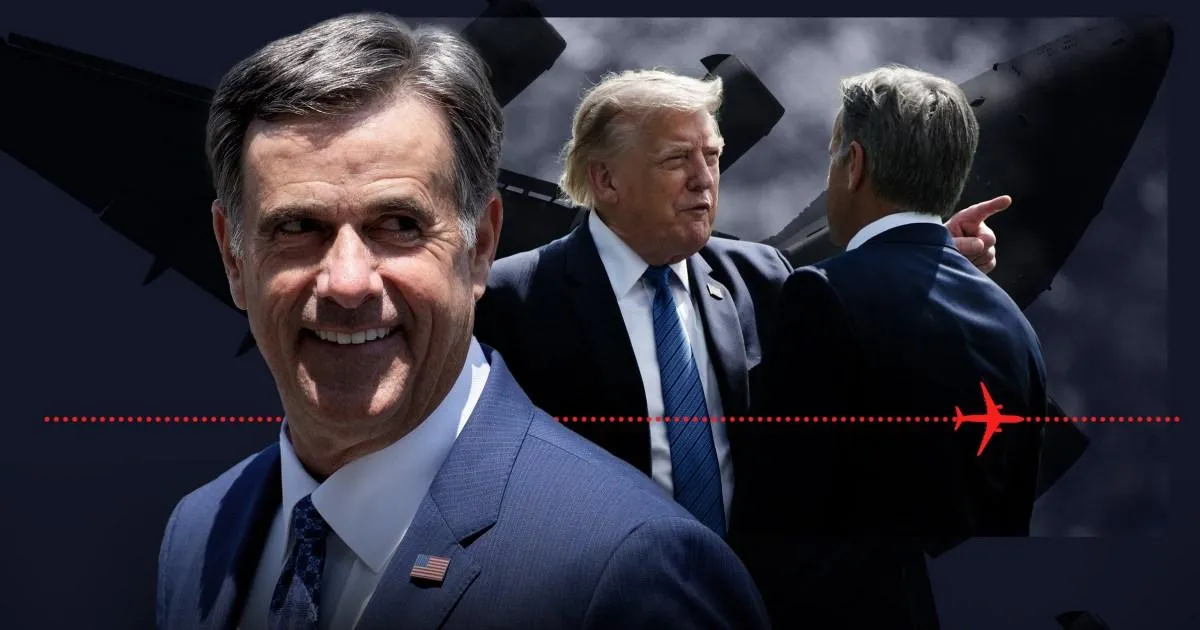
The unannounced arrival of CIA Director John Ratcliffe in Moscow has sent ripples through the diplomatic and intelligence communities, signaling a potential, albeit fragile, shift in the icy relationship between Washington and the Kremlin. The visit, which took place early Tuesday morning, was conducted with an unusual level of secrecy and was only confirmed when photographs emerged of the distinct American diplomatic motorcade moving through the Russian capital. The most telling detail, perhaps, is the flight path itself—a large American transport plane was tracked leaving Latvia and landing in Moscow, a route that suggests careful planning and a desire to avoid the more traditional, heavily monitored arrival points. For two nations locked in a bitter geopolitical struggle, the sheer fact of a face-to-face meeting between such a high-ranking intelligence official and his Russian counterparts is a significant departure from the recent norm, where communication has largely been conducted through sharply worded press releases and proxy conflicts.
The silence from both the White House and the Kremlin regarding the specific agenda has naturally fueled intense speculation. However, former British military attaché John Foreman, who spent years stationed in Moscow, offered a compelling interpretation during a BBC Radio 4 interview. He suggested that such a high-profile, unannounced visit is rarely a social call; it is almost always a signal that urgent matters require direct, behind-closed-doors discussion. Foreman’s analysis points to the conversation likely revolving around “escalation management”—a diplomatic term for establishing clear red lines and preventing a dangerous miscalculation from spiraling into a broader, more catastrophic conflict. This is about communication, not necessarily for reconciliation, but for the practical, cold-eyed management of a volatile standoff, ensuring that both sides understand the risks of crossing certain thresholds.
The context for this urgent dialogue becomes clearer when examining the recent patterns of covert activity plaguing European airspace. Russia has increasingly launched swarms of drones and other unidentified aerial vehicles towards the UK and continental Europe, prompting a “sobering report” from the International Institute of Strategic Studies (IISS). Their investigation revealed a sophisticated operation involving Vladimir Putin’s so-called “shadow fleet”—a network of ostensibly civilian vessels that are now suspected of acting as launch and recovery platforms for these drones. The sheer scale of the intrusions, which have targeted not only strategic military installations like RAF Fairford, Lakenheath, and Mildenhall but also dozens of civilian airports and industrial sites across Europe, points to a deliberate campaign of probing and intelligence-gathering. This is not random activity; it appears to be a systematic effort to test the readiness and vulnerabilities of Western air defenses.
The IISS report offers a critical strategic assessment of these activities, suggesting that the drone incursions are a key component of the Kremlin’s “wider unconventional war” on the West. The intelligence agencies behind these operations appear to be gathering vital data—mapping out the coverage gaps, reaction times, and limitations of Europe’s integrated air defense systems. By repeatedly sending drones into sensitive airspace, Russia is effectively conducting a live-fire reconnaissance mission, learning exactly how NATO would respond in a real-world conflict scenario. The fact that this information is being cited in the context of the CIA Director’s visit underscores that the problem has moved from a local nuisance to a critical security threat that demands high-level strategic discussion. It is a tactic designed to pressure and destabilize, forcing Western resources to be perpetually diverted to chase phantom threats across vast territories.
These reconnaissance missions have now become a near-constant source of tension, with “mystery drone sightings” plaguing military bases and civilian communities alike. This pressure campaign creates a complex psychological and operational environment, forcing air forces to scramble jets, divert flights, and expend resources on what are essentially probing actions. The Kremlin is likely using these actions to demonstrate its reach and capability, while also probing for weaknesses in the West’s collective resolve. In this context, Director Ratcliffe’s trip to Moscow could be interpreted as a direct American response to this pressure—a decision to confront the issue at its source. It is a high-stakes gambit, acknowledging that while public posturing continues, a private channel is now necessary to address the very real risk of an accidental or intentional clash that neither superpower truly desires.
Ultimately, the meeting in Moscow serves as a stark reminder that superpower rivalry, particularly between nuclear-armed states, is not solely conducted through open warfare. It is a complex game of shadowy operations, covert signaling, and the constant, high-wire act of managing a dangerous crisis. The unsettling conclusion from the IISS report, combined with the urgency of the CIA Director’s personal visit, suggests that Western intelligence agencies are deeply concerned about the direction Russia is taking. While the official statements from Washington and Moscow remain terse and non-committal, the very act of this quiet, back-channel meeting hints at an unspoken mutual recognition: despite the heated rhetoric and aggressive posturing, direct dialogue remains an essential tool for preventing a local flare-up from igniting a genuine global conflagration. The world will be watching for the subtle, non-verbal cues that inevitably follow such high-stakes negotiations.