
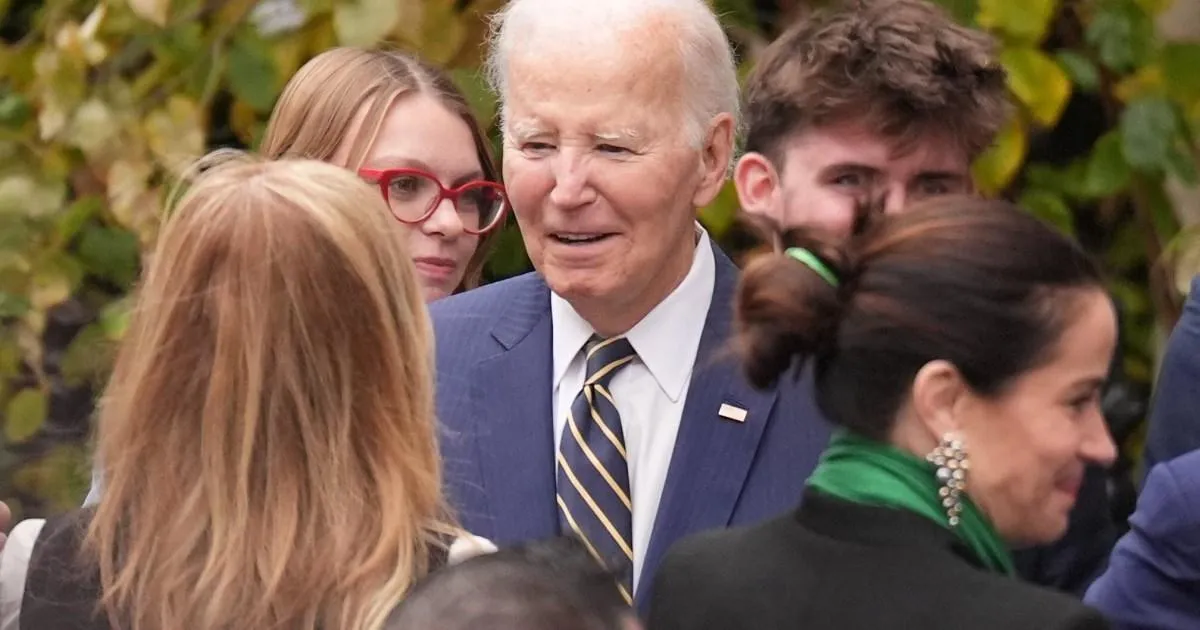
On a damp November afternoon in Dublin, the historic cobbled grounds of Trinity College Dublin became the backdrop for a moment that felt both deeply personal and profoundly public. Joe Biden, the former president of the United States, had made a surprise appearance in the city, not for a political rally or a diplomatic summit, but to watch his son Hunter receive one of the university’s most prestigious honors. The occasion was meant to be a celebration—a recognition of Hunter’s public advocacy and personal resilience, awarded by the College Historical Society, affectionately known as the Hist. But outside the walls of the 1937 Reading Room, where the ceremony unfolded, an entirely different mood was brewing. Students had gathered not to applaud, but to protest. Their anger was not directed at Hunter Biden, but at his father, and specifically at the role the former president played in the unfolding catastrophe in Gaza. What followed was a collision of two worlds: a family milestone wrapped in academic prestige, and a student movement fueled by moral outrage, all converging in one of Ireland’s most storied institutions.
The tension inside the venue reportedly simmered as students began voicing their dissent even before the ceremony concluded. According to The University Times, Trinity’s student newspaper, protests began in the 1937 Reading Room itself, with students making their feelings known about Biden’s record on the Gaza war. Then, as the Biden family prepared to leave, the anger spilled out into the open. Outside, pro-Palestinian demonstrators gathered in force, their chants cutting through the air with pointed clarity: “genocide Joe.” In the chaos that followed, milk cartons and other objects were thrown toward the former president and his wife, Jill Biden, as they made their way through the university’s front square. It was a scene of raw, unfiltered emotion—frustration that had been building for over a year, suddenly finding an outlet in the presence of a man many protesters view as complicit in mass suffering. Gardaí, the Irish police, moved in swiftly, arresting at least two people. Social media footage showed a garda using a baton, while Harper Alderson, editor of The University Times, told Irish broadcaster RTÉ that officers also used pepper spray to control the growing crowd. “The protest grew very large as the cars were moving through the front square of the college,” she said, capturing the scale of the unrest in a single, vivid observation.
In the aftermath, the reaction from student leadership was swift and unflinching. Trinity College Dublin Students’ Union, alongside the Irish student union Aontas na Mac Léinn in Éirinn, condemned both the police response and the decision to honor Biden’s family at all. In a joint Instagram post, the unions expressed their shock and disappointment, calling the police action against what they described as a “peaceful protest” appalling. They urged the university to investigate the incident, while making clear that the students’ actions were rooted in a deeply held moral stance. “Students have every right to protest [Biden’s] visit, challenge those in positions of power and demonstrate their solidarity with the Palestinian people,” the unions said. Their words framed the protest not as a chaotic outburst, but as a calculated act of conscience—an attempt by young people to hold power accountable in real time. The context for their anger is stark. According to Gazan officials, more than 74,000 Palestinians have been killed since October 7, 2022, including 1,500 people since the cease-fire. A United Nations human rights panel has gone further, accusing Israel of committing genocidal acts in the coastal strip, a claim Israel has denied. For many students, the numbers are not abstract statistics but a moral indictment—and the presence of the former president, whose administration provided military and diplomatic support to Israel, turned a university event into a flashpoint for grief and protest.
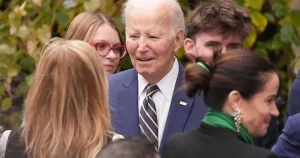
Amid the protests, however, the ceremony itself carried its own deeply human significance. Hunter Biden was awarded the Gold Medal for Outstanding Contribution to Public Discourse, an honor bestowed by the College Historical Society for his recent advocacy on American politics and media, as well as his work on addiction and recovery. The Hist, one of the oldest debating societies in the world, described Hunter as a commendable figure for the award, citing his willingness to speak openly about deeply personal struggles that many people face in silence. For Hunter, the moment was clearly emotional. “To be able to come back to Ireland and be with my whole family, it means the world,” he said at the event, his voice reflecting genuine gratitude. He added that it was “good” his father could join him for the occasion. In that moment, the protest outside seemed a world away—a father attending his son’s moment of recognition, sharing in a rare moment of joy amid years of public scrutiny and personal hardship. It was a reminder that public figures, even those at the center of political storms, are also human beings with family bonds and private milestones. The image of Joe Biden watching his son receive an award, perhaps with pride and relief, stood in stark contrast to the chants and flying milk cartons just outside the gates.
The visit, however, was not confined to the university. Later in the day, the Biden family met with Micheál Martin, the Taoiseach of Ireland, in a meeting that underscored the enduring connection between Biden and the country of his ancestors. Martin shared his appreciation warmly, noting that Biden has always been a steadfast friend to Ireland. Reflecting on their meeting, Martin recalled Biden’s deep Irish roots and his previous visits, praising the former president for his lifelong support of the nation. Speaking at Tallaght Stadium in Dublin, Martin went further, emphasizing the substance behind the symbolism. “In the early years, he was a great supporter of the peace process, and then later he was a really strong supporter of Ireland in the context of Brexit,” the Taoiseach said. For many in Ireland, Biden’s connection to the country is not merely diplomatic but ancestral and emotional, rooted in a history of emigration, resilience, and the hope for peace. The meeting served as a reminder of the multifaceted nature of Biden’s legacy—a figure who, to many, is both a champion of peace in Northern Ireland and, to others, a name associated with devastating violence in Gaza. The same man, seen through different lenses, becomes a symbol of contradictory truths, and those contradictions were laid bare on the streets of Dublin that day.
Ultimately, the moments outside Trinity College Dublin were about far more than a single visit or a single award. They were about the deep, unresolved questions that continue to haunt our global conscience—questions about power, accountability, and the responsibility of leaders to those whose lives are shaped by their decisions. For the students who raised their voices and threw milk cartons, the protest was an act of desperation as much as defiance, a way of saying that they refuse to let the horrors in Gaza be normalized or forgotten. For Joe Biden, the visit was a chance to stand beside his son at a defining moment, to be present as a father rather than a politician. Both perspectives are profoundly human, even if they collided in anger and confusion. The milk-stained streets and the solemn halls of Trinity College now hold a story of irreconcilable tensions—a family’s pride, a nation’s grief, a generation’s demand for justice. In the end, the images from Dublin are not just about a former president or a protest. They are about the messy, painful, and often contradictory ways we navigate our shared humanity in a world still struggling to find peace.