


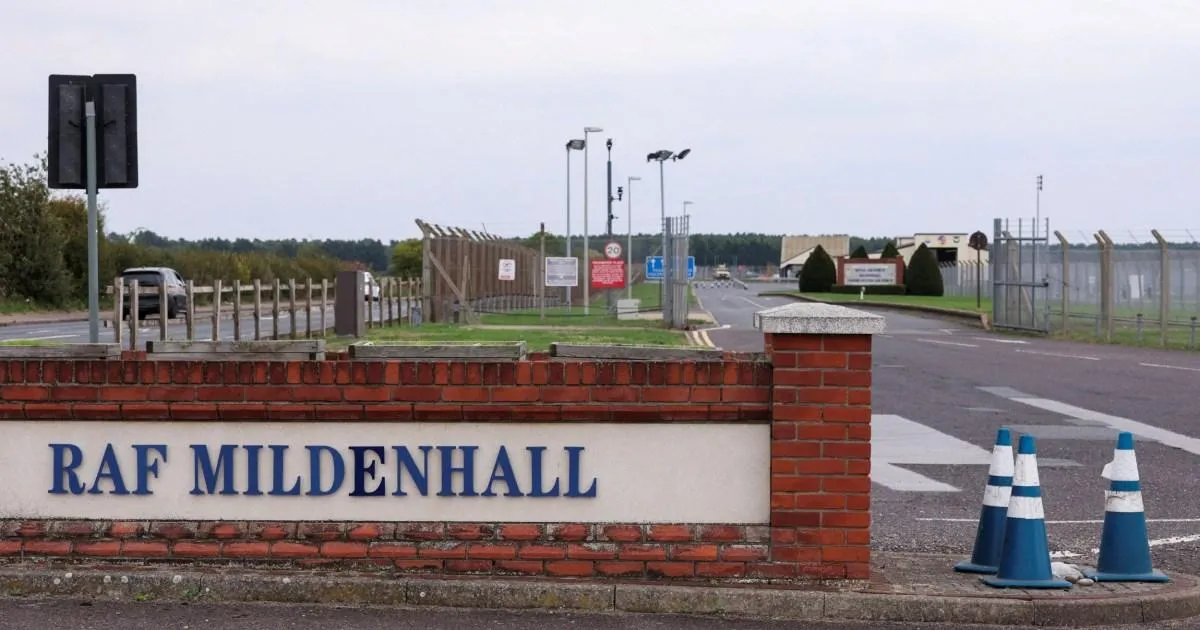
The grey Monday morning at RAF Mildenhall felt heavier than usual. The Suffolk base, a sprawling hub of American military activity in the British countryside, hummed with a tense, unspoken energy. For the airmen and women who serve there, the familiar ritual of coffee, briefings, and pre-flight checks took on a sharper edge. Word had spread quietly: two US refuelling tankers had been ordered into the sky early, not for a routine training mission, but as part of an urgent repositioning to Germany. By the time the village church bells across the flat landscape had rung for midday, more tankers had followed, peeling off from their parking stands one by one, climbing into the overcast sky and heading for alternative locations across Europe. The movements were swift, precise, and deeply unsettling. This was no ordinary exercise. It was an evacuation, a defensive reaction to a threat that had emerged from the shadows of the long-running standoff between the United States and Iran. No official announcement greeted the departure. There were no sirens, no dramatic press conference. Just the roar of engines, the fading silhouettes of aircraft, and the quiet, nagging question in the minds of those who watched: what have they been told that we have not?
The news that two tankers had been shifted to Germany came first from the Wall Street Journal, a fragment of information that confirmed what locals had already sensed. The exact nature of the threat remained unclear, swirling in the speculative fog that often accompanies such movements. American officials were reportedly still discussing what had triggered the alert, but the message was clear enough: the danger was credible enough to move aircraft, and move them fast. This was not an isolated incident. Weeks earlier, the US had withdrawn its strategic bombers from RAF Fairford, another English base, following what was described as a suspected Iran-related terror incident near the airfield. That earlier retreat had already set the alarm bells ringing among military observers and residents alike. Fairford, a base used for heavy bomber operations, had suddenly fallen silent, its massive aircraft gone, leaving behind only empty runways and the faint smell of jet fuel. Now, with the tankers leaving Mildenhall, the pattern seemed chillingly deliberate. The Ministry of Defence, in true bureaucratic fashion, offered no reassurance, only a carefully worded statement that “aircraft and other assets move regularly according to operational requirements.” It was a phrase designed to soothe, but it did the opposite. When bombers and refuelling planes start scattering across European airfields, nothing feels routine.
To humanize this story, we must strip away the cold jargon of geopolitics and look at the people whose lives are woven into these machines. A refuelling tanker is not just a piece of hardware; it is a mobile gas station in the sky, a lifeline for combat aircraft on long missions. But it is also a workplace, a home away from home for a crew of pilots and boom operators who have families, pets, and plans for the weekend. Their sudden departure meant missed birthdays, hurried phone calls to spouses, and the familiar ache of packing an overnight bag with no idea when they would return. For the ground crews left behind, the day became a blur of checklist revision, safety inspections, and the emotional labour of pretending everything was under control. On bases like Mildenhall, the American presence has long been a fixture of local life. English neighbours share pints with American airmen, children attend the same schools, and friendships blossom across the Atlantic divide. But moments like this tear at that fabric. The base becomes a fortress, the calm exterior of the community is strained, and the reality sinks in that these young men and women are, quite literally, in the crosshairs of a global confrontation. Their quiet courage is easy to overlook from the outside, but it is the heartbeat of this story.
Then came the curious intervention of President Donald Trump. Just a day before the tankers fled Mildenhall, Trump had taken to Truth Social with a message that seemed to oscillate between optimism and menace. He described an “excellent conversation” with Qatar’s Prime Minister, Sheikh Mohammed bin Abdulrahman bin Jassim Al Thani, a diplomatic call that apparently touched on the future of the conflict with Iran. The President spoke of a “Greatest Naval Blockade in History” and a new operation called Iron Gate, promising that land and sea operations would continue. He insisted that Iran could not have a nuclear weapon, and that this was “non-negotiable.” But then, in the same breath, he made a stunning claim: the US was seeing “positive momentum toward an end” to the conflict. War and peace, threat and progress, all jumbled together in a single social media post. For the families of the airmen who had just been dispersed across Europe, those words must have felt like a cruel paradox. If the end was truly near, why were their loved ones being shuffled like chess pieces? Why the urgent evacuation, the frantic phone calls, the sudden absence of aircraft from their long-familiar bases? The answer, perhaps, lies in the strange duality of modern statecraft, where public gestures of diplomacy are paired with private preparations for catastrophe.
The broader context only deepens the unease. Gulf states, according to Trump, were said to favour the status quo, preferring to keep up the naval blockade rather than risk a full-scale war. He warned that if anything changed, the United States was “locked and loaded” and ready to go, but he also suggested that such an outcome seemed “quite unlikely.” These contradictions are the stuff of nightmares for the men and women tasked with actually carrying out military orders. They do not have the luxury of political spin. They cannot afford to interpret “positive momentum” as a reason to relax. For them, every whisper of intelligence, every shift in the threat level, every hastily arranged flight to Germany is a matter of survival. The crews at Mildenhall and Fairford are used to being on the front lines of a conflict that rarely makes headlines in their home towns back in the United States. They serve in a foreign land, separated by an ocean from the people they love, and they do so with little fanfare. When a story like this breaks, the public tends to focus on the geopolitics, the naval blockades, the presidential egos. But the real story is the quiet resolve of the individuals who climb into those aircraft, never quite knowing whether the mission will be a simple refuelling flight or a prelude to something far darker.
In the end, this is a story about waiting. The tankers have gone to Germany, the bombers have left Fairford, and the people of Suffolk are left with empty skies and unanswered questions. The threat from Iran is not yet fully understood, even by those who made the decision to move the aircraft. It is a reminder that intelligence is often incomplete, that danger can be sensed before it is seen, and that the safest course of action is sometimes simply to scatter, to hide, to survive. For the local communities around these bases, there is a strange mix of pride and anxiety. They have hosted American forces for decades, through Cold War tensions and Middle Eastern conflicts, and they know the rhythm of military life. But a threat that reaches all the way to the Suffolk countryside, that forces the world’s most powerful air force to scramble its tankers in the early morning fog, is different. It brings the war home in a way that television footage never can. The hope now is that Trump’s “positive momentum” is genuine, that the diplomatic channels will hold, and that the young men and women who left so abruptly will soon return to their bases, to their families, and to a semblance of normalcy. But as the sun set on Monday over RAF Mildenhall, the runways remained quiet, the hangars were half empty, and the only thing certain was the uncertainty of the days ahead. For the airmen and their families, as for all of us, peace is not a distant abstract idea. It is the sound of a plane landing safely, the sight of a loved one walking through the door, and the comforting thought that tomorrow will be ordinary again.