


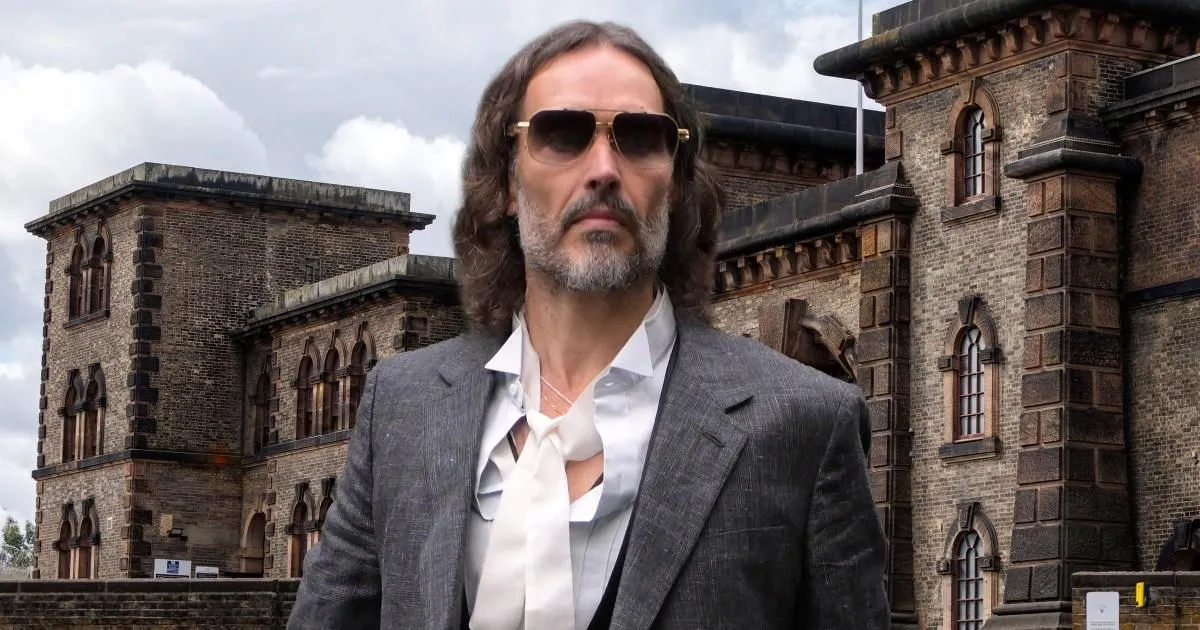
Russell Brand’s life has undergone a violent rearrangement. The comedian and actor, once a whirlwind of manic energy, provocative humour, and relentless self-promotion, is now an inmate at HMP Wandsworth, one of Britain’s most notorious prisons. After a month-long trial, the 51-year-old was convicted of rape and sexual assault against four women, with offences dating between 2004 and 2009 — a period when he was at the peak of his fame, commanding stages, screens, and tabloid headlines. On November 5, the guilty verdict landed, and Brand was immediately taken to Wandsworth, where he spent the weekend before being sentenced. The judge handed him ten years and six months, and he was then transported back to the same Victorian walls. The judge’s words were damning: Brand was a “sexual predator” who told a “series of lies” and displayed “staggering arrogance,” with an entourage that “indulged” his “dreadful behaviour.” For a man who had spent decades mocking authority and twisting language into dazzling shapes, being reduced to a prison number is a brutal irony. He is no longer the showman in a velvet suit; he is a prisoner in a crumbling institution, awaiting whatever comes next. His wife, Laura Gallacher, who remained at his side throughout the trial, now faces a very different life as well. But while the conviction itself is seismic, so too is the place where Brand now finds himself. HMP Wandsworth is not a quiet, orderly facility. It is overcrowded, understaffed, and repeatedly condemned by inspectors as unsafe, squalid, and inhumane. For a man with a target on his back, that is not just uncomfortable — it is genuinely dangerous.
HMP Wandsworth is a Category B prison built in 1851, and it was designed for a different era. It was meant to hold roughly 894 people, but at any given time it crams in between 1,400 and 1,457 inmates. That staggering overcrowding means most prisoners share cells that were built for one, with all the tension and misery that implies. According to reports, life inside follows a grim, repetitive rhythm. Inmates wake at 7.45am, eat breakfast in their cells, and then remain locked up for the rest of the day, aside from brief meal breaks at 12.45pm and 4.45pm. In theory, prisoners are entitled to between 30 minutes and an hour of fresh air each day. In reality, at Wandsworth, that outdoor time is often cancelled or disrupted because there simply are not enough staff to supervise it. This is what the BBC described as a Groundhog Day existence: men spending 22 to 23 hours a day in small, often damaged cells, staring at the same walls, breathing the same stale air. Imagine the psychological weight of that monotony, especially for someone like Brand, whose entire identity was built on performance, attention, and movement. No cameras, no applause, no escape into a character. Just a small room, a metal door, and a sentence that stretches out in front of him. The daily routine is not designed to reform or heal; it is designed to manage a mass of humanity with limited resources. And when resources run out, what is left is a crude form of containment that leaves people to rot in their own frustration and despair.
The physical conditions at Wandsworth have been condemned in the strongest possible terms. In 2024, HM Chief Inspector of Prisons Charlie Taylor wrote to the then Secretary of State, invoking an urgent notification for improvement after inspectors found extremely poor living conditions. There was damaged flooring and furniture, broken windows, leaking fixtures, and more than 900 outstanding maintenance jobs. Many cells had no screening around the toilet, even when two men were sharing the space. The prison was dirty and plagued by vermin: rat faeces were found in showers, and mouse droppings were found in food areas. Reports suggest that even Brand’s first night’s prison food was “inedible,” which is a small detail but a telling one. For a man who once enjoyed fine dining and private chefs, the contrast must be overwhelming. But the food is not the real problem. Brand reportedly spent his first night in solitary confinement because he faced “real danger” from other inmates. That is a stark admission from prison authorities. Even in a facility where everyone is locked down, Brand needed to be separated for his own safety. The label of sex offender carries a particular stigma inside prison walls, and famous inmates are often seen as targets for violence or humiliation. The degrading conditions at Wandsworth — the lack of privacy, the filth, the broken promises of basic sanitation — are not just about broken buildings. They are about a system that has lost its way, where punishment has become indistinguishable from neglect. Brand is not the only person suffering there; he is simply the most recognisable one, and the one whose case has drawn the public eye to a place that would probably rather stay in the dark.
Safety, or the lack of it, is the deeper crisis. Wandsworth has a long history of violence, self-harm, and deaths in custody. The 2024 inspection revealed that ten self-inflicted deaths had occurred since the previous inspection, with seven of those happening in the last twelve months. Even more alarming, 40% of emergency cell bells were not answered within five minutes, despite an increased rate of self-harm. More than half of prisoners said it was easy to get access to drugs. Staff shortages make all of this worse. Around one-third of staff are regularly unavailable on any given day due to sickness, training, or other non-operational duties. In 2025, Wandsworth was reported to have the worst staff sickness levels among major London prisons, with a sickness rate of 17.1% compared to the national average of 11.02%. At times, the prison was managed by fewer than 85 officers, meaning roughly one staff member for every 18 inmates. That is not adequate supervision by any standard. It is no wonder that prisoners spend nearly all day in their cells; there aren’t enough bodies to run a meaningful regime. For Brand, this is both a threat and a fear. He is a high-profile sex offender, the kind of figure who often becomes a target for other inmates looking to make a point or earn respect. In a prison where staff cannot even answer emergency bells promptly, the idea of being assaulted or endangered is terrifying. The lack of staff also means that informal hierarchies and violence can thrive. When cell doors are the only thing keeping order, the moment they open, all bets are off. Brand may try to keep his head down, but in a place like Wandsworth, anonymity is impossible.
Wandsworth’s problems are not new. A 2022 report by the same chief inspector found that there were not enough staff to provide even the most basic regime, and described the prison complex as “crumbling and overcrowded.” Prisoners could go several days without a shower, and the vermin problem with rats, mice, and pigeons was major. The prison’s vulnerabilities were exposed dramatically in September 2023, when former British Army soldier Daniel Khalife escaped. The 25-year-old strapped himself to the underside of a food delivery truck and used a makeshift sling made from kitchen trousers to get out of the prison kitchen. His escape triggered a nationwide manhunt, but he was recaptured 75 hours later. In November 2024, Khalife pleaded guilty to escaping custody and was found guilty of spying for Iranian intelligence; in February 2025, he was sentenced to 14 years and 3 months. The escape revealed broken CCTV cameras that had been out of service for over a year, and vehicle-search procedures that were skipped or poorly executed. For a prison that was already under fire, it was a humiliating blow. For Brand, this background matters because it shows how fragile the system is. A man was able to slip out on a food truck while the same facility struggles to keep its basic operations running. Legal experts and reports suggest Brand will not stay at Wandsworth indefinitely; he is likely to be transferred to a permanent long-term facility once the prison service decides where to place him. But for now, he is in a place where even the state’s ability to keep prisoners safe is questionable. There is no indication that Brand would try to escape, but there is every indication that he will need protection, and that protection is not guaranteed.
Brand now joins a strange and infamous lineage of notable figures who have passed through HMP Wandsworth’s gates. Boris Becker, the tennis champion, spent time there in 2022 after being convicted of hiding assets related to bankruptcy. WikiLeaks founder Julian Assange was held there during his lengthy extradition battles. Ronnie Kray, the East End gangster, served a three-year sentence there in 1956 for a pub assault. Ronnie Biggs, one of the Great Train Robbers, was an inmate in 1963 and escaped in 1965 using a rope ladder. Gary Glitter, the disgraced pop singer and convicted sex offender, was remanded at Wandsworth in 2015 before being moved elsewhere. And in one of the most poignant chapters, Oscar Wilde was transferred to Wandsworth in 1895 after being convicted of gross indecency. It is a strange club: poets, sportsmen, spies, gangsters, comedians, and deviants all sharing the same corridors. Brand now belongs to that club, though his place in it feels uniquely grim because the world watched his downfall in real time. His wife Laura Gallacher stood by him during the trial, but even her presence cannot soften the isolation he now faces. There may be appeals and legal fights ahead, but the immediate truth is that Brand will spend years behind bars, learning a rhythm of life that has nothing to do with fame. In the eyes of the public, he was once a beloved entertainer; now he is just another prisoner in a failing institution. HMP Wandsworth, with its broken windows, overcrowded cells, and exhausted staff, is the backdrop to his new reality. It is a sobering reminder of how quickly the brightest lights can be extinguished, and how unforgiving the machinery of justice can be when it grinds a fallen star down to the level of a number.