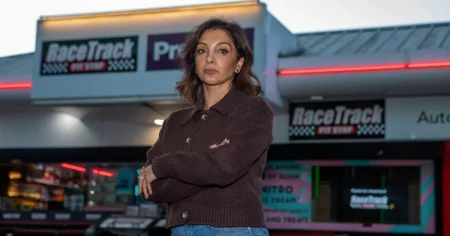




Mali Osmelak didn’t set out to make headlines. She was simply a mother trying to make life work. With a young daughter to care for, she needed an income that could bend around the rhythms of motherhood — school runs, playdates, sick days, bedtime. So, like millions of others, she turned to Vinted, the online marketplace where pre-loved clothes find new homes. What began as a way to declutter her wardrobe soon became something more: a genuine source of income. She signed up for a Vinted Pro account — the platform’s offering for registered business sellers — and began selling in earnest. Her efforts paid off. Over time, she built up a balance of £6,000, a significant safety net for a family living on one income. But then, without any clear warning, it all came to a halt. Her account was restricted. The money she had earned was locked away, out of reach, and the simple, hopeful venture that had given her flexibility and independence suddenly turned into a nightmare of frustration, red tape, and fear.
Vinted is not just an app; it is a phenomenon. Millions of people across the UK use it every day to buy and sell second-hand clothing, driven by a growing desire to shop sustainably and save money. For many, it is a casual hobby. For others, like Mali, it is a vital source of livelihood. To operate legally and safely, the company requires certain sellers — especially those using business accounts — to complete verification checks. These checks are designed to confirm identity, satisfy anti-money-laundering regulations, and ensure that the platform is not being used for fraud. In principle, this makes sense. No one wants criminals using digital marketplaces to launder money. But in practice, the process can be cold and unforgiving. When Mali began the verification procedure, she expected a straightforward formality. Instead, she found herself trapped in a repetitive loop of automated responses. Every time she tried to resolve the issue, she was met with the same generic messages, the same dead ends. There was no real human being to explain what was wrong, what she had done, or how to fix it.
What made the experience even more painful was the fact that this wasn’t just a technical glitch — it was her family’s money. Those £6,000 represented months of work, careful pricing, packaging, and posting. It was money she had counted on for everyday expenses, for her daughter’s needs, for the quiet security that comes from having a little something put aside. As the weeks dragged on, her frustration grew into desperation. She wasn’t asking for a favour. She wasn’t trying to cheat anyone. She had simply done what was asked of her, sold her items, and waited for her earnings to be released. Instead, she was met with silence and indifference. Eventually, Mali reached her breaking point. She decided to take legal action. With no other avenue left, she filed a claim against Vinted and its payment partner, Mangopay, spending nearly £500 of her own money on court fees just to fight for what was already hers. It was a leap of faith in a legal system that can feel intimidating and expensive. But she had no choice. She had asked for help, and nobody had helped her.
Remarkably, the solution came almost as soon as the legal paperwork was filed. Within days of taking her case to court, her account was suddenly verified. Her access was restored. The money was released. It felt less like a fair resolution and more like a quiet admission that the system had failed her all along. But the ordeal was not over. In June, the courts ruled in Mali’s favour, ordering Vinted and Mangopay to pay her £1,207.50 to cover the court fees and the costs she had incurred during the nightmare. Yet, even then, she didn’t see a penny of it. The ruling was a legal victory, but financially, it changed nothing. The money she was owed for her sacrifices — the fees, the stress, the sleepless nights — remained unpaid. “I need that cash. I will fight it,” she told the BBC. “I’m going to tell the court their system is completely broken. I needed help, and nobody helped me.” Her words carry the weight of someone who has been pushed to the edge, not by a deliberate villain but by an algorithm, a bureaucracy, a system so indifferent that it could not see the human being on the other side of the screen.
When asked about the case, Vinted issued a statement saying that Mali’s verification check had not been successful because her documents did not match the name on her account. They added that they had since helped her update it and that her account was now verified. Mangopay, for its part, said it does not comment on individual cases. But these explanations only deepen the question at the heart of the story: why did it take a court claim for a simple issue to be resolved? If the problem was a name mismatch, a real human being could have spotted it in minutes, explained the issue, and helped her correct it. Instead, she was left to battle an automated labyrinth, sending messages into a void, receiving nothing but canned responses, and ultimately forced to pay hundreds of pounds to be heard. For Vinted, this is a public relations problem. For Mali, it is a personal one. The company’s statement suggests that everything worked out in the end, but it misses the point entirely. She was not “helped” until she became a legal threat. The system didn’t work; it just eventually gave up.
Mali’s story is not just one person’s unfortunate experience. It is a symptom of a much larger problem in the modern digital economy. Marketplaces like Vinted have created incredible opportunities for ordinary people to earn money from their own homes. They have empowered mothers, students, and side-hustlers to build small businesses without formal infrastructure. But they have also created a new kind of power asymmetry. When something goes wrong, there is no one to call, no manager to ask for, no branch to visit. Users are left at the mercy of ticket systems, automated emails, and artificial intelligence that may or may not understand their problem. And when the sums involved are life-changing, this coldness becomes genuinely harmful. Mali is a fighter — she proved that in court. But she should never have had to fight so hard for her own money. Her determination has exposed a flaw in how these platforms treat their most vulnerable users. As she waits for the money she was awarded, she is planning her next step. She wants to tell the court, and the world, that the system is broken. But perhaps the most important message is simpler and more human: behind every locked account is a real person, with real bills, real hopes, and a real life. And they deserve better than an automated response.