

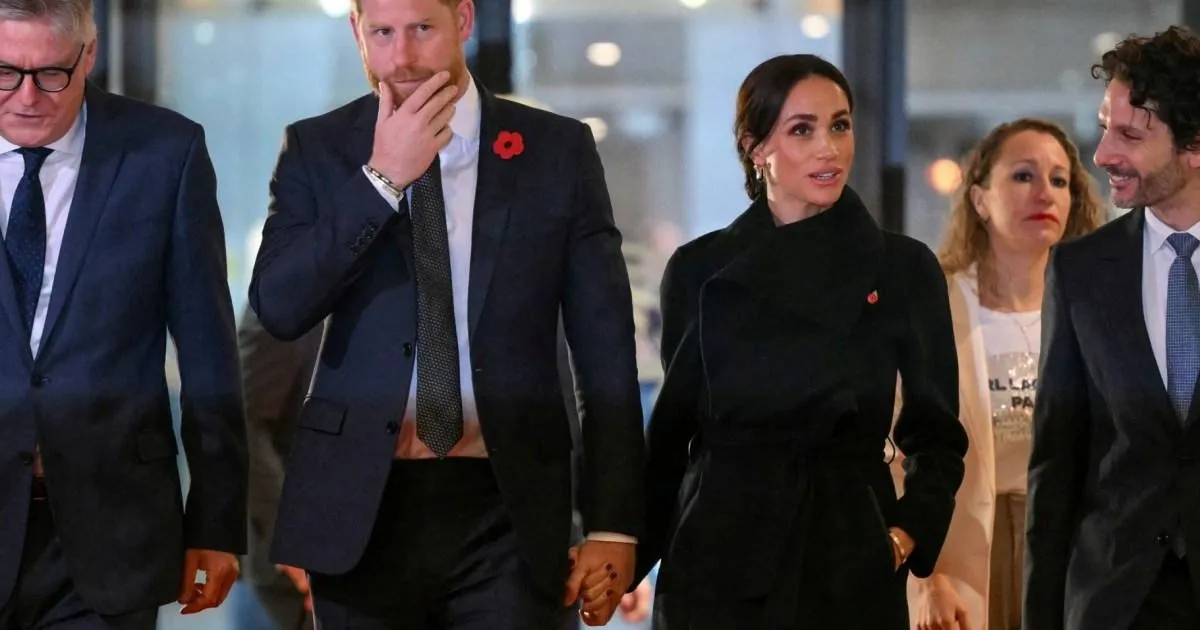
The imposing architecture of Brussels’ European Parliament provided a stark and fitting backdrop for a visit marked by profound personal turmoil and public duty. The Duke and Duchess of Sussex arrived hand-in-hand, a united front against a storm of controversy that had broken just days before. Their presence in the Belgian capital was for a cause deeply personal to them: the opening of the Lost Screen Memorial, a poignant installation dedicated to children whose lives have been tragically cut short by online harm. Yet, the air was thick with an unspoken tension. The announcement that Meghan would not be delivering her anticipated speech had already sent ripples through the gathered press and dignitaries, transforming what was meant to be a dual address into a solo performance for Prince Harry. The reason, confirmed by her team, was the fallout from a family crisis unfolding thousands of miles away in a Florida courtroom.
The decision for Meghan to step back from the microphone was not taken lightly. A source close to the Duchess revealed that the weight of the situation had left her emotionally unprepared for the public scrutiny of a speech. “She’s just not strong enough, emotionally, to be doing any public speaking right now,” the source confided to reporters, a rare admission of vulnerability from a woman often perceived as fiercely resilient. This retreat from the podium spoke volumes, shifting the focus from the cause they had traveled to champion to the personal anguish bubbling beneath the surface. While Meghan accompanied her husband, a supportive presence at his side, her silence was a deliberate and necessary act of self-preservation. As they walked through the venue, they were met with a barrage of questions about her father’s arrest, to which they offered no comment, their clasped hands serving as their only response to the intrusive inquiries.
In the hall, Prince Harry took to the stage alone, a solitary figure carrying the weight of both his mission and his personal circumstances. His address was heartfelt and impassioned, steering resolutely away from the personal scandal to focus on the universal right of every child to be safe. He articulated a powerful truth, stating that a child’s safety “should not depend” on their geographic location, a rallying cry for global cooperation in the digital age. The emotional core of the event, however, came from a testimonial delivered by a mother who had lost her child to online harms. As she spoke, sharing her devastating story, the raw grief in the room was palpable. Meghan, visibly moved, embraced the mother in a moment of shared sorrow that transcended the formalities of the occasion, a silent gesture of solidarity that spoke more powerfully than any prepared remarks could have.
This public engagement in Brussels, her first since the accusations surfaced, was thus defined by this duality: a commitment to a cause juxtaposed with the shadow of her estranged father, Thomas Markle Snr. The 82-year-old had appeared in a Florida court just days prior, charged with possession of child sexual abuse material. The US Department of Justice detailed a federal complaint alleging the material included “sexually explicit photographs of himself with prepubescent girls,” discovered in two Los Angeles-area storage units he had rented for nearly two decades. The charges followed an investigation initiated by a report from his son, Thomas Markle Jnr, who claimed to have found boxes of incriminating material in his father’s home in the Philippines. This led to a raid on a storage unit in Mexico, also believed to belong to the elderly man. At his court appearance, Thomas Snr was ordered into home detention with electronic monitoring, prohibited from traveling outside specific federal districts in Florida and California.
The charges against Thomas Markle Snr are the latest and most severe chapter in a long and painful public estrangement. Meghan had cut contact with her father in 2018 after he was caught staging photos for the paparazzi, an act that marked the beginning of their very public rift. He has consistently denied all allegations of child sexual abuse, previously dismissing them as “sick lies.” However, the gravity of the new federal charges has cast a long, dark shadow. The Duchess has previously described the allegations as “troubling and disturbing,” expressing her “sincerest hope is that justice will be fully served and that the priority remains the safety and protection of innocent children.” These words, released in a statement, now take on an even more profound resonance as she faces the reality of the legal proceedings against her father while trying to navigate her own public life and charitable work.
The visit to the Lost Screen Memorial was a stark reminder of the mission that Harry and Meghan have made central to their post-royal lives. The memorial itself is a powerful, somber art installation, featuring photos of children and young people lost to online harm, each encased in a smartphone-shaped box—a chilling symbol of the very devices that can so often be a gateway to danger. The couple was shown the exhibit, their faces reflecting the gravity of the stories it contained. Through The Archewell Foundation, they have been vocal advocates for a safer digital world, particularly for children. This trip to Brussels was meant to be a high-profile demonstration of that commitment, but it was unavoidably interwoven with the personal crisis. The image of a private meeting with grieving parents stands in stark contrast to the headlines of the public scandal, highlighting the difficult balance the couple must strike between their advocacy and their personal lives, a balance that on this occasion was severely tested.