


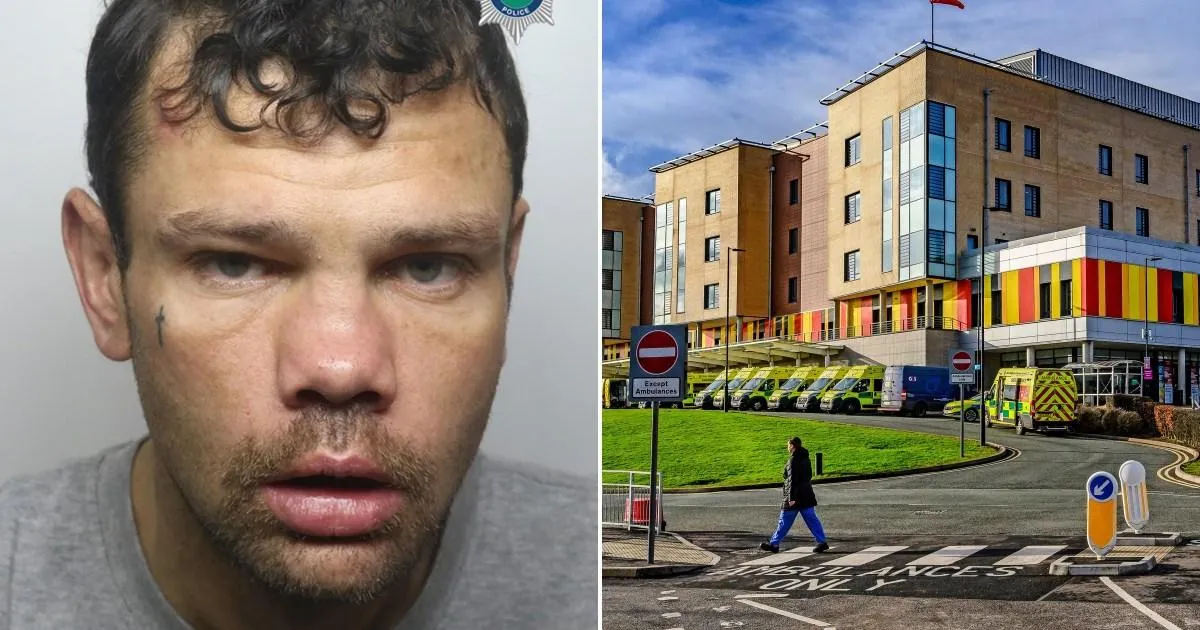
On the evening of March 25th, the routine of a busy hospital triage bay was shattered by an act of reckless chaos. Marshall Leese, a 32-year-old man in the grip of a drug-induced psychosis, commandeered an ambulance that was actively treating a patient. The vehicle had been left running outside the Royal Stoke University Hospital, its “run lock” mode engaged, a standard safety feature designed to keep the engine on while allowing paramedics to step away with the keys. In a moment of unguarded vulnerability, Leese slipped into the driver’s seat and drove off, unknowingly (or perhaps knowingly, in his fractured reality) taking with him not just an expensive vehicle, but the lives of an elderly patient, his carer, and the paramedic responsible for their care. The theft was not a simple act of carjacking; it was a terrifying abduction that transformed a sanctuary of healing into a speeding vessel of fear and danger.
The realization of what was happening dawned on the paramedic in the back with horrifying clarity. He had assumed his colleague, who held the keys, had returned to the driver’s seat. Instead, he found himself looking at a stranger. The ensuing confrontation was a raw mix of professional duty and primal fear. The paramedic shouted at Leese, demanding he pull over and pointing out the vulnerable passengers in the back, but his words were met with silence. The ambulance continued its journey, a hulking metal box weaving through the evening traffic, running red lights and jolting its occupants. For the paramedic, every mile was a fresh surge of terror. He was not just a witness to a crime; he was trapped in a mobile prison with a man whose behavior was utterly unpredictable. His primary concern was for his patient, but his own safety was now hanging precariously in the balance. This was no longer a medical emergency; it was a hostage situation on wheels.
The true gravity of the situation lay in the identity of the passenger in the back. A man in his 80s, who was taking blood thinners for a pre-existing condition, was being treated for a serious head injury. His condition was already critical, and the care he was receiving was delicate. The court would later hear a chilling assessment of the potential consequences of this reckless joyride: had the ambulance crashed, the elderly man, with his compromised blood’s ability to clot, would have had “no chance of survival.” Leese’s erratic driving, which included disregarding traffic signals, transformed the ambulance from a vehicle of hope into a potential death trap. The physical jostling of the vehicle, the sudden stops, and the acceleration could have exacerbated the man’s head injury, while the psychological terror of the situation was a secondary assault on his fragile state. The entire episode was a compounding series of threats to a life that was already in a precarious position.
Leese’s actions were not born of cold calculation but were the terrifying output of a severely compromised mind. He had been in the throes of an intense episode induced by the synthetic drug “monkey dust,” a substance notorious for causing extreme agitation, paranoia, and violent delusions. Moments before the hijacking, he had been “ushered out” of another ambulance’s driver’s seat by alert paramedics, yet he was not stopped from climbing into the second. His delusions were profound; he believed he was “being controlled” and “receiving coded messages” that directed him to take the vehicle. In his mind, this was not a crime, but a mission. The court heard he thought he was obeying an external force, a narrative that makes his actions no less dangerous but paints a picture of a man utterly lost to his drug-fueled reality. His erratic driving and care for other vehicles, as noted by the judge, was a bizarre contradiction—a sliver of his consciousness still aware of the physical world around him, even as his mind was adrift in a sea of paranoia.
The ordeal finally came to an end when Leese stopped the ambulance at a petrol station in Chesterton. Police were able to apprehend him, though he reportedly attempted to hide. He was taken into custody and later appeared at Stoke-on-Trent Crown Court, where he pleaded guilty to a litany of charges: false imprisonment, aggravated vehicle taking, failing to provide a specimen for analysis, and driving without insurance. His record showed a history of criminality, including a previous vehicle theft. In his mitigation, his defense barrister, Jennifer Devans-Tamakloe, painted a portrait of a man leading an “extraordinarily difficult and chaotic lifestyle,” struggling with long-term abuse of alcohol and drugs. She argued that his daily use of monkey dust had a profoundly negative impact on his mental state, directly contributing to the delusions that led to his actions. It was a defense of tragedy, not of justification, highlighting a life spiraling out of control long before that fateful day.
The judge, Recorder Ben Williams KC, sentenced Leese to 21 months in prison. In his remarks, he acknowledged that Leese had demonstrated a degree of care for other vehicles and hadn’t driven at high speeds, but the offense was still one of extreme severity. The judge highlighted the 20-minute duration of the journey, a sustained period of terror for those held captive. The paramedic, who remained with the patient and his carer throughout, described himself as “terrified about the whole situation.” The sentence was a reflection of the seriousness of the crime, but it could not undo the trauma inflicted on the paramedic, the patient, or the patient’s carer. The incident stands as a stark warning about the immense, unpredictable dangers faced by first responders and the fragility of safety in public spaces. It also casts a harsh light on the devastating consequences of drug abuse, not just for the user, but for the innocent people caught in the crossfire of their delusions.