



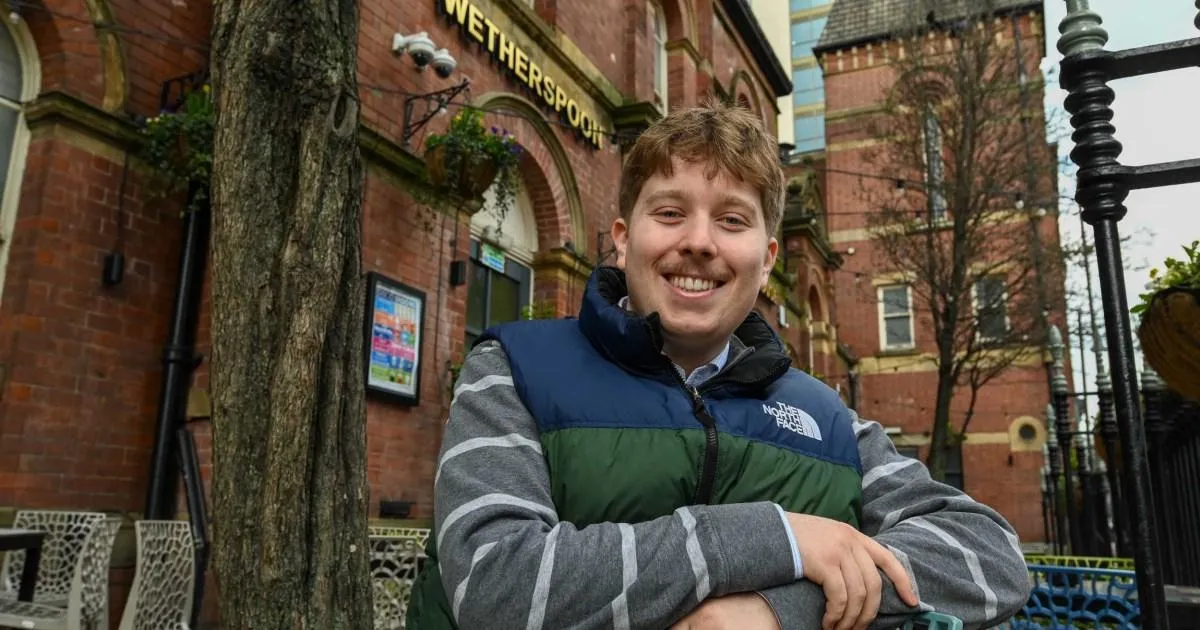
When it came time to choose a topic for his final-year university dissertation, Josh Griffiths could easily have played it safe. He was studying for a BA honours degree in geography at the University of Leeds, and there were plenty of serious, conventional subjects to pick from. But the 22-year-old had something else in mind. He was a self-confessed huge fan of Wetherspoons, and he believed that the budget pub chain deserved real academic attention. So instead of writing about climate change, urban planning or economic regeneration, he decided to make Wetherspoons the centre of his 10,000-word research project. It was an unconventional choice, but one that paid off in the most satisfying way possible. His dissertation received a mark of 74%, which helped him secure a first-class degree. More surprisingly, his supervisor, Professor David Bell, revealed that in nearly four decades of teaching, he had never encountered an undergraduate dissertation about Wetherspoons. For Josh, this was not just a matter of personal taste. He genuinely believed that Wetherspoons offered a fascinating window into British society, a place where people from all walks of life come together over affordable food and drink. He saw the chain as more than just a business; he saw it as a social institution, one that deserves to be studied just as seriously as any cathedral, museum or city square.
Josh’s project was ambitious in both scope and detail. He did not simply write a general appreciation of his favourite pubs. Instead, he investigated three key questions: how consumers actually use Wetherspoon pubs, what is most popular behind the bar, and which locations might make sense for future expansion. To answer these questions, he selected four very different branches as the main case studies. In Leeds, he studied Beckett’s Bank and The Golden Beam. In the City of London, he spent time observing The Crosse Keys, one of the chain’s grandest and busiest sites. And in Petts Wood, south-east London, he examined The Sovereign of the Seas, a more typical suburban pub. The variety was deliberate. By comparing city centre venues, financial district pubs and local suburban branches, Josh was able to see how Wetherspoons adapts to different communities. But he did not stop there. He also visited other Wetherspoon pubs up and down the country, treating each trip as part of his academic fieldwork. Among the places he particularly enjoyed were The Lion & The Unicorn at Waterloo station and The Samuel Peto in Folkestone, Kent. These visits gave him a richer understanding of how the chain works beyond his core case studies, and he seemed to genuinely relish every research trip.
What made Josh’s dissertation stand out was not just the subject matter but the way he went about studying it. His supervisor, Professor Bell, was impressed by his use of observational data. Rather than relying only on questionnaires or official statistics, Josh sat in the pubs and simply watched. He observed customers at different days and times, paying close attention to how the same room could transform from a quiet morning coffee spot into a lively evening social hub. He noted the diversity of the people who came through the doors: students, pensioners, office workers, families, tourists and regulars who seemed to be part of the furniture. He watched how some people nursed a single drink for hours, while others dashed in and out. This kind of detailed observational work is difficult to do well, but Josh did it brilliantly. Professor Bell said: “I was really impressed by Josh’s finished project. He used observational data brilliantly to capture the diverse uses and customers, comparing different days and times to show the many roles which Spoons has in the community.” Yet Josh did not stop at observation. He also used GIS mapping, a geographic information system, to look for potential new sites where Wetherspoon venues could open. This combination of human observation and technical mapping impressed his supervisor enormously. Bell described it as “a really innovative mix of methods” and admitted that he had become an observer of Spoons life himself because of Josh’s work.
There is something very human about a student choosing to write his dissertation on a pub chain he genuinely loves. Josh was not a detached researcher hiding behind academic jargon. He was a young man who understood something important: that the places we often take for granted are full of meaning. Anyone who has spent time in a Wetherspoons will recognise what Josh observed. In the morning, the pubs are quiet and calm, filled with retired people reading newspapers, young parents with pushchairs, and customers drinking 99p coffees. At lunchtime, the atmosphere changes as office workers and families arrive for burgers, curries and fish and chips. By evening, the same space becomes a social gathering place, a meeting point for friends and colleagues. Unlike many other pubs, Wetherspoons often has no loud music, no constant football on television and no pressure to keep moving. Customers are allowed to sit for as long as they like. For many people, a Wetherspoon is not just a pub. It is a community centre, a quiet refuge, a handy waiting room, a second living room or even a temporary office. Josh’s research captured these many roles beautifully. He did not simply report what Wetherspoons looks like from the outside. He showed what it does for people, and why it matters in their daily lives. That is precisely what makes good geography, and good storytelling, so powerful.
Josh’s dissertation also touched on a much bigger story about modern Britain. For years, the country has been losing pubs at an alarming rate. Traditional locals have closed in huge numbers, and many high streets have struggled to survive. Wetherspoons, by contrast, has become one of the most recognisable and successful hospitality brands in the country, with hundreds of pubs across the United Kingdom and Ireland. The chain has a particular talent for taking over grand old buildings such as banks, cinemas, fire stations and theatres, and giving them a new lease of life. Its no-music policy, cheap prices and app-based ordering have made it distinctive in a competitive industry. Love it or hate it, Wetherspoons has become part of the fabric of British life. By choosing to study it, Josh was asking serious questions about what these pubs mean for the communities they serve. His research explored why some locations work well and others might be worth considering for expansion. In doing so, he brought together the worlds of academic geography and commercial strategy. It was a reminder that studying everyday places, even ones associated with cheap drinks and sticky floors, can reveal a great deal about class, leisure, work, community and belonging. A Wetherspoons pub, in Josh’s hands, became a map of contemporary Britain.
In the end, Josh Griffiths’ gamble on an unusual dissertation topic paid off in every possible way. He earned a first-class degree, impressed an academic who had never seen anything quite like it, and proved that serious research can be both enjoyable and accessible. Professor Bell’s parting words were a lovely tribute. He said: “I really enjoyed supervising Josh and have, myself, become an observer of Spoons life.” That comment says a great deal about the quality of Josh’s work and the unexpected power of the subject. A student’s enthusiasm can change the way even a veteran academic sees the world. Josh’s story is also a reminder to students everywhere that the best research often grows out of genuine curiosity rather than a desire to play it safe. The world is full of ordinary places that are quietly extraordinary. Pubs, cafes, parks, stations and streets all contain stories waiting to be noticed. Josh noticed one of the most familiar places in British life and gave it the serious academic treatment it rarely receives. He also gave countless university students a little bit of hope: that choosing a topic you love, no matter how unusual it may seem, can lead to great results. After all, there are few more human experiences than sitting in a Wetherspoons, watching the world go by, and realising that even the most ordinary places are full of life worth studying.