

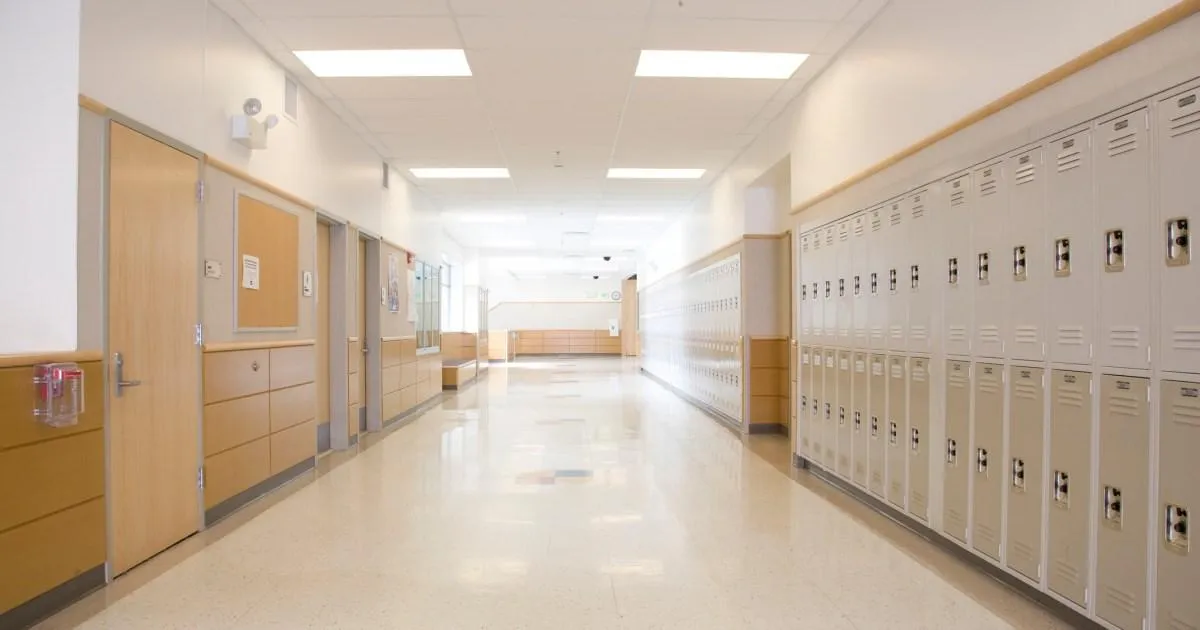
Behind the red brick walls and familiar school gates, an unsettling quiet has settled over parts of Enfield. Three schools — Bishop Stopford’s School, Starks Field Primary School and Suffolks Primary School — are now facing the possibility of closure, with the local Conservative council arguing that falling pupil rolls have made it financially impossible to keep their doors open. The statistics are stark: Bishop Stopford’s is operating at less than half capacity, Starks Field is below 45 percent full, and Suffolks is projected to fall below 37 percent occupancy by 2029. But numbers never tell the whole story. Every empty desk represents a child who has moved away; every half-empty class represents a teacher who still plans lessons for a room that grows quieter each term; every anxious parent-teacher meeting carries a fear that the community they have chosen might not be here next September. For the families who have stayed, these aren’t just figures in a council report. They are the daily reality of walking past closed classrooms, of watching a school’s budget shrink, and of hearing local politicians talk about their children’s education in the language of cost and capacity rather than care and potential. The uncertainty is already taking an emotional toll: children ask whether their school will be there when they start a new year; parents wonder whether to move their child before they are forced to; staff, many of whom have poured years into these schools, are left in limbo, unsure whether their careers and communities are about to be dismantled in the name of efficiency.
This is not a localised problem, and it is spreading across London with alarming speed. Enfield is only the latest borough to be caught in the grip of a demographic shift that has been building for years. Councils in Richmond-upon-Thames, Newham, Camden and Ealing have all proposed closing local schools, and research commissioned by London Councils and led by Islington Council found that 90 schools across the capital have already either closed or merged in the last five years. The reasons are painful and complex. Birth rates across London have been falling for years, meaning fewer children are entering the system. The pandemic accelerated an exodus of families from inner-city life, as many who could afford to leave sought more space and a different pace of life. Now, with the cost-of-living crisis squeezing household budgets, many of those families cannot afford to return, even if they want to. The result is a slow but steady thinning of demand in classrooms that were once bursting at the seams. Inner London has been hit especially hard, and the trend is not yet showing signs of reversing. Councillor Una O’Halloran, London Councils’ executive member for children and education, said boroughs will exhaust every possible option before closing a school, but the situation is being driven by forces outside their control, forcing tough decisions. She stressed that councils are doing all they can to minimise disruption to children and families while trying to preserve London’s impressive record of high school standards. But for the families living through it, the reassurance feels thin. A school is not just a building; it is a place where friendships are formed, where children learn to trust adults outside their family, and where communities gather. When a school is threatened, the grief is real, even before any decision is made.
For some schools, the closure risk feels particularly shortsighted because of the vital work they are doing with vulnerable children. Andrea Cassius, head teacher of Suffolks Primary School, acknowledged that pupil numbers are falling well below the national average, but she argued passionately that the school’s recent investment in supporting pupils with special educational needs and disabilities — known as SEND — should be reason enough for the council to keep it open. Suffolks has opened autism units for Key Stage One and Key Stage Two, introduced speech and language support, and built up a range of inclusion services designed to meet children where they are. “We’ve got a huge range of needs that we meet within our school,” Cassius said. The school has been working with the borough for two years to give the community something that is badly needed, and during the summer the council agreed to double provision for autistic children at the school from 20 pupils to 40, with a further expansion of another 20 pupils designated for September 2027. The contradiction is not lost on campaigners. How can a school be considered unviable at the same time as the council is expanding its specialist provision? For families who have fought for years to get the right support for their children, the proposed closure feels like a betrayal. Enfield North MP Feryal Clark, who joined campaigners hoping to keep the schools open, said closure should not be the first port of call, especially when demand for SEND provision is growing across the borough. She also raised the human cost for older pupils, particularly at Bishop Stopford’s School. “You’ve got children in the middle of studying for their GCSEs and A-levels. Where are they going to go?” she asked. It is a devastating question, and one that the council’s financial spreadsheet does not easily answer. These are not just statistics; they are teenagers who have worked for years toward exams that will shape their next steps, and they now face the prospect of being uprooted in the middle of that high-pressure moment.
The political battle surrounding the closure proposals has only deepened the anxiety. The plans to close the three Enfield schools were initially brought forward by the Conservative administration on the council, but they were then “called in” by Labour councillors, who accused the Tories of producing a report full of “material inaccuracies and inconsistencies.” Labour’s call-in request argued that the council had not adequately explained why these three schools were selected for potential closure or repurposing when other schools across the borough were experiencing similarly falling numbers. Family by family, the community has responded not with quiet acceptance but with active resistance. Campaigners gathered recently at Enfield Civic Centre, where the future of the schools was discussed at a scrutiny committee meeting, and their presence was a reminder that decisions made in council chambers are felt in kitchen tables across the borough. The council, for its part, says it is committed to a “fair and transparent consultation” and insists that all three schools were identified because of falling and projected pupil numbers, surplus places, budget pressures, and the impact of reduced pupil funding. A six-week consultation on the proposals will go ahead, and no formal decision has yet been made about the future of any of the schools. But the consultation itself is a double-edged sword. For parents, it is an opportunity to be heard. For staff, it is another long stretch of uncertainty, during which morale will inevitably suffer and the best teachers may decide to leave before any decision is made. The process is meant to be democratic, but for those living through it, it can feel like watching a slow-moving catastrophe unfold in real time.
The pain is not confined to Enfield. In October, parents at Kew-Riverside Primary School in Richmond-upon-Thames submitted a revised proposal challenging their council’s decision to close the school by September 2027 — despite the school receiving a glowing report from Ofsted just a few months earlier. That juxtaposition captures the strange logic of the current moment: a school can be excellent and still be considered expendable, because excellence does not fill classrooms when the children simply are not there. The underlying hope among education leaders is that London’s population will eventually rise again, that the pendulum will swing back, and that the city’s extraordinary appeal will reassert itself. Councillor O’Halloran acknowledged that London’s population has always ebbed and flowed and that while pupil numbers may be declining now, the trend could well reverse in the long term. That is why boroughs are trying to protect the education estate as much as possible, keeping school sites able to meet future levels of need. But protecting the estate and keeping schools open are not the same thing. There is a growing recognition that the government needs to work more closely with local councils to decide what happens to vacant school premises in the short and medium term. O’Halloran said boroughs would welcome support with capital costs from the government to convert closed schools into specialist provision for children with special educational needs and disabilities where there is demand. It is a sensible idea, but it does little to comfort the parents whose children are in schools that could close before such conversions ever happen. They are not asking for grand long-term strategies; they are asking for their children’s school to still be there when the summer holidays end.
A spokesperson for the Mayor of London responded to the growing crisis by noting that decisions to close schools are made by local councils, not by City Hall, but acknowledged that the closure of any school can be a stressful experience for children, parents and staff. The spokesperson pointed to a range of factors shaping London’s changing population — falling birth rates, the long-term impact of Brexit, and cost-of-living challenges — and highlighted the Mayor’s efforts to support families: building more new homes than at any time since the 1930s, funding free school meals for all state primary school children, cleaning up the air young Londoners breathe, and investing £30 million in youth clubs. These are meaningful commitments, but they are not an answer to a child who stands in the middle of a nearly empty classroom and asks whether their school is closing. For now, the fate of Bishop Stopford’s, Starks Field and Suffolks remains uncertain, subject to consultation and political negotiation. No formal decision has been made, and campaigners are not giving up. Their fight is about more than these three schools; it is about what kind of city London wants to be. A city that treats schools as disposable expenses is a city that is quietly giving up on its own future. A city that listens to parents, trusts teachers, and believes in the value of community is a city that finds another way. London has always been a place of change, and it will always reinvent itself. But some things should not be allowed to simply fade away — and for the families in Enfield, those things are not just institutions but the classrooms where their children laugh, learn, grow, and feel safe. They are waiting, hoping that someone with power will see beyond the spreadsheets and remember that every empty chair in every threatened classroom is also a story of a family that chose London as home.