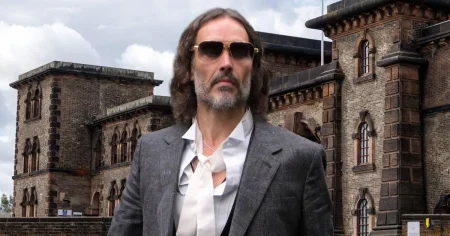



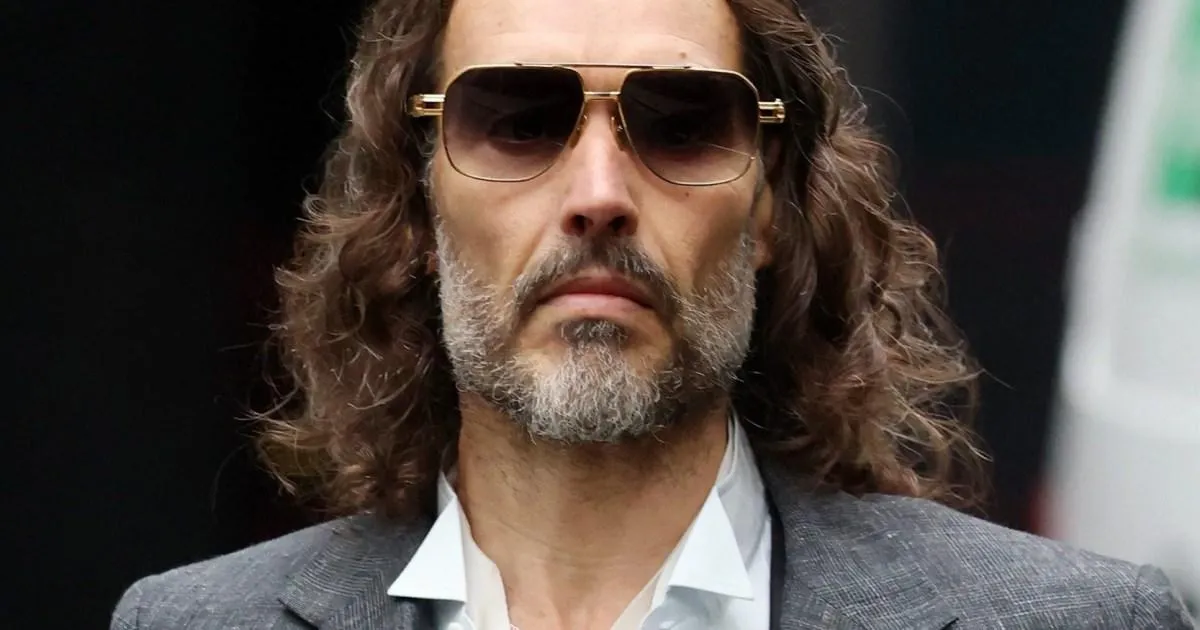
Outside the heavy gates of HMP Wandsworth, the scene on Tuesday afternoon was one of tentative release and lingering tension. A handful of men emerged clutching black bin bags and small plastic carriers, blinking into the gray light of a London afternoon. They were part of the government’s latest wave of early prison releases, a policy designed to ease chronic overcrowding in England’s jails. But just a short distance beyond those same walls, one newly arrived inmate was being led to a different kind of confinement. Russell Brand, the once-celebrated comedian and film star, had been sentenced just the previous day to ten and a half years in prison for one count of rape and three counts of sexual assault against four women. Now, as freed prisoners walked away from the Victorian building toward buses, family members, and uncertain futures, the name of the disgraced celebrity hung in the air. The prison, with its foreboding architecture and grim history, had already begun to whisper his arrival.
Among those released on this third wave of the early release scheme were roughly 650 inmates serving sentences of more than two years and five months and fewer than three years and two months. The scheme, controversial from the start, has been defended by the government as a necessary emergency measure to prevent the prison system from collapsing under its own weight. But for those leaving, the relief was palpable. One man, released after serving a year of an eighteen-month sentence for a drug offence, spoke openly about what awaited Brand inside. “I’m out after a year of a year and a half sentence. I’m going to be a chef now,” he said, before explaining that Brand was being held on C block, a wing reserved for around 100 vulnerable inmates. According to this former prisoner, Brand was not sharing a cell. “Most share a cell there but he’s on his own,” the man said. “There’s a gym there with pull up bars to keep fit and he will have a TV in his room.” He added that the prisoners were “excited about having a celebrity here” and that they had been expecting Brand’s arrival for some time. The claim painted a picture of a man isolated from the general population, yet still afforded certain comforts, a detail that would inevitably spark public debate about privilege even behind bars.
The theme of privilege echoed in the words of another released inmate, a man whose year-long sentence for a sex offence had been reduced by three weeks. Speaking to reporters, he said that Brand’s wealth would allow him to navigate prison life far more comfortably than the average inmate. “He’s in C block and has access to a football pitch, a basketball court and gym,” he said. “He can bring in an Xbox or whatever. If you have the money, you are laughing. It’s like Sainsbury’s in there if you have the money and he obviously will. He can bring himself in a nice duvet for sure.” The comparison to a supermarket was stark and telling. In a place meant to be defined by deprivation, money still found a way to smooth rough edges. The image of Brand ordering comforts from the inside while many prisoners left with nothing more than a bin bag was a powerful illustration of the inequalities that persist even within a supposedly egalitarian institution. Another man, freed after just 65 days behind bars, confirmed that Brand had become the talk of the prison. “I didn’t see Brand, but he’s on his own in a block, I’m told,” he said, simply adding, “I’m happy to be out.” For these men, Brand was less a human being than a curiosity, a known face in a world of anonymity.
Yet the human reality of Brand’s fall from grace was also beginning to emerge through the voices of those closest to other inmates. A woman whose partner was jailed at Wandsworth said her partner had spoken with the disgraced star. “He is devastated and the conditions terrify him, but he is praying,” she said. The words suggested a man overwhelmed by the abrupt collapse of his life, a public figure now stripped of status and security, confronting the cold, unforgiving texture of prison existence. Another woman, visiting her brother inside, offered a darker warning. “My brother says the other prisoners are out to get Brand,” she said. “My brother is not like that, but some others want to get money from Brand because he is rich and famous. It always happens.” This comment cut through the more sensational claims of luxury and comfort, revealing the persistent danger faced by high-profile sex offenders in custody. Despite the relative protection of a vulnerable prisoners wing, the threat of exploitation and violence was never far away. Brand, who built his career on charm and controversy, now occupied a space where his fame made him both a target and a trophy. The prison system, for all its talk of security, could not fully protect him from the predatory instincts of other men.
Beyond the specific case of Russell Brand, the early release scheme has reignited a broader conversation about the purpose of prison in modern Britain. Jamie Dale, an ex-prisoner who now runs the Old Lags Network, an organisation that supports people leaving custody, was outside Wandsworth handing out food and toiletries to those released. He acknowledged the public anger over early releases, but argued that the existing system had already failed everyone involved. “Prison damages people,” he said. “And if the public thinks that warehousing people is going to change them, it’s not, it makes them worse. It makes them into more violent people, more unpredictable people, and there is zero rehabilitation going on inside prisons right now because they are about 30% too full. The prison service and the probation service are in survival mode, and they just, because of that, they’re just unable to deliver proper rehabilitation.” His words gave voice to a frustration shared by many criminal justice reform advocates: that overcrowding has turned prisons into warehouses rather than places of transformation. The early release scheme, in this view, was not a kindness but a triage measure, a recognition that the system could no longer contain the bodies it was legally obliged to hold.
What remains is a complicated and unsettling picture. Russell Brand, convicted of serious sexual crimes, now sits in a Victorian prison, isolated from the general population, the subject of both fear and fascination among his fellow inmates. His wealth may buy him small comforts, but it cannot buy back his reputation, his freedom, or the years he will spend behind bars. At the same time, hundreds of other men are being freed early, not because they are rehabilitated, but because the system is too full to hold them. The juxtaposition of these two realities forces a question: what does justice actually look like? For some, it is the sight of a wealthy celebrity finally brought low. For others, it is the release of a prisoner who can return to society and restart his life as a chef. Neither image is entirely satisfying. The early release scheme exposes the fragility of a justice system stretched beyond its limits, while Brand’s case reminds us of the human capacity for harm, denial, and eventual accountability. As the gates of Wandsworth continue to open, releasing men into the uncertain light of freedom, and as one of the most famous faces of British comedy adjusts to the grim routines of prison life, the deeper issue remains unresolved. A prison that cannot rehabilitate is not a solution. A justice system that relies on early release to survive is not functioning. And a society that measures justice only by punishment may find that it has built cages not only for the guilty, but for its own best hopes of change. For now, the men outside are starting over, and the man inside is beginning a sentence that will outlast the headlines. The story of HMP Wandsworth, on that ordinary Tuesday, was not just about one celebrity’s fall. It was about the many invisible prisoners, the ones who leave with bin bags and the ones who stay, and the enduring question of whether prison ever truly serves the cause of justice or simply delays the reckoning we all must face.