


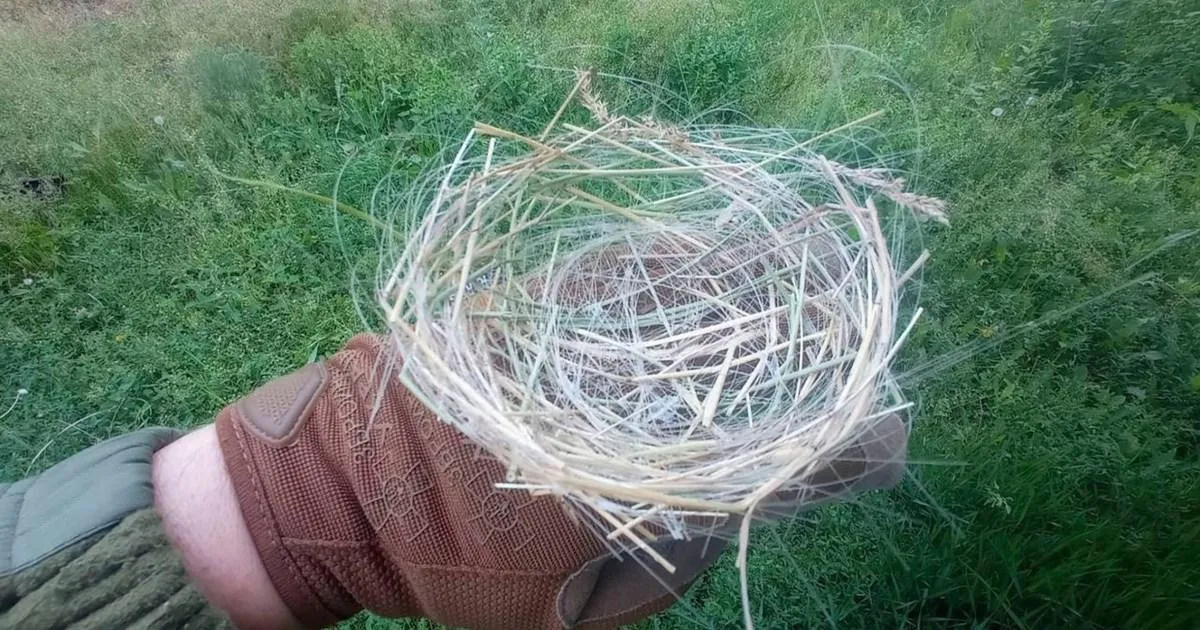
Across the scarred landscapes of Ukraine, a haunting visual testament to the ongoing conflict has begun to emerge from the wreckage. While the front lines are defined by the roar of artillery and the hum of surveillance technology, nature is quietly adapting in the most surreal way imaginable. Along the 746-mile stretch of the front, birds have begun constructing their homes not from the traditional twigs, moss, and grass favored by generations of their ancestors, but from discarded fiber-optic cables. These ultra-thin wires, originally deployed by both Ukrainian and Russian forces to connect control stations to attack drones and secure communications, now drape over shattered trees and ruined buildings like a glistening, synthetic spider web.
The phenomenon was brought to public attention after Ukrainian soldiers discovered these structural anomalies in frontline regions like Donetsk, Kharkiv, and Zaporizhzhia. For the birds, these cables—some reaching lengths of up to 20 kilometers—offer a surprisingly sturdy alternative to organic materials. One particularly striking nest was recovered from a tree in the Donbas region after it was toppled by a Russian glide bomb. When the tree fell, the nest remained intact, a tangle of stiff, artificial fiber that stood in stark, chilling contrast to the natural environment. Experts, including Yana Hrynko from Kyiv’s War Museum, have begun collecting these artifacts, noting that they serve as a chilling physical manifestation of how total war fundamentally alters the ecosystem.
For the soldiers fighting on the ground, these nests represent a bittersweet survival story. A support battalion from the 12th Azov Brigade recently shared images of one such nest, poignantly describing it as a manifestation of nature persists even in the face of scorched earth and constant shelling. The optics of a delicate life-cycle occurring within a shell of military-grade communication equipment create an “apocalyptic” aesthetic that has captured the attention of observers worldwide. Groups like UAnimals have echoed this sentiment, lamenting that while nature is nothing if not resilient, the presence of non-biodegradable fiberglass in these nests highlights the lasting environmental trauma being inflicted upon the Ukrainian countryside.
From a biological perspective, this behavior is a fascinating, if concerning, example of avian adaptability. Ornithologists like Auke-Florian Hiemstra, who has spent her career studying nest construction, note that birds have long utilized human-made refuse to bolster their homes. We have seen them weave cigarette butts—likely for the nicotine’s parasite-repelling properties—into their lining, and even use pandemic-era face masks as soft, mattress-like padding. However, the use of industrial military cables is unprecedented. While these synthetic fibers might provide superior structural integrity, they pose significant risks, including the potential for chicks to become entangled in the long, rigid strands or to accidentally consume toxic remnants of the production process.
The rigorous scientific examination of these nests is currently ongoing. Researchers are working to extract DNA traces from the structures to identify exactly which species have swapped natural construction for modern warfare’s debris. Hiemstra, who has examined countless nests throughout her career, admits that even she has never encountered anything quite like this. The study is not just about identifying a species; it is about understanding how rapid human-driven environmental changes force evolution to outpace natural selection. These birds are not choosing to abandon their traditional customs by preference, but are reacting to a world where their forests have been replaced by a sprawling lattice of communication wires.
Ultimately, these nests serve as a mirror turned toward humanity, reflecting our propensity to reshape the natural world in our own destructive image. They are, at once, a symbol of the tenacity of life and a somber indictment of the tragedy unfolding in Ukraine. As the war continues to grind on, the landscape remains littered with the remnants of weaponry that will outlive the conflict itself. While we may marvel at the ingenuity of a bird that crafts a home out of the very fiber-optics used to guide drones of war, we are reminded that neither the birds nor the land they inhabit should be forced to endure such an existence. These nests are more than just biological curiosities; they are markers of an era where even the wildest, most fragile lives are forced to build their future upon the broken strands of our conflicts.