


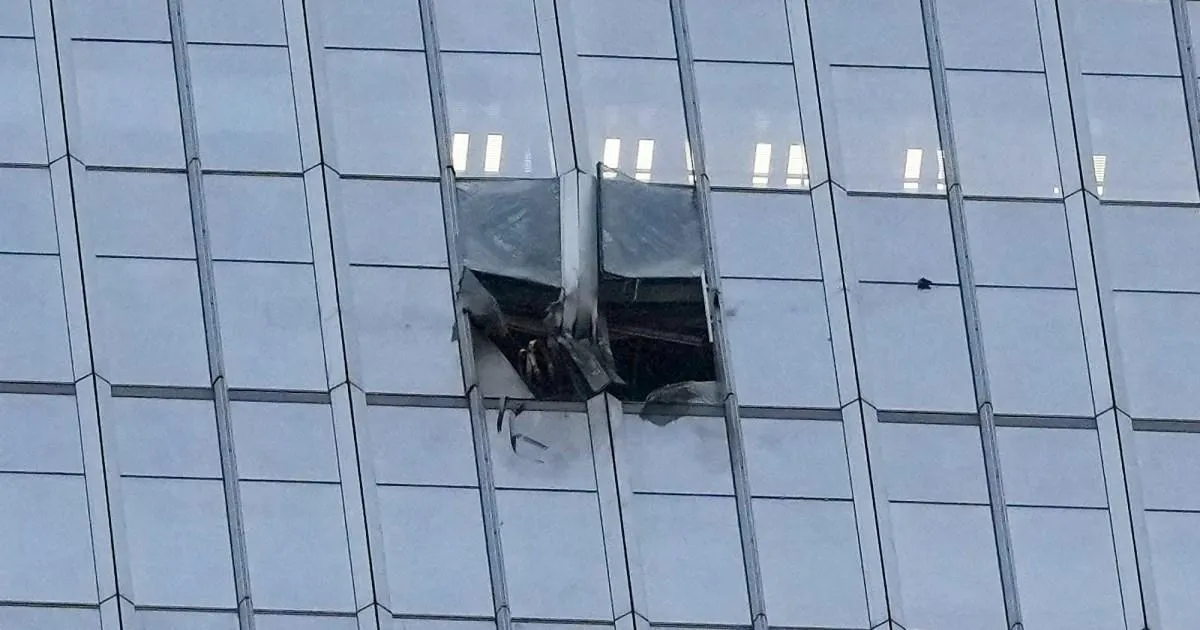
The recent tragedy involving a B-12PP aircraft colliding with the CITIC Tower—Beijing’s tallest and perhaps most recognizable skyscraper—has left the global community in a state of unsettling bewilderment. On a quiet Friday, what should have been a routine flight transformed into a devastating incident, resulting in the death of the pilot and leaving thirteen others on the ground wounded. The building itself, a 109-story marvel known locally as “China Zun,” now stands as a somber landmark, its façade scarred by gaping holes and currently obscured by makeshift boards. Despite the gravity of the event, the official response from Chinese authorities has been strikingly sparse, limited to a brief, sixty-word summary in the Beijing Daily that recounts only the most basic facts, leaving a vacuum of information that the rest of the world is struggling to fill.
The aftermath of the crash has been characterized by an intense and immediate effort to control the narrative. Reports consistently highlight a systematic scrubbing of digital spaces; videos that captured the terrifying moments of impact have been erased from Chinese internet servers, and even benign imagery of the skyscraper has been scrubbed from local social media platforms. The silence extends to professional circles as well, with aviation firms suspending light aircraft operations and sources indicating they were instructed to refrain from discussing the incident entirely. Major state-backed outlets, such as the Xinhua news agency and China Central Television, have notably bypassed the story, contributing to a sense of opacity that has only deepened international concern regarding transparency.
Piecing together the flight path reveals a series of baffling irregularities that complicate the mystery. The aircraft reportedly took off from Shifosi Airport, intending to complete a short circuit before returning by 5:45 p.m. However, shortly after departure, the jet inexplicably deviated from its flight plan. Flight tracking monitors reported that the signal was lost somewhere near Beijing’s East Fifth Ring Road, moments before the plane veered into the side of the skyscraper. The fact that this collision occurred within a strict no-fly zone—an area specifically protected from such incursions—raises urgent questions about how a private aircraft could have breached one of the most secure and heavily monitored cities in the world.
The location of the crash is perhaps the most alarming aspect of the entire affair. The CITIC Tower sits only a few kilometers away from Zhongnanhai, the high-security heart of the Chinese Communist Party. For security analysts, this proximity is not merely a detail; it is a profound failure of defensive protocols. Bill Bishop, a prominent China analyst, took to social media to characterize the event as a “massive security breach,” noting that had the plane continued its trajectory for just a few seconds longer, it could have potentially impacted the leadership headquarters itself. Such a scenario would have been a tectonic shift in Beijing’s security apparatus, transforming a localized tragedy into a national crisis of confidence.
As the physical site is repaired and the boarded-up windows hide the extent of the damage, the lack of definitive answers continues to fuel speculation. While district authorities have confirmed that an investigation is currently underway, the public remains in the dark about the identity of the pilot who lost their life and the technological or human failure that led to such a disastrous deviation. By treating the incident with such extreme administrative caution, the authorities have inadvertently amplified the sense of unease, turning a tragic accident into an enigma that suggests deeper, unresolved fragilities within the capital’s intricate security web.
Ultimately, the crash serves as a stark reminder of the fragility of modern urban centers, even those under the most stringent surveillance. Beyond the missing flight logs and the missing footage, there is a human element to this story that remains unaddressed: the confusion of the affected families, the terror of the wounded, and the lingering question of how a “no-fly zone” failed to function. As the world watches and waits for a more comprehensive report, the CITIC Tower remains a haunting, silent witness to the event. Whether the full truth will ever surface remains uncertain, but for now, the incident lingers as a sobering example of how quickly the routine tasks of humanity can turn into a mystery that tests the transparency and stability of a superpower.