



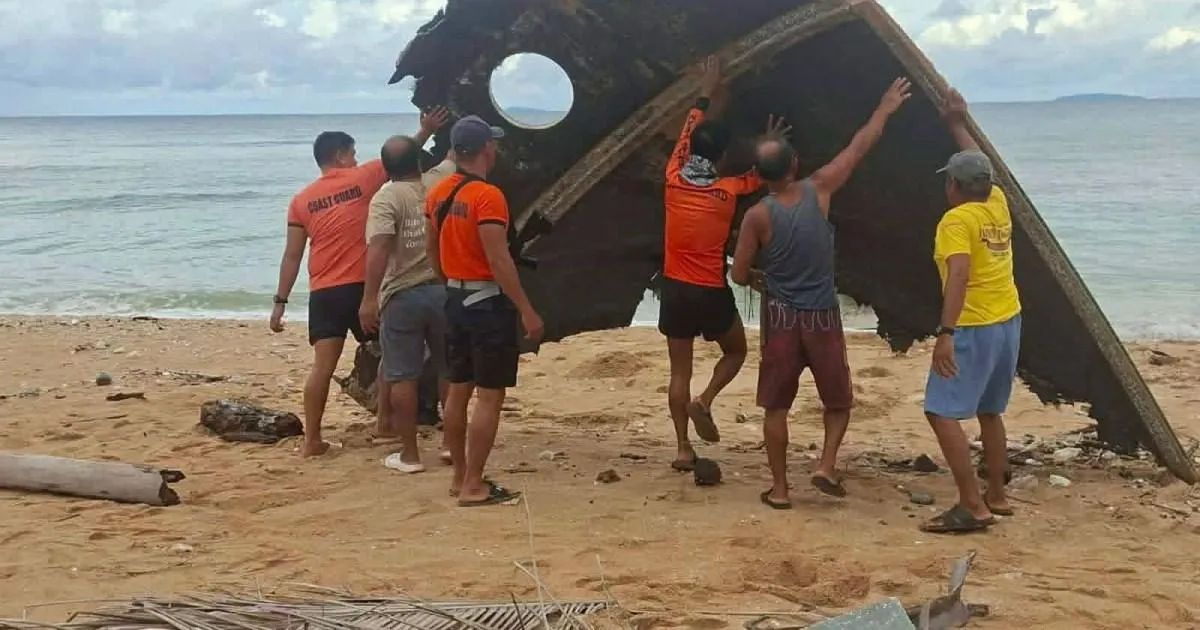
The tranquil waters off the coast of Bisucay Island, a remote and picturesque part of the Philippines, were recently the site of a startling discovery that highlights the complexities of modern space exploration. Early Wednesday morning, local coastguards were dispatched to the Balading settlement following reports of strange, metallic wreckage washing ashore. What began as a routine day for the island’s inhabitants quickly shifted into a delicate recovery operation, as authorities arrived to secure what appeared to be remnants of a rocket. The sight of twisted metal protruding from the surf served as a stark, tangible reminder that the vast, silent activities occurring high above our atmosphere can sometimes have very literal, heavy-handed consequences here on the ground.
This recovery follows weeks of cautious anticipation by the Philippine Space Agency (PhilSA). When China launched the Long March 12 rocket from Hainan Island on June 17, the scientific community kept a watchful eye on its trajectory. PhilSA had issued prudent warnings, noting that the rocket’s flight path meant that its discarded debris would likely re-enter the atmosphere and descend into the waters near Puerto Princesa, Palawan. While such launches are routine in the global space race, the unpredictable nature of an uncontrolled descent meant there was always a lingering concern that debris might find its way into populated areas, posing risks to aircraft, essential infrastructure, or the lives of those living in coastal communities.
The logistics of the recovery operation were swift and professional, reflecting a heightened sense of alertness among local maritime authorities. By 6:46 a.m., a specialized response team was on the scene, meticulously documenting the wreckage and ensuring that the debris was safely transported to the Coast Guard Station in Eastern Palawan for further study. The process was handled with care, not only to preserve evidence for the ongoing investigation but also to ensure the safety of the local residents who had alerted the authorities to the strange objects initially. For the people of Bisucay Island, the sudden presence of coastguard personnel and the removal of the debris acted as a brief, sobering disruption to their quiet maritime lives.
At this stage, however, a definitive connection between the recovered metal and the Long March 12 rocket has yet to be officially confirmed. While the timing and the geographical location align closely with the launch projections shared by international aerospace monitoring agencies, authorities remain measured and analytical. Through the formal channels of a Notice to Airmen (NOTAM), China had provided advance warning of “aerospace flight activity,” yet the reality of space debris is that it does not always land exactly where current atmospheric modeling suggests. Investigators are currently conducting a detailed technical examination to confirm whether these shards are indeed from the Chinese launch or if they belong to an entirely different, perhaps older, piece of space hardware.
The investigation serves as a necessary exercise in transparency and public safety. The Coast Guard District Palawan has been quick to urge calm, issuing clear assurances to the public that all necessary protocols are being strictly followed while the wreckage undergoes forensic analysis. This incident is a poignant reminder of the “Space Age” reality we now inhabit, where the debris of industrial progress circulates above our heads, sometimes falling back to Earth in the most unexpected corners of the globe. As the authorities continue their work, their priority remains twofold: understanding the technical origins of the wreckage and ensuring that the coastal waters—and the people who depend on them—remain protected from the remnants of our reach into the stars.
Ultimately, the event on Bisucay Island encourages a broader reflection on the way we manage the skies. As more nations and private companies vie for presence in orbit, the frequency of such maritime discoveries is likely to increase. The Philippine Coast Guard has promised to share updates as the investigation progresses, providing a sense of closure to the local community and clarity for the global aerospace community. For now, the pieces of metal tucked away in a Palawan hangar stand as a curious artifact—an extraterrestrial visitor of human design that has traveled from the high-velocity world of orbital launches back to the quiet, rolling tides of an island shore.