



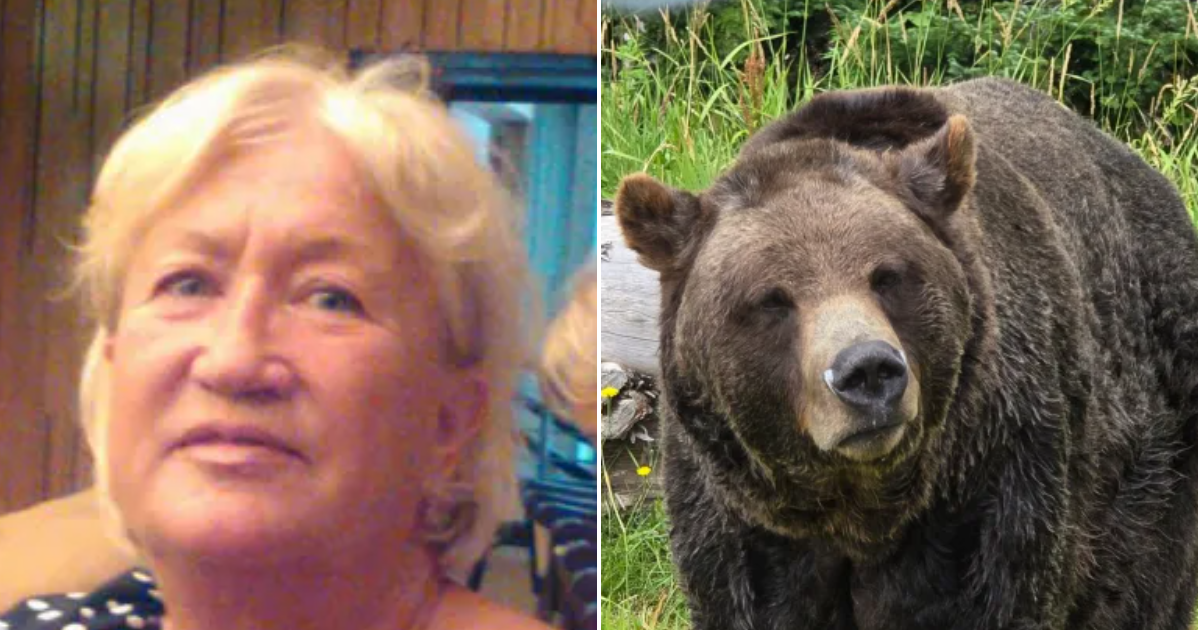
In the quiet stillness of a Siberian village, a life ended in a way no one could have prepared for. Lyudmila T., a woman in her mid-sixties, was found dead outside her own home, just fifty feet from the door she had walked through countless times. She lived alone in Verkhniy Kebezh, a small settlement perched on the edge of a dense forest in Russia’s Krasnoyarsk region, where the wild is not a distant concept but a neighbor that sometimes crosses the fence. Investigators said her injuries were consistent with an attack by a wild animal, and the evidence quickly pointed to a brown bear. The animal had come into her garden during the night of September 16, leaving behind a broken fence, deep scratches on the wooden wall beneath an open window, and a trail of terror that would end in tragedy. Lyudmila was due to celebrate her sixty-seventh birthday in just over a month. Instead, her body was discovered on the ground near her home, in the place where she had likely spent her last moments fighting for survival. The image of that lonely scene, a house on the edge of the woods, a garden fence splintered, and a woman who had simply been living her quiet life, is enough to send a chill through anyone who believes home is a sanctuary. For Lyudmila, the sanctuary was breached by something far older and more powerful than any lock or wall, something that had no regard for the boundaries humans build between themselves and nature.
In the aftermath, officials and local media scrambled to piece together exactly what had happened that night. Early reports were even more frightening, suggesting that the bear had broken into the house itself and dragged Lyudmila from her bedroom. But Russia’s Investigative Committee, which looked into the death, found no evidence that the animal had actually entered the home. Instead, they concluded that the sixty-six-year-old was most likely attacked outside, in the open air between her house and the forest. One possibility that emerged was that Lyudmila heard a disturbance in her garden and went outside to see what was happening, a reaction that feels almost unbearably human. Perhaps she thought it was a stray dog, or the wind knocking something over, or maybe she simply wanted to protect her property. Emergency service sources quoted by the Russian news agency TASS suggested that Lyudmila may have heard a noise, looked through her window, and in that moment, the bear grabbed her. The window had been left open for ventilation on that warm September night, and there were scratches on the wall beneath it, marks that seem to tell a story of huge claws reaching for a human presence. What is known is that a neighbor was staying at the house that night and was apparently asleep on a mattress beneath the window. That neighbor survived, unharmed, a fact that only deepens the cruelty of fate. The fence around the front garden was damaged, leading investigators to believe the bear had forced its way onto the property, perhaps drawn by a scent, perhaps by chance. By the time police arrived, the animal was gone, melting back into the forest like a ghost, and hunters were still searching for it when the initial official account was released.
This tragedy did not happen in a vacuum, and the broader picture makes it even more unsettling. Verkhniy Kebezh is a tiny settlement in the Ermakovsky district of southern Krasnoyarsk, an area of Siberia where forests stretch endlessly and bears are not a rare sight. Russia’s Natural Resources Ministry has recorded that roughly twenty to thirty bear attacks occur across the country in a typical year, and officials have linked many of these encounters to animals finding easily available food in bins and open waste containers. When bears become accustomed to human leftovers, they lose their natural fear of people, and the consequences can be fatal. Lyudmila was the fourth person killed by a bear in the Krasnoyarsk area in just a matter of weeks, a staggering statistic for such a short period. Across Russia, at least twelve bear-related deaths had been recorded since the beginning of 2026, a grim milestone that speaks to an ongoing and intensifying conflict between humans and wildlife. Meanwhile, the country’s estimated brown bear population has grown dramatically over recent decades, from about 130,000 in 1990 to roughly 307,900 in 2026. More bears, more people moving into wilder areas, and more careless food storage create a dangerous equation. It is a reminder that the dividing line between civilization and wilderness is not as solid as we like to believe. For communities like Verkhniy Kebezh, bears are not abstract symbols of nature’s majesty; they are real, everyday threats that walk through the same spaces where children play and old women tend their gardens.
The summer had already been a difficult one for Russia, with a series of deadly encounters involving brown bears reported across the country. Each incident leaves behind a community in mourning, a family shattered, and a renewed sense of vulnerability in places where people have always understood the risks but never fully accepted them. In Siberia, the forest is both a source of life and a source of danger; it provides food, firewood, and beauty, but it also shelters creatures that see humans as prey or rivals. When a bear attacks, it is not acting out of malice but out of instinct, hunger, or a perceived threat to its territory. Yet for the victims and their loved ones, that distinction offers little comfort. The story of Lyudmila is not just about statistics or animal behavior; it is about a woman who was going about her life, who had a birthday coming up, who lived alone but was not entirely alone, as a neighbor was staying with her that night. It is about the randomness of tragedy, how a moment of curiosity or concern can lead to a fatal encounter. It is about the scars left on a small village when one of its own is taken so violently. And it is about the broader question of how humans and bears can coexist in a world where their habitats increasingly overlap. There are no easy answers, but the growing number of attacks demands attention, not just from officials in Russia, but from anyone who cares about conservation, community safety, and the delicate balance between respecting wild animals and protecting human life.
Lyudmila’s death, for all its horror, is also a deeply human story. She lived alone in a house on the edge of a village, close to dense woodland, a lifestyle that suggests a certain independence, perhaps a preference for solitude, or simply a life that had always been that way. The fact that she was due to celebrate her sixty-seventh birthday adds a layer of poignancy; she was not an old woman who had faded into the background, but someone with an upcoming milestone, a reason to gather with friends or family, a future that was abruptly erased. A neighbor was staying at her home that night, sleeping on a mattress beneath the window, which raises questions that will never be fully answered. Did Lyudmila hear the bear first? Did she wake the neighbor? Did she try to confront the animal, or was she simply in the wrong place at the wrong time? The investigation is ongoing, and some details may never be known. But what is certain is that her final moments were terrifying, isolated, and violent, a stark contrast to the quiet, unremarkable life she had been living. The photographs released from the scene show marks on the outside of the house, evidence of a struggle or at least of the bear’s attempt to enter. They are silent witnesses to a nightmare. In the days since, the village of Verkhniy Kebezh must be grappling with a new reality, one where the forest feels closer and darker, where every rustle at night carries a warning, where the memory of a woman’s screams, if any were heard, haunts the air.
Ultimately, the death of Lyudmila T. is a tragedy that echoes far beyond a small Siberian village. It reminds us that nature is not always gentle, that the wild animals we admire from a distance can become deadly when their paths cross ours, and that the growing bear population, combined with human encroachment and the careless availability of food, creates conditions for disaster. Officials have pointed to open waste containers and bins as attractants, and there is a clear lesson in that, not just for Russia but for any community that borders on bear habitat. If people fail to manage their garbage, if they leave windows open at night in areas where bears roam, they are inviting danger. But no amount of advice can bring back Lyudmila, and no explanation can fully ease the pain of her loss. She is remembered as the fourth person killed in her region in a matter of weeks, one of at least twelve across Russia this year, a number that feels like a cold statistical tally of individual lives cut short. Behind each number is a person with a name, a home, a birthday on the horizon. Behind each number is a family and a community left to mourn. As hunters continue to search for the bear that took her life, the wider world looks on with a mixture of sorrow and fear. The forest remains, vast and beautiful and indifferent, and somewhere out there, a bear carries on living as it always has. The only thing that has changed is that a woman who called the edge of that forest her home is gone, leaving behind a damaged fence, an open window, and a silence that says more than any investigation ever could.