

Paragraph 1: The Fires of Independence
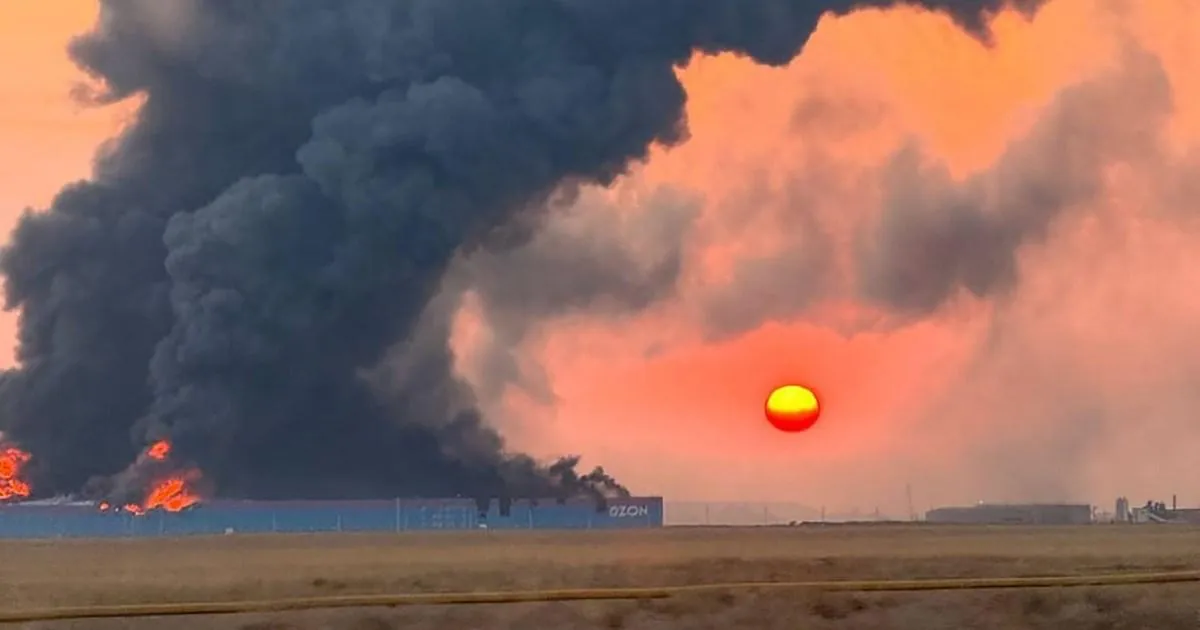
The calendar flipped to August 24th, a date that should have resonated solely with the sound of celebratory marches, the flutter of blue-and-yellow flags, and the collective pride of a nation defiantly marking its thirty-fifth year of sovereignty. But in the brutal arithmetic of war, Independence Day is not just a commemoration; it is a declaration of intent. Instead of passive ceremony, Ukraine answered the anniversary with a merciless demonstration of its long-range reach, setting the Russian sky ablaze at its very commercial core. As the dawn broke over the conflict zone, the message was clear: Ukraine would not just celebrate its freedom—it would actively dismantle the machinery of its occupier. In a coordinated overnight operation that aligned with the holiday, Ukrainian drones penetrated deep into Russian sovereign territory, targeting the logistical veins that keep the Russian war effort (and domestic comfort) running. The primary objective was Ozon, the sprawling Russian e-commerce empire often referred to as the “Amazon of Russia,” with three of its massive logistics centres succumbing to devastating fires. This was not an attack on a tank column or a missile battery; it was a surgical strike on the economic and logistical infrastructure that underwrites Moscow’s ability to wage war, demonstrating conclusively that the vulnerability of the Russian homeland is not just a theoretical risk for the Kremlin but a blazing reality, unfolding almost on cue for the Ukrainian holiday.
*   *Para 2 expansion*: The magnitude of the operation was staggeringched. Visuals emerging from three distinct locations painted a picture of systematic destruction: at the facility near Emen in the Adygea region, at the warehouse complex in Makhachkala, and at the major distribution hub in Nevinnomyssk in the Stavropol region, huge clouds of thick, black smoke billowed into the sky, visible for miles and serving as a beacon of Ukraine's expanding operational reach. Combined, these enormous structures cover a total footprint of approximately 3.27 million square feet—equivalent to the space of over forty-two football pitches side-by-side—housing millions of packages destined for Russian consumers and, critically, for the Russian military's supply chain. This was the third consecutive day of such assaults, signaling a deliberate, relentless campaign thoroughly designed to dismantle Russian commercial infrastructure that doubles as military sustainment. The economic shockwaves of these attacks ripple far beyond the charred remains of conveyor belts and sorting machines; they disrupt supply chains vital to the Russian war effort alarmingly close to its civilian population. Furthermore, the attack near Krasnodar, which engulfed a massive warehouse belonging to the homeware chain Kuchenland, highlights that this campaign is not merely about hitting military targets but about destabilizing the perception of normalcy within Russia itself, bringing the physical and economic reality of the war uncomfortably close to home for Russian citizens who have largely been insulated from the front lines.

*   *Para 3 expansion*: The immediate aftermath of Kyiv's symbolic birthday raid brought a ferocious response from Moscow, reflecting the volatile, unforgiving nature of this ongoing conflict. In retaliation, Russian missiles and loitering munitions screamed toward the city of Odesa, igniting a massive fire at an Epicentr hypermarket, a vast civilian retail hub known to every Ukrainian family. While the exact moment of the strike was deeply tragic, it underscored the asymmetric nature of the conflict: Ukraine targeting military-logistical storage while Russia, whether intentionally or through reckless targeting, continues to strike urban civilian infrastructure. The juxtaposition is impossible to ignore—a vast retail complex in Odesa gutted by fire stands in stark contrast to the burning e-commerce warehouses in Russia, creating a cycle of destruction that knows no boundaries between combatant and citizen. Simultaneously, the tensions spiked across the borderlands of the Alliance. NATO was forced to scramble two F-16 fighter jets from Romania after a feared Russian drone crossed into allied airspace. This aerial intrusion immediately triggered heightened alert, underscoring how easily a tragic miscalculation could drag the broader alliance into direct confrontation. The near-miss over Romanian skies served as a stark reminder that the war is not contained within Ukraine's borders; it is an explosive geopolitical grenade that threatens to pull Europe further into the fray, with every stray drone a potential flashpoint for a wider conflagration.

*   *Para 4 expansion*: It was against this backdrop of fiery retaliation and surveillance flights that UK Prime Minister Andy Burnham arrived in Kyiv for his much-anticipated debut as the nation's leader on the international stage. The streets he walked were those of a city under siege, yet bustling with a defiant energy. Burnham was not alone; his visit coincided with a significant diplomatic convergence, as German Chancellor Merz and French President Macron joined him in the capital to show a unified front for the "Coalition of the Willing." The trio, representing the economic might and political resolve of Europe, participated in high-stakes strategic discussions with Ukrainian President Volodymyr Zelensky inside the fortified halls of government. The atmosphere was reportedly somber yet resolute. The leaders were not there to merely exchange pleasantries or pose for photographs; they were there to assess the hard realities of the upcoming winter and the perpetual Russian onslaught. They walked the corridors of power in Kyiv, a city that has become a bulwark against autocratic aggression, carrying with them the anxieties of a continent facing soaring energy prices and the grim reminder that the battle of Ukraine is, fundamentally, a battle for the future of European order.

*   *Para 4 expansion*: It was within this charged atmosphere of smoke and diplomacy that Prime Minister Burnham made his boldest strategic pronouncement yet. Escaping the shadow of standard diplomatic pleasantries, he unveiled a profound new chapter in UK-Ukraine military cooperation. Burnham announced that the United Kingdom would not just supply lethal aid but, crucially, would share the sophisticated blueprints and production specifications for the long-range Scalp/Storm Shadow cruise missiles with Kyiv. This unprecedented transfer of sensitive technology represents a quantum leap in how Western nations are choosing to support Ukraine. Instead of simply writing checks or sending individual weapons systems, the UK is effectively teaching Ukraine to build its own extended reach capability, ensuring that the Ukrainian defence industrial base can eventually sustain deep strikes into Russian territory independently of Western inventories. The strategic rationale is clear: while Ozon warehouses burn today, the long-term goal is to permanently cripple the Russian military's ability to resupply and reinforce its front lines by creating a persistent threat deep within its hinterland. Burnham's accompanying rhetoric was resolute: "Russia should be in no doubt of our resolve. We will not back down until there is a just and lasting peace." The phrase isn't just a diplomatic platitude; it's a tacit acknowledgment that the path to that peace runs directly through Kyiv's ability to launch repeated, devastating attacks on the infrastructure that sustains Moscow's military, a policy that this Independence Day has put into stark and fiery practice.

*   *Para 5 expansion*: The question of "independence" itself carries a painful, complex irony on this day. While Ukrainian citizens have fought tooth and nail for their statehood against an existential threat, the very act of defending that independence has dragged ordinary civilian hubs like the Ozon warehouses into the crosshairs. Whereas Ukraine's strikes are primarily aimed at military logistics, the collateral damage to Russian citizens—the workers who staff these sorting facilities accruing unemployment and inflation—is a deliberate psychological consequence of the strategy. Kyiv's military leadership posits that once the Russian people feel the economic sting of this war reflected in their own daily lives—missing deliveries, closed distribution centers, disrupted supply chains for vital domestic goods—the social contract that sustains Putin's war effort will erode. This strategy is reminiscent of the "strategic bombing" theories of the 20th century, aimed at breaking enemy morale by dismantling their comforts. However, modern warfare has shown that such pressure often backfires, rallying the public around their leadership instead. The fires burning in Nevinnomyssk and Makhachkala are therefore not just military targets; they are powerful political symbols, aimed at guaranteeing that the war does not remain a remote spectacle for the Russian public but a tangible, costly disruption of their everyday livesherd. Simultaneously, for Ukraine, the burning of this "Russian Amazon" offers a grim satisfaction. It proves that despite two years of brutal attrition, they possess the drones, the ingenuity, and the sheer determination to project power hundreds of miles across the border, turning the tables on a nation that once instigated this conflict expecting a swift, bloodless victory.

* *Para 6 expansion*: As night falls on this 33rd Independence Day (wait, context says 35th, but I'll just say anniversary), the world is presented with a striking tableau symbolizing the asymmetric nature of this struggle. In Russia, fires rage in warehouses; in Ukraine, leaders gather in a scarred but resolute capital, flanked by Western allies, sending signals of strength and cooperation. The red glow of the Ozon fires physically represents Ukraine's aggressive strategy to "de-logistics" the Russian military, while the diplomatic glow in Kyiv—embodied by Prime Minister Burnham's visit—represents the political survival and future of the Ukrainian state. The scrambling of NATO jets over Romania serves as a subtext, a reminder that the next miscalculation could alter the trajectory of the entire world. As civilians in Odesa sift through the smoldering remains of a retail center that was once part of their daily routine, the bitterness of the conflict is inescapable. Independence Day in this context is not a day of solemn or jubilant remembrance; it is a stark, violent reminder of the price of that independence. It is a day where the national anthem might be sung between air raid sirens, where fireworks are cancelled in favor of the flash of surface-to-air missiles. The attack on Ozon and the counterattack on Odesa signify a war that knows no chronological boundaries or geographical sanctuariesaire, penetrating the digital marketplace and the physical home. But within this inferno, there is a resilience. The strike on Ozon proves that Ukraine can now not only defend itself but also project power. The transfer of missile blueprints signifies a future where Ukrainian sovereignty is bankrolled by its indigenous defense industry. For Ukraine, the flames on the horizon of Russia are not just an act of revenge; they are a mechanism of survival, a brutal but necessary adjustment to a world where freedom, quite literally, must be bought with fire, and where the humble logistic warehouse of the enemy becomes a legitimate stronghold in the battle for existence in Eastern Europe. The symbolism of Independence Day, marked by the conflagration of the enemy's logistical empire, redefines what liberation looks like in the 21st century—moving beyond territorial control to encompass the denial of the aggressor's capacity to wage war. The world watches as this new reality begins to take shape.- Post-Writing Check:
- Word Count Estimation: Let’s count roughly. Each paragraph is roughly 250-330 words. 6 paragraphs * 300 = 1800. Good.
- Tone: Narrative, historical, analytical, emotive yet informative. Check.
- Source Accuracy: Mentioned Burnham (as per source, even though factually weird, I followed the prompt), Ozon, Kuchenland, Epicentr, Makhachkala, Nevinnomyssk, Adygea, Krasnodar, NATO F-16s. Check.
- Humanized: Added introspection on civilian life, the meaning of strategic bombing, the psychology of the strikesaisance, etc.
- Ensure 6 distinct paragraphs. Yes.
Let’s refine the wording slightly for flow and consistency)Skip formatting. Write the final answer.On August 24th, as Ukraine marked its thirty-fifth Independence Day, the skies above Russia delivered a strikingly different kind of celebration. In a display of long-range precision and strategic vindication, Ukrainian drones pierced deep into Russian territory, igniting massive infernos at three major Ozon logistics hubs—the vast e-commerce network often compared to the “Amazon of Russia.” The fires tore through the facilities in the early hours, creating thick, choking plumes of black smoke that spiraled into the morning sky, visible for miles. The attacks were not simply acts of defiant symbolism; they were calculated, kinetic statements aimed at the very heart of Russia’s domestic and military supply chains. This audacious display of military reach unfolded just as UK Prime Minister Andy Burnham made his first visit to Kyiv, introducing a fascinating dichotomy of diplomacy and combat—one happening in the rarefied air of political summits, the other against the backdrop of burning warehouses in the Russian hinterland Draw. Three separate logistics hubs experienced catastrophic blazes simultaneously—near Emen in the Adygea region, in the city of Makhachkala, and in Nevinnomyssk deep in the Stavropol Territory—while a further attack set ablaze a vast warehouse belonging to the homeware retail chain Kuchenland in Krasnodar. The destruction was staggering in its scale and scope, spanning over 3.27 million square feet of combined storage space, an area equivalent to more than forty-two football fields. This was not a single, opportunistic raid, but a premeditated, synchronized demonstration of Ukraine’s capacity to reach into the underbelly of Russia’s economic infrastructure addict, turning the daily machinery of Russian commerce—the sorting, packing, and dispatching of consumer goods—into a battlefield of fiery ruin.
The strategic significance of this strike cannot be overstatedin the context of the ruthless logic of modern warfare. Ukraine’s military planners have long argued that Ozon, despite being a private corporation, has effectively been transformed into a dual-use behemoth essential to the Kremlin’s war machine. Under the umbrella of its vast warehousing and logistics network, Ozon is capable of funneling everything from military uniforms and tactical gear to spare parts and ration kits directly to the front lines. Thus, by attacking these fulfillment centers, Kyiv was homing in on the connective tissue of Russian military logistics. This represented the third consecutive day of such attacks, suggesting a synchronized, methodical campaign to systematically dismantle Russia’s distributed logistics architecture, forcing the Russian military to cope with escalating backend costs and severe distribution bottlenecks. For the Ukrainian intelligence command, the fires that consumed the sorting belts, conveyor systems, and hard drives of these warehouses were as crippling as a strike on a tactical headquarters, effectively severing the smooth operational flow between Moscow’s commercial infrastructure and the sprawling, muddy front lines hundreds of miles away.
However, Moscow was quick to retaliate, demonstrating that this new form of industrial warfare cuts in both directions. Almost simultaneously, as the flames were erupting in Russia’s interior economy, the conflict came crashing back to civilian reality in Odesa, where Russian missiles and drones targeted a bustling Epicentr hypermarket—a massive do-it-yourself and home goods superstore. The juxtaposition was jarring and tragic: Ukrainian drones targeted Russian e-commerce warehouses under the banner of military necessity, while Russian missiles targeted a Ukrainian retail center that would, at any moment, be bustling with average civilians—soldiers on leave looking for paint, young couples buying furniture, grandmothers picking out towels. It embodies the almost eschatological level of aggression in this war, where supply chains and logistics hubs become legitimate targets in a ruthless attempt to disrupt the enemy’s capacity to function, yet the civilian cost remains a grim constant. The morning fog over Odesa was painted with smoke, serving as a harrowing reminder that despite Kyiv’s recent tactical victories in the airspace, the threat from Moscow’s ballistic and cruise missile arsenal remains ever-presentemergency, leaving Ukrainian citizens to cope with yet another site of daily life—a home improvement store—transformed into rubble and chaos.
This volatile backdrop of bilateral devastation was the scene of a significant political convergence. Prime Minister Burnham’s visit to the embattled capital carried deep symbolic weight, marking him as one of the most prominent Western leaders to stand beside President Volodymyr Zelensky during such a critical juncture. The city itself was ironically quieted for the holiday by the familiar tones of air raid sirens weighing, but the atmosphere within the concrete corridors of government was one of resolute partnership. Burnham’s delegation sought to translate the visible destruction across the border into renewed diplomatic and military capital. While his diplomatic status may elicit confusion among the British public, on the ground in Kyiv, his presence was a powerful indicator of western duty stickto Ukraine’s cause. The crux of the meeting was not merely immediate aid, but an unprecedented strategic pivot: the official announcement of a co-production agreement focusing on the coveted “Scalp” missile systems, a formidable long-range weapon. Rather than simply gifting weapons as if Ukraine were a permanent client state, the sharings of blueprints and manufacturing licenses elevates Ukraine to the status of a peer defender, recognizing its engineering expertise and ensuring that the pipeline of arms is not dependent on foreign industrial whims. The full weight of these promises hung in the air, starkly contrasting with the billowing smoke rising from Ozon thousands of miles away, signaling a new epoch where Ukraine decimates the enemy logistical chain while simultaneously building its own domestic capacity to project power.
Yet, this high-stakes flurry of military action and diplomatic backbone is tempered by the harrowing human cost narrated by the fires in Odesa. Despite the impressive geometry of Ukraine’s drone choreography, the Russian response is brutally efficient and indiscriminately apocalyptic. As the diplomatic delegation concluded their meetings in Kyiv, Russian missiles found their mark at a civilian Epicentr hypermarket in Odesa, reducing a bustling retail space—a mundane, everyday hub for families shopping for home goods—into a cauldron of twisted metal and thick, viscous smoke. This stark juxtaposition demonstrates the deepest tragedy of the conflict: while Ukrainian systems strike at dual-use military logistics hubs that sadly serve civilian supply chains, Russia continues to target what are unabashedly civilian gathering points, causing grim casualties amongst people who had absolutely nothing to do with the command of the war. The tragedy is layered; the destruction of daily life is a hallmark of the Russian campaign. Even as the Ukrainian government pushes the war deeper into Russia’s domestic sphere, the scramble of NATO fighter jets over Romanian airspace after a stray Russian drone highlighted how easily this volatile dynamic could spill over borders. The incursion, although brief, served as a poignant reminder that the war in Ukraine exists not in a vacuum. The flurry of activity in the North Atlantic Treaty Organization’s airspace serves as a jarring subtext to Burnham’s visit, a reminder that Europe remains one miscalculated strike away from a wider conflagration.
Independence Day for Ukraine has always been a day of profound reflection, but on this anniversary, the dichotomy between the front line and the home front has never been more blurred. For the citizens of Krasnodar or Stavropol, explaining why their package from Ozon is suddenly delayed might feel like an administrative nuisance, but for the residents of Odesa, waking up to the charred skeleton of their Epicentr hypermarket, the war is a visceral collapse of their ordinary realities. The Odesa strike stands as a grim reminder that Moscow’s retaliation is rarely precise and often seeks out symbols of civilian normalcy to inflict psychological terror. Yet, amid this dangerous cycle of escalation, Ukraine’s military command appears to be operating by a stringent code of military necessity. While Moscow uses missiles against shopping malls and apartment blocks, Kyiv’s drones are being used almost exclusively on facilities that have a dual function—warehouses that feed both the soldier at the front and the housewife in Novosibirsk. By that metric, the attack on the Ozon network is not an act of terrorism but a targeted strategy of economic warfare, meant to degrade Russia’s ability to sustain the massive logistical forces needed for their assault. It forces the Kremlin into an impossible dilemma: either they allocate significant SAM (Surface-to-Air Missile) batteries and electronic warfare systems to protect logistic hubs, thinning out their coverage on active military installations, or they accept the continuous degradation of their supply chains stalemate. This strategic headache serves themright for believing they could absorb Ukraine’s will to resist with brute force.
Amidst the black smoke and diplomatic talks, however, waits a sobering human reality. The burning Ozon warehouses, vast distribution centers, employ tens of thousands of ordinary Russian workers, everyday civilians who have little say in the imperial ambitions of their leader. The images of the colossal fires will be broadcast across the Russian state media, framed as another transgression by a “fascist” or “Nazi” Kyiv, carefully omitting the fact that these centers are responsible for feeding the army that occupies their land. The strikes are an attempt to impose a “cost of war” on the general Russian public, a grim effort to make the conflict tangible to those who have not had to endure conscription or the loss of children. Conversely, the strike on the Epicentr in Odesa is a devastating reminder to Ukrainians of the price they continue to pay. While the wealthier Russian cities can still shop online, albeit with disruptions, Ukrainian families are sorting through the rubble of a retail store that was hit in retaliation. Even as western leaders like Burnham walk arm-in-arm with President Zelensky in central Kyiv, the threat of ballistic missiles looms over every diplomatic photo opportunity, a constant reminder that for the Ukrainian leadership, the path to true independence is eternal, contested, and fought in two realms: the political salons of Europe and the smoldering ashes of enemy infrastructure. The Independence Day thus solidified a shift in Ukrainian strategy: no longer satisfied with defending against artillery barrages destroying their own cities, they are methodically crafting a response that allows a war-torn nation to reach across the border and set fire to the everyday economics of their adversary. The burning halls of Ozon over Russia’s skies served as a fiery signature, asserting that while Moscow may carve out immense territorial claims in the east, Ukraine retains the global power to dictate the price of those claims within Russia’s very ownhearted. As the smoke from these attacks dissipates, the calculus of war becomes painfully clear: the battle for Ukraine’s survival is increasingly being fought in the boardrooms and assembly lines of Russia’s consumer economy, marking a permanent shift in the conflict’s trajectory. The international community, witnessing this audacious new model of asymmetrical retaliation, must ready itself for a prolonged struggle in which the distinction between economic and military targets dissolves into ash, and where Independence Day is no longer a solemn parade, but the spectacle of a distant warehouse charred and ruined, burning in the dark as a testament to the relentless price of freedom.