

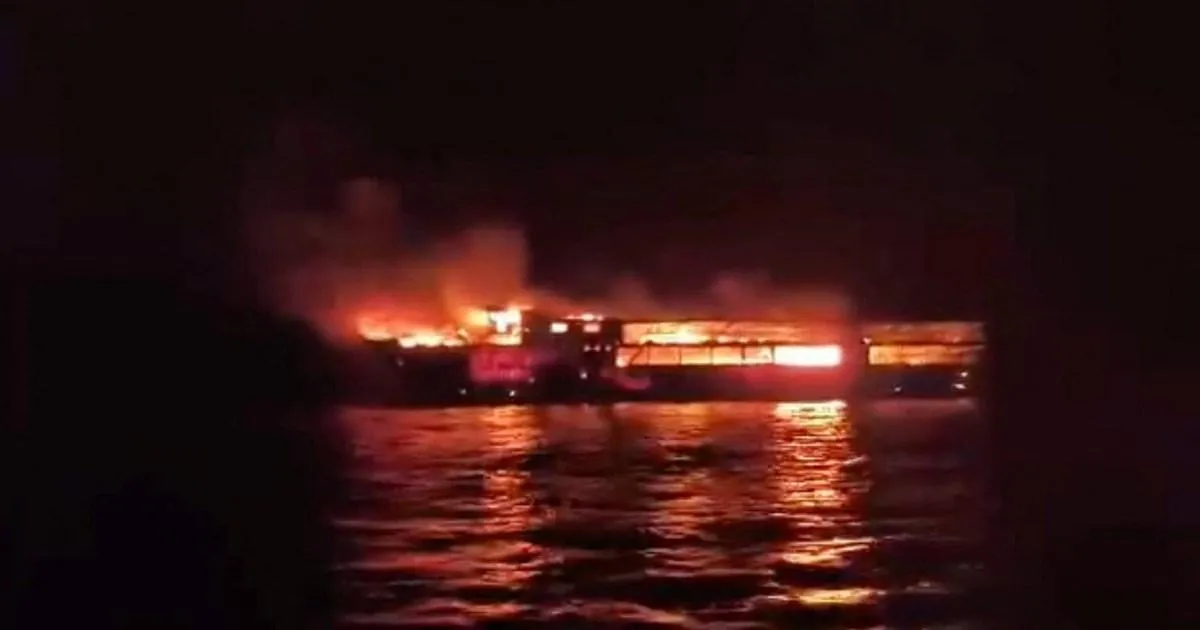
In the darkness off the Philippine coast, a scene that should have been nothing more than a routine overnight journey turned into one of the most terrifying maritime ordeals the country has seen in recent memory. The MV June Aster, a ferry that had set sail from Manila earlier in the day, was making its way toward Coron in Palawan province, a celebrated tourist destination whose turquoise lagoons, towering cliffs, and shipwreck-strewn waters draw visitors from every corner of the globe. The vessel was carrying 134 passengers and crew when the first sign of trouble emerged at around 6.45pm local time, just as the sun was dropping below the horizon and the sky was turning from orange to black. The ferry was only 1.3 miles offshore, close enough that people on land could see the first plume of smoke and the glow of flames through their windows, but far enough that jumping into the water felt like a leap into the unknown. Within minutes, the fire had consumed large sections of the ship. Thick black smoke poured out of the hull, and panicked passengers scrambled for life jackets and escape routes. Many did not find them. By the time the coast guard and local fishing boats reached the scene, the MV June Aster was engulfed from bow to stern, a blazing hulk floating in the night sea. At least five people were confirmed dead, and 87 were unaccounted for. The 43 survivors who were pulled from the water had escaped by jumping overboard, clinging to debris, or being rescued by boats that raced toward the flames while others moved away. For the people who watched from the coast, it must have been unbearable to see the burning ferry and know that loved ones were trapped aboard. That sight, the sound of distant cries, the smell of smoke carried on the wind, would be seared into the memory of everyone who witnessed it. The scale of the disaster was slow to sink in. At first, there were only rumours. Then came the first rescue boats. Each arrival brought survivors and a fresh wave of anguish, because every empty seat on those boats meant another family somewhere was waiting in vain. What had begun as a hopeful journey to one of the Philippines’ most beautiful places had become a nightmare, and the beautiful shoreline that promised paradise now looked like a distant, unreachable dream. The MV June Aster was not a large cruise ship; it was a working ferry, the kind of vessel that millions of Filipinos rely on every day, which made the tragedy all the more devastating.
Video footage captured during the disaster showed the ferry fully ablaze, its decks collapsing and its hull listing slightly, while rescue teams searched the water around it. The ship had left the Philippine capital earlier in the day and was already deep into its voyage, making the timing of the fire particularly cruel. The alarm was raised at 6.45pm, but by then the flames had already taken hold. Survivors later recalled hearing a sudden crackling sound from below deck, followed by the rapid spread of smoke and heat. The coast guard said the fire may have started in the cargo hold, where the ferry carried vehicles, fuel, and the belongings of passengers, and then moved upward through the passenger areas. Some people managed to reach the upper decks, where they waved flashlights and screamed for help. Others jumped into the sea, not because they wanted to leave the ship but because staying on it meant certain death. The water was dark and rough, and many of the passengers were not wearing life vests. Local fishermen were among the first to respond, pulling people from the water with nets and ropes. The coast guard brought 43 survivors to shore near Coron, including two Chilean nationals. The rescued were taken to a nearby area where they received emergency treatment. Many were shivering, crying, or simply staring blankly ahead, their minds overloaded by what they had just lived through. The search continued as night fell, with rescuers using powerful searchlights and aircraft flying low over the water, hoping to find more survivors among the scattered debris. But as the hours passed, the chances of finding more survivors began to fade, though no one was willing to say so out loud. The ferry itself remained partially afloat, a burning wreck that stood as a stark reminder of how quickly things had gone wrong. For those who were still missing, the sea had become a cruel, uncertain refuge, and every moment of silence from the rescue teams deepened the anxiety felt by the families waiting on land. The rescue boats moved slowly through the debris field, crews calling out into the darkness and listening for any sound that might lead them to someone alive.
Investigators were still working to determine the exact cause of the fire, but the most likely origin, according to initial survivor accounts, was the cargo hold. The coast guard’s spokeswoman, Commodore Noemi Cayabyab, described the difficulty of gathering information from people who had just lived through such an ordeal. “We have tried to get stories from the survivors but they are still in shock,” she said. Those words carried the weight of the disaster. The survivors who were able to speak gave disjointed accounts: a sudden crackling sound, a wall of heat, bodies pushing through smoke-filled corridors, the splash of people hitting the water. Some passengers were not wearing life vests, Cayabyab noted, a small detail that would become a major focus of the investigation. How could a ferry operating in Philippine waters, in the 21st century, not have every passenger prepared for an emergency? Were there enough life jackets? Were they stored in accessible places? Was the crew trained to guide passengers to the life rafts? These questions now hung over the wreck. The official response had been rapid, with coast guard, police, military and civilian volunteers all taking part in the rescue effort. But the outcome was still devastating, and the investigation was expected to take weeks, if not months. The families of the missing demanded answers, and the survivors wanted to understand why a routine ferry trip had turned into a death trap. The burned-out hulk of the MV June Aster, still visible from the shoreline, became the centerpiece of that search for truth. It was no longer a ferry; it was a crime scene, an accident site, and a memorial, all at once. In the coming days, investigators would interview every survivor, examine the wreckage, and review the ferry’s maintenance records and safety certificates. They would also look into the weather conditions, the cargo manifest, and any previous incidents that might have involved the vessel. None of that, however, would bring back the dead. For the people who lost someone on board, the pain would not be eased by explanations. The only thing that could offer any measure of peace was knowing that their loved ones did not die in vain, and that the lessons from this tragedy would be strong enough to bring about real change.
The Philippines is a nation of islands, more than 7,600 of them, stretching across the western Pacific like scattered jewels. For the people who live there, the sea is not a distant attraction but a working road, a source of food, a connection to relatives and a pathway to opportunity. Ferries are the workhorses of this vast archipelago, carrying millions of passengers every year between Manila, the provinces, and the tourist resorts that dot the coastline. But this reliance on sea travel has also made the country vulnerable to tragedy. Accidents on ferries are not uncommon, and the list of deadly incidents is a painful reminder of what happens when safety is neglected. In January, 65 people died when a vessel carrying 293 passengers and crew sank near Baluk-baluk island in the southern Philippines, one of the worst maritime disasters in the country in years. Earlier still, in March 2023, the MV Lady Mary Joy 3 caught fire while travelling from Jolo to Zamboanga City, killing 33 people and injuring many others. Each tragedy followed the same pattern: overcrowding, inadequate safety equipment, a slow response, or a fire that spread faster than anyone could control. The MV June Aster disaster now joins this grim catalogue. It is tempting to see these events as isolated accidents, but the truth is that they reflect deeper problems in the country’s maritime industry. Aging vessels, budget pressures, poor maintenance and weak regulation all play a role. Every time a ferry leaves port, it carries not just passengers but also the collective responsibility of an entire industry. And every time a fire breaks out, that responsibility is put to the test. Too often, the test is failed. The geography of the Philippines means that banning ferry travel is not an option; too many communities depend on it, and too many people have no alternative. The only answer is to make the existing system safer. That requires investment, training and enforcement, all of which have been promised many times in the past. But promises alone do not float ships or fight fires. They do not hand out life jackets or prepare crews for the moment when panic breaks out. The government must move beyond words and commit to reforms that will protect every passenger, from the wealthiest tourist to the poorest farmer returning home.
Behind every number in the news reports is a human story, and the MV June Aster was full of them. It is impossible not to imagine the lives that were interrupted: tourists who had saved up for months to see Coron’s famous lagoons; mothers and fathers heading home to children who were waiting for them; young people setting out on their own for the first time. Each of them boarded the ferry with a different story, but when the fire broke out, all of those stories were suddenly forced into the same desperate struggle. By the time survivors reached the shore, they were not the same people who had boarded the ferry hours earlier. Their clothes were soaked and torn, their faces were streaked with soot, and their eyes carried a mixture of relief and terror. Some collapsed into the arms of relatives who had been waiting at the port, while others sat alone, unable to speak. The rescue workers, too, were changed by what they had witnessed. They had pulled people from the water, but they had also seen bodies that would never make it home. Local fishermen who had joined the rescue acted on instinct, because in a country like the Philippines, the sea connects everyone, and a person in trouble is a person in trouble, no matter who they are. Their boats had returned to shore time and again, their decks wet with seawater and carrying the exhausted survivors of the fire. But for every boatload of survivors, there were families who saw no familiar face. The waiting went on. Photographs were shown to officials and volunteers. Phone numbers were exchanged. Prayers were whispered. The night was long, and the darkness of the sea seemed to reflect the uncertainty that gripped the hearts of those who did not know if they would ever see their loved ones again. As the hours dragged into the next day, the initial shock began to give way to grief. News anchors read the names of the missing, and the numbers on screen seemed to move too slowly for some and too quickly for others. The survivors who found their relatives felt a joy that was almost unbearable, followed by guilt for their own relief. Those who did not feel only the echoing silence that comes when a phone goes unanswered. The human cost of the disaster cannot be measured in statistics alone. It is measured in empty chairs at dinner tables, in unopened gifts carried from the capital, in holiday plans that will never be made, and in the faces of children who are waiting for parents that will not be coming home.
The search for survivors continued through the night and into the following morning, with coast guard vessels, military aircraft, and volunteer boats sweeping the waters around the wreck. The chance of finding more people alive grew slimmer with every hour, but the rescuers refused to give up. The confirmed death toll of at least five was expected to rise, and the ash-strewn wreckage of the ferry was still smoking in the distance, a bitter reminder of the violence of the fire. In Coron, the port town that usually greets travellers with warmth and welcome, the mood was heavy with sorrow. International authorities, including the UK Foreign Office, were reported to be in contact with Philippine officials over concerns for foreign nationals, as the news of the disaster rippled across the globe. But for the families of the missing, the most important work was happening out at sea, in the quiet determination of the rescuers. As the sun climbed higher, the search expanded along the shoreline and into the open water, but the ominous emptiness of the waves told its own story. The MV June Aster disaster had moved into a new and painful phase: no longer a rescue operation filled with adrenaline, but a recovery mission marked by grief. Even as that reality sank in, the call for accountability grew louder. How many more times would the Philippines watch its ferries burn or sink? How many more families would have to bury the people they sent off with love and goodbyes? The country cannot continue to accept these tragedies as though they were inevitable. Every ferry must be safe. Every life jacket must be accessible. Every crew member must be trained for an emergency. Every regulatory body must do its job. The sea is not the enemy; complacency and neglect are. The victims of the MV June Aster deserve more than tears. They deserve change, and the nation owes it to them, not just in words but in concrete, unbreakable action. Until then, every ferry that leaves the port will carry the memory of this fire, and the hope that it will not happen again. Their names may never become famous, but they will be remembered by the people who loved them, and their deaths must never be forgotten.