


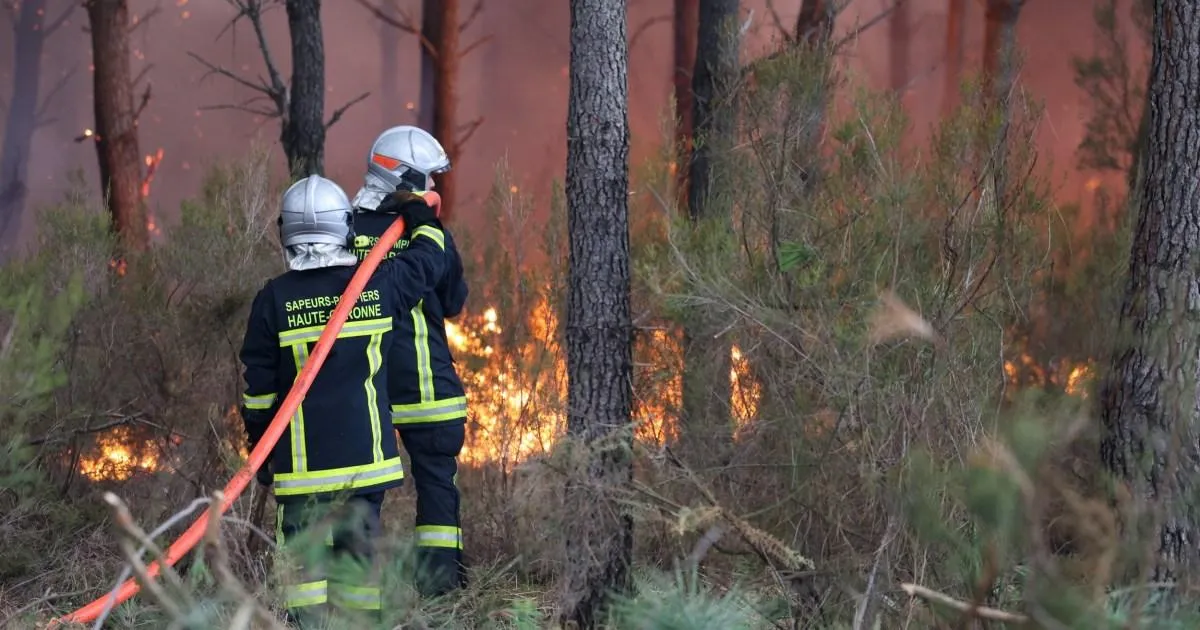
The atmosphere across southwestern France has turned hauntingly somber as a massive, relentless wildfire inches closer to the historic city of Bordeaux. Currently situated just nine miles from the city limits, the blaze is being pushed by erratic, punishing winds and blistering temperatures that have left the region in a state of high alert. President Emmanuel Macron has convened an emergency cabinet meeting to address the crisis, designating the next 24 hours as a make-or-break window for containment efforts. While no immediate evacuation order has been issued for those inside the city, the unpredictability of the flames has kept both officials and residents on edge.
The sheer scale of the disaster has pushed emergency responders to their absolute limits, with veteran firefighters describing the confrontation as a “David-versus-Goliath” struggle. The fire has become so intense that it has generated its own volatile weather system, including a rare “pyrocumulonimbus” thunderstorm that creates localized lightning strikes and shifting wind currents. These conditions make the fire front nearly impossible to fight head-on. Local spokespeople have noted that the blaze is constantly morphing, forcing teams to adopt defensive strategies rather than offensive ones, as 42,000 hectares of land have already been reduced to ash in what is being recorded as one of France’s most devastating fire events since the Second World War.
The human cost of this catastrophe continues to climb, with over 220,000 people across southwestern France forced to abandon their homes. This tragedy is not limited by borders, as Spain is simultaneously grappling with its own series of massive blazes near Valencia, Madrid, and Ávila. In total, more than 330,000 lives have been disrupted across the two nations. For those caught in the path of the destruction, the experience has been described as “apocalyptic,” with vacationers and long-time residents alike watching as the sky turns a suffocating, burnt hue and ash descends like snow upon their communities.
Despite the widespread chaos, French officials are striking a delicate balance between public safety and economic stability. Government representatives like Éléonore Caroit have encouraged tourists to maintain their travel plans, emphasizing that the majority of the country remains untouched by the flames. The request is an attempt to sustain the tourism industry, which remains vital to the regional economy. However, this message is balanced with the heavy reality that the current situation is significantly worse than the record-breaking fires of 2022. Officials are urging visitors to stay highly informed and to strictly follow local guidance, as the situation remains fluid and potentially dangerous.
On the ground in Bordeaux, the reality is far more visceral than the headlines suggest. Local business owners report that the city is currently blanketed in a thick layer of smoke and ash, stifling daily life and forcing many residents to wear masks simply to move through the streets. For those who chose to stay, the prevailing sentiment is one of deep anxiety, prioritizing the safety of loved ones and the valiant emergency services working around the clock. Even in the city center, which remains physically distant from the active flames, the proximity of the inferno serves as a constant, suffocating reminder of the environmental power looming just beyond the perimeter.
Ultimately, the plight of those in Bordeaux and across the wider region serves as a stark reminder of the escalating risks posed by climate conditions. International leaders, including British Foreign Secretary Ed Miliband, have expressed solidarity, maintaining close communication with their European counterparts to monitor the situation. As the fire continues to burn with an “unstoppable” momentum, the focus remains firmly on the exhausting, perilous efforts of the crews on the frontline. For now, the people affected are left to wait, watch the horizon, and hope that the critical hours ahead provide the glimmer of relief needed to prevent a historic city from being consumed by the flames.