



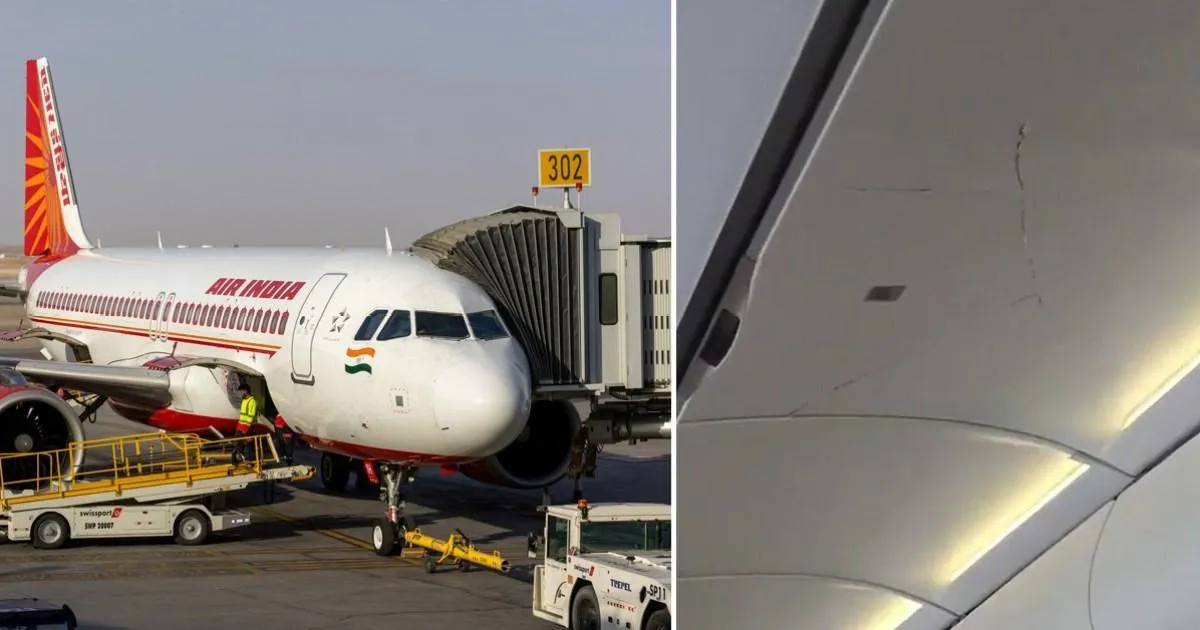
The skies over the Bay of Bengal turned from a routine flight into a nightmare for those aboard Air India flight AI2379 earlier today. The Airbus A320, carrying 137 passengers and eight crew members, was roughly 90 minutes into its journey from the tropical paradise of Phuket, Thailand, when it was suddenly seized by violent turbulence. Without warning, the aircraft plummeted nearly 300 feet, transforming a peaceful cruise into a scene of chaos and terror. The force of the drop was so intense that it left physical scars on the plane itself, with footage later revealing a significant crack running through the interior ceiling of the cabin.
For the passengers, most of whom were dozing or relaxing mid-flight, the experience was jarring and deeply traumatic. One traveler described the moment the plane suddenly tilted, noting that the cabin quickly descended into a state of panic. Many passengers—including young children—suffered head injuries as the aircraft jolted downward. One man recounted the harrowing ordeal, explaining that he sustained a painful injury to his lower back, while his brother suffered a shoulder injury and, most distressingly, a burst eardrum. It was a stark reminder of how quickly the mundane nature of air travel can shift into a life-altering emergency.
When the flight finally touched down at Delhi’s Indira Gandhi International Airport at 11:07 a.m., the gravity of the situation became clear. Instead of the usual hurried exit of travelers eager to start their day, the scene was one of distress. Ambulances lined the tarmac, and paramedics were seen assisting passengers in wheelchairs, many of whom were heavily bandaged. Air India confirmed that a total of 17 people—13 passengers and four crew members—required immediate medical attention. While some were fortunate enough to be discharged after initial checks, a dozen individuals remained hospitalized, underscoring the severity of the internal impact caused by the sudden drop.
In the aftermath, Air India has moved to reassure the public while cooperating with official safety protocols. The airline issued a statement acknowledging the “momentary event” and emphasizing that the aircraft continued to operate normally for the remainder of the flight after the initial turbulence. Company representatives have been stationed at the hospitals to provide support to the injured and their families, ensuring that those affected are not left to navigate the recovery process alone. The airline has also notified relevant regulatory authorities and the aircraft manufacturer, Airbus, to launch a formal investigation into why the incident occurred with such violent force.
The incident has naturally reignited public anxieties surrounding aviation safety, particularly given the backdrop of India’s recent history with air travel. While the aviation industry operates with rigorous safety standards, the memory of past tragedies remains a sensitive topic for the country. Every incident, whether a minor mechanical issue or a terrifying bout of turbulence, serves as a high-stakes lesson for regulators. As investigators begin their work to understand the specific atmospheric conditions that led to the sudden loss of altitude, the focus for the victims remains on healing—both from the physical trauma of the impact and the psychological shock of the mid-air drop.
Ultimately, flight AI2379 stands as a somber reminder of our vulnerability when we step onto a plane. While we often view air travel as a routine, almost mechanical necessity, the sheer power of the elements can defy even the most sophisticated technology. As the 12 hospitalized individuals continue their recovery, the aviation community will undoubtedly look closely at this flight’s data to see if any preventative measures can be taken to better protect passengers against the unpredictability of the clouds. For those on board that day, the arrival in Delhi was not just the end of a flight, but a deeply felt relief after surviving an event that could have ended very differently.