


There is something quietly magical about old light fittings. They are not just brass and glass; they are bearers of atmosphere, witnesses to countless evenings, reflections of lives that were once lived beneath their glow. That is why the upcoming sale at Anderson & Garland in Newcastle has stirred so much excitement among maritime collectors and history lovers. On October 1, a remarkable collection of light fixtures salvaged from the RMS Olympic, the Titanic’s older sister, will go under the hammer. These are not ordinary antique chandeliers. They are relics from an age when ocean liners were floating palaces, when the White Star Line competed not just on speed but on splendour, and when crossing the Atlantic was a journey of a week or more, dressed in dinner jackets and evening gowns. The first standout lot is a brass three-branch ceiling light with delicate cut-glass acorn shades, believed to have once hung in the ship’s First Class Smoking Lounge. It measures 46 centimetres wide and is expected to fetch between £5,000 and £8,000. Another lot, a pair of ormolu and cut-glass ceiling lights thought to have come from the famous Grand Staircase, carries an estimate of £5,000 to £10,000. But estimates seem almost beside the point. When it comes to White Star Line memorabilia, the past has a habit of surprising everyone. In December 2023, a matching pair of Smoking Lounge lights sold for £23,400. In 2024, three lots of Olympic fittings made more than £72,000, including a pair identical in design to the Grand Staircase lights now being offered. There is a reason for this enthusiasm. These fixtures are not just pretty objects; they are survivors. They made it through decades of changing tastes, through wars, through the scrapyard, through all the careless ways we discard the past. And now they are here, ready to begin a new chapter in someone’s home, casting their light once again. To hold one of these pieces is to hold a small, glowing door into a vanished world.
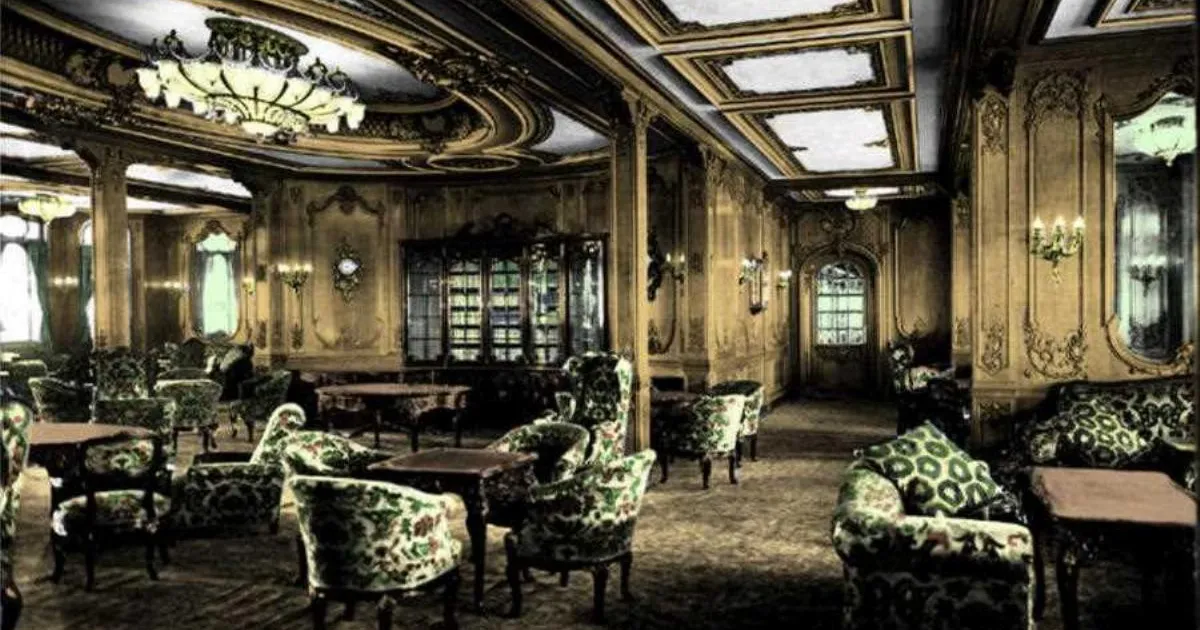
Think for a moment about the Smoking Lounge where the first of these lights once shone. This was a room reserved for the most privileged passengers aboard the Olympic, a place of leather chairs, polished wood, cigar smoke curling toward the ceiling, and low conversations that might touch on business, politics, romance, or the simple pleasure of a voyage. The brass fitting with its cut-glass acorn shades would have cast a warm, amber glow over all of it. It was designed not merely to illuminate but to impress, to remind everyone who looked up that they were traveling in the most magnificent vessel ever built. In the Edwardian era, no detail was too small for the White Star Line. Every balustrade, every light, every pane of cut glass was chosen with care, because the company understood that luxury was not just about size; it was about the richness of the experience. The fact that this particular fixture has survived is almost miraculous. When Olympic was withdrawn from service in 1935, her interior was scattered to the winds. Panels, doors and fittings ended up in pubs, hotels, private houses and yacht clubs across Britain. But the light fittings were often overlooked, too large, too awkward, or too easily damaged to be worth saving. Many were lost to scrap, weather, or demolition. To see one now, intact, with its original shades still present, is to feel the hand of time and chance. It is easy to imagine the craftsmen who made it, working in a factory more than a century ago, unaware that the ceiling light they were assembling would still be admired by strangers in the 2020s, long after the ship that carried it had become a legend.
The second lot, the pair of ormolu and cut-glass ceiling lights from the Grand Staircase, carries a different kind of magic. The Grand Staircase was the heart of the Olympic, a sweeping architectural masterpiece that connected the upper decks of the ship and provided the setting for some of the most iconic photographs taken aboard these liners. It was a place where first-class passengers paused to feel the drama of the sea, where newly arrived travellers looked up and caught their breath, and where meals began and ended with the gentle swish of silk and the sounds of laughter. The lights that hung there were not mere fixtures; they were jewels suspended in a dream of wood and wrought iron. The pair now up for auction has spent the last three decades in storage, removed from a house in Northumberland where they had been installed after the ship was demolished. For thirty years, they waited in darkness, preserved by chance, probably forgotten by all but a few. Now they are being offered to the public, and their story is finally emerging. It is remarkable to think that these particular lights may have been seen by some of the most famous people of the early twentieth century, or at least by people who were themselves famous in their own worlds. They might have shone above the heads of returning war veterans, or of honeymooners, or of elderly passengers taking what would be their last Atlantic crossing. The stairs themselves are gone, of course. The ship is gone. But the lights remain, still elegant, still delicate, still ready to make a room feel like the deck of a liner cutting through a starlit sea. That is why provenance matters. It is not just about authenticity; it is about the feeling that you are touching a thread in a larger story, one that connects you to a past so grand it feels almost impossible.
The RMS Olympic herself deserves a little of the spotlight, because her story is often overshadowed by the tragedy of her younger sister. She was the lead ship of the White Star Line’s Olympic-class trio, launched in 1910 and entering service in 1911. Titanic and Britannic followed, and both would meet premature ends: Titanic on her maiden voyage in 1912, Britannic in 1916, sunk by a mine while serving as a hospital ship. But Olympic was different. She was the one who survived, the one who carried passengers for twenty-four years, from 1911 to 1935, crossing the Atlantic again and again with remarkable reliability. During the First World War she served as a troopship, transporting soldiers to battlefields and bringing the wounded home, earning the nickname “Old Reliable” from the men who trusted her with their lives. There is something deeply human in that nickname, a reminder that ships, like people, can be judged by their endurance as much as by their glamour. Olympic had no short, dramatic blaze of glory; she had a long, steady, working life. She weathered collisions, submarines, war, and an ever-changing world. She carried the rich and famous, but she also carried ordinary people seeking new lives in America. She was a floating city, and her lights were part of the daily existence of thousands upon thousands of passengers. It is easy to forget, when we think of the Titanic, that the Olympic-class liners were not built as memorials to tragedy. They were built as expressions of hope, ambition and human confidence. In their polished wood and cut glass, you can still feel the optimism of a time when the future seemed boundless.
After being withdrawn from transatlantic service in 1935, Olympic was sold to businessman Sir John Jarvis for £97,500, a sum that today would seem impossibly small for such a vessel. The ship was partially demolished at Jarrow, Tyneside, in a carefully planned project designed to provide work for a struggling region that had been ravaged by the Great Depression. It was a strange fate for the grandest liner of her age, to end her days in a shipbreaking yard in the northeast of England. But it was also a kind of mercy: instead of being towed abroad and scrapped in obscurity, she was used to give employment to men who desperately needed it. Her luxurious fittings were auctioned off before the ship was broken up, and many ended up in private homes and businesses, scattered across the country like seeds from a tree that had finally fallen. Some went to hotels and restaurants, where they continue to light the tables of people who may have no idea of the voyages they once made. Others were installed in the grand homes of wealthy collectors, who wanted to own a piece of maritime history. And still others were stored away, forgotten for decades, as happened with the pair of lights now on sale. It is a strange fate for an object to outlive its original world so completely. A chandelier that once hung above kings and millionaires might later hang above a pub in a mining town, or a suburban staircase, or nothing at all. But perhaps that is exactly what makes these objects so precious. They have lived long enough to become stories, and every new owner becomes part of that story.
In the end, the auction of these light fittings is not really about money, even though the prices may be impressive. It is about memory and the strange human desire to hold on to the past in physical form. We cannot step aboard the Olympic; we cannot walk up that famous Grand Staircase or sit in the Smoking Lounge and feel the ship move under our feet. We cannot hear the band playing or smell the salt air. But we can look at a light fitting and imagine all those things. We can let our minds fill in the flickering shadows, the overcast mornings at sea, the goodbye waves on a Southampton pier. Objects have a way of transcending their material form. A piece of brass and glass becomes a relic when it is connected to a legend, and the Olympic is tied to a story that includes both triumph and heartbreak. These lights have endured through war, dismantling, neglect and storage. They have waited a long time for someone to look up at them again. When the auctioneer brings down the gavel on October 1, a new chapter will begin. Someone will carry these fixtures home, hang them in a new place, switch on the light, and see a warm glow that once found its way through the dark of the Atlantic nearly a century ago. And perhaps, for just a moment, the old ship will feel alive again, remembered not as a footnote to the Titanic’s tragedy but as the survivor it truly was, a great queen of the seas whose light never faded completely.