



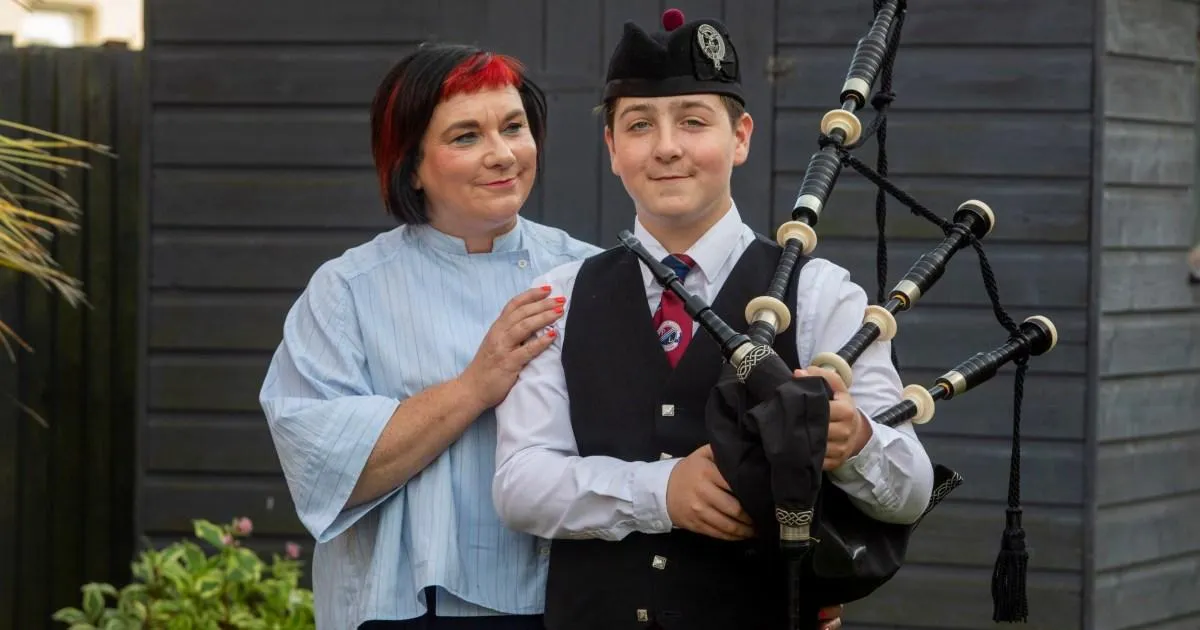
On a Saturday afternoon in Edinburgh, the air in Princes Street Gardens carried the familiar, defiant cry of bagpipes. The sound came from a twelve-year-old boy named Elliot Wilson, who had found a quiet corner near the park’s winding paths, hoping to earn a few pounds for new piping equipment. Elliot had been playing the bagpipes for three years, and busking was his way of turning practice into purpose, sharing music with strangers while saving up for something he loved. It was the nineteenth of September, a day that had started with the simple promise of a peaceful performance. Families strolled past, tourists paused to take photos, and the gentle hum of the city surrounded him. His mother, Lynsey Wilson, sat nearby, keeping a watchful eye and enjoying the sound of her son’s pipes drifting through the gardens. But then, without warning, the atmosphere changed. A large group of young people appeared at the edge of the gardens, moving quickly and deliberately. They were dressed entirely in black, and every single one of them seemed to be holding a phone or a camera. They were livestreaming, feeding the moment to an online audience, and they were heading straight toward Elliot. Before Lynsey could fully understand what was happening, the group had swarmed around her son, surrounding him in a tight, intimidating circle. She tried to push closer, but the crowd was too dense, and she found herself shoved to the outskirts, unable to see what was happening to her boy. All she could hear were the bagpipes, and the loud, chaotic voices of strangers demanding that Elliot play for them. Her heart pounded. She knew Elliot was terrified, and she was terrified too.
The group was led by a well-known livestreamer, a TikTok and YouTube influencer called J2hundred, whose followers had gathered around him that day to be part of his broadcast. They had cameras in Elliot’s face, pressing in close, shouting over one another, their black clothing making them feel like a single menacing mass. Elliot stood at the centre, small and alone, clutching his beloved pipes. They ordered him to play. They wanted a show, a moment of content, and they did not care that he was only a child. Elliot, frozen but brave, lifted his instrument and began to play. He chose “Scotland the Brave,” a tune he knew by heart, and he played it one time through, his fingers moving even as his mind raced with fear. Then he stopped. The crowd lingered, still filming, still shouting. And in the chaos, one of the people in the group sprayed a black liquid over him, drenching his kilt and saturating his bagpipe case. The liquid soaked into the fabric and the leather, ruining both. Elliot did not even see it happen—he was too focused on playing, and everything moved too fast. By the time the group finally drifted away, the damage was done. Lynsey rushed to her son, her relief mixed with shock. He was physically unharmed, but the terror in his eyes was unmistakable. She later said, “I was just relieved when they went away, and Elliot was okay.” But the moment stayed with them, and the video of it had already been streamed live to thousands of people. The family could not put the pipes back in the case because the liquid had completely saturated it. The kilt would need professional cleaning. And the memory of being surrounded by a black-clad mob would not be so easily washed away.
When Lynsey later watched the footage, she felt a deep mixture of anger, sadness, and disbelief. The video showed her son, small and surrounded, playing his pipes under pressure while a group of strangers filmed his discomfort. It was posted on TikTok and quickly spread, triggering a wave of outrage across the internet. People who saw the clip were horrified that a child could be treated that way simply for playing music in a public park. The harassment had been filmed and streamed for entertainment, and that made it even more painful. But alongside the anger came something unexpected: an outpouring of sympathy and support. Messages flooded in from across the country and beyond, from people who had never met Elliot but who felt a sudden, fierce protectiveness over him. Some of the young people who had been part of the group even reached out to apologise, a small but meaningful step toward accountability. The family, still shaken, began to realise that the cruelty of a few would be outweighed by the kindness of many. Lynsey said that the support had been overwhelming, and that some people had even offered to go busking with Elliot when he returned to the streets, standing beside him in solidarity. It was a reminder that for every person who tries to tear someone down, there are countless others ready to build them back up. The incident had been intended to humiliate a young musician, but instead it had awakened a community’s compassion. Lynsey, watching her son process everything, felt a strange pride amid the pain. Elliot was not broken by the experience. He was determined to move forward, and he was already thinking about how to turn the negative into something positive.
Determined not to let the incident define him, Elliot decided to channel his energy into action. With his family’s help, he launched a fundraiser. The initial goal was simple: replace his ruined bagpipe case and pay for the dry cleaning of his kilt. But the response was extraordinary. Within days, donations had exceeded sixteen thousand pounds, far more than the family ever imagined. In a post on his Facebook page, Elliot explained exactly what had happened. He named J2hundred and the people who had been following him during the livestream, describing how he had been surrounded at very close proximity while playing and repeatedly asked to perform. He wrote that one of the people following the influencer had sprayed liquid over him and his pipe case, ruining the case and forcing the kilt to be dry-cleaned. The family were overwhelmed by the generosity of strangers who wanted to help a twelve-year-old bagpiper they had never met. But rather than keep the extra money for himself, Elliot chose to donate the remainder to his school pipe band. The donation would help fund travel and equipment for competitions, turning a personal attack into a benefit for the musical community he loved. It was a decision that spoke volumes about his character. He could have used the money to buy new gear, to save for the future, or to treat himself after a traumatic ordeal. Instead, he thought of his bandmates, of the shared love of music, and of the many other young pipers who would now have a better chance to compete and perform. In the midst of everything, Elliot had chosen generosity over grievance, and that choice resonated with everyone who followed his story.
The support did not stop at donations. People who had never met Elliot offered to go busking with him when he returned to the streets, standing beside him in quiet solidarity so that he would never have to face a crowd alone again. His Facebook and Instagram pages, under the name “Elliot the Bagpiper,” filled with messages of encouragement from people around the world. Musicians sent their respect. Parents shared stories of their own children being bullied. Older pipers offered advice and friendship. Lynsey watched her son absorb it all, and she felt an overwhelming sense of pride. “Elliot is resilient—he’s been very mature about the whole thing,” she said. “He’s got a Facebook page and an Instagram page, and the outpouring of support that he’s seen on there has made him feel so much better. I’m so proud of him. He’s handled this so maturely and turned a negative into a positive. It just shows that bullies like that don’t always win.” For a twelve-year-old, Elliot has shown a wisdom beyond his years. He did not respond with anger or bitterness. He did not let fear keep him from his music. Instead, he let the support lift him, and he allowed the experience to teach him something important about the world: that cruelty is loud, but kindness is louder. The young people who had surrounded him may have thought they were taking something from him that day, but in truth, they gave him something far greater—a demonstration of how many people cared about him, and how quickly a community could rally around a boy and his bagpipes.
Elliot’s story is not just about a bagpiper who was attacked; it is about a community that refused to let cruelty have the final word. In the days since the incident, the image of a young boy standing alone with his pipes, surrounded by a black-clad crowd, has been replaced by images of solidarity, generosity, and hope. The money raised will repair what was damaged, but the deeper repair is emotional. Elliot knows now that he is not alone. When he picks up his pipes again, he will carry with him not the memory of the mob, but the memory of the kindness that followed. His kilt will be clean, his case will be new, and his heart, though tested, will remain open. The school pipe band will benefit from the generosity of strangers, and Elliot will continue to play the music he loves, in the city he loves, on streets where he is known not as a victim, but as the boy who turned a terrible moment into a lesson in resilience. The sound of bagpipes has always been one of defiance—a sound that refuses to be silenced. Elliot Wilson’s pipes were nearly silenced that afternoon, but instead they have never rung louder. The harassment, the livestream, the black liquid—all of it will fade into memory. What will remain is the roar of support, the warmth of a community, and the quiet courage of a twelve-year-old who chose to keep playing. Bullies, as his mother said, don’t always win. Sometimes they are drowned out by the music. And sometimes, that music is played by a boy with a second-hand case, a clean kilt, and a future full of possibilities.