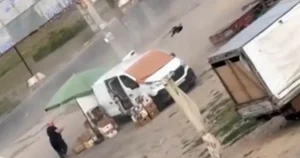

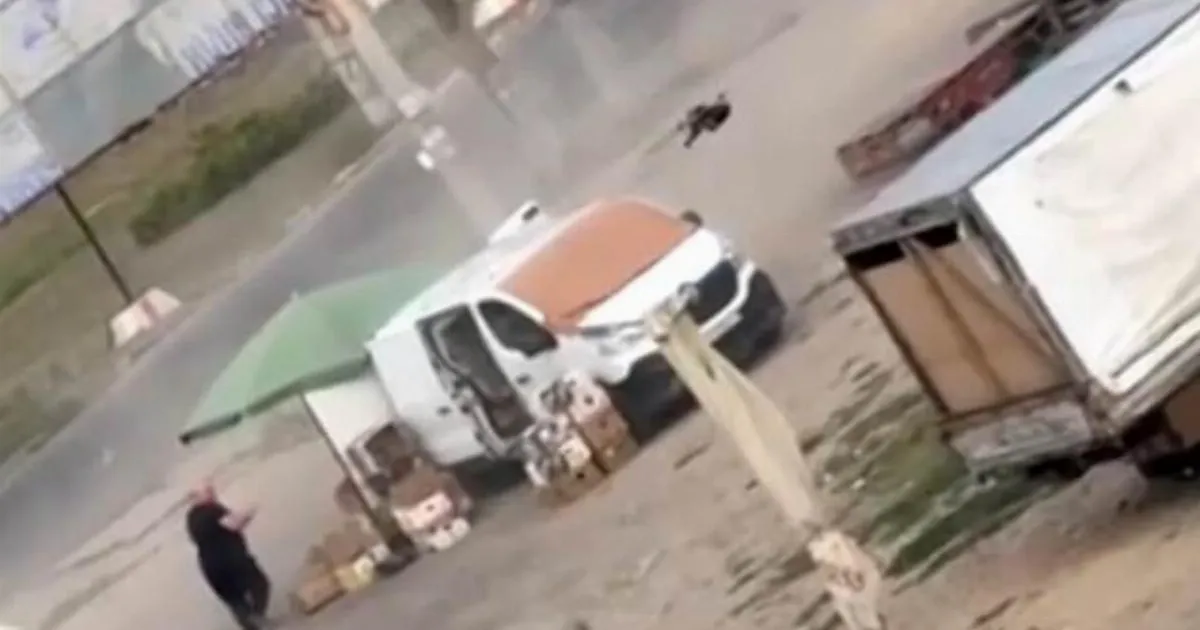
The war in Ukraine has evolved into a landscape of unimaginable cruelty, where the front lines are no longer confined to trenches or military installations, but have bled into the daily lives of innocent people. Recently, footage emerged from the Tsentralnyi market in Kherson that serves as a harrowing reminder of this reality. At 6:30 a.m., a 52-year-old fruit seller was simply beginning his day, setting up his modest stall to earn a living. The normalcy of his morning was shattered when he heard the ominous buzz of a Russian drone circling overhead, transforming a routine task into a desperate, frantic struggle for survival.
The footage of the event is deeply disturbing, capturing a scene of systematic terror that has been likened to the dark days of the Bosnian civil war. As the drone stalked him, the man ran in desperate circles around his delivery van, his movements heavy with the exhaustion of a civilian forced into an uneven game of cat and mouse. He was not a soldier; he was a greengrocer. Yet, the drone operator pursued him with chilling precision, eventually diving in to detonate the payload at point-blank range. Against all odds, the man survived the blast, though he was left bloodied and concussed, a testament to the raw brutality of the attack.
Ukrainian President Volodymyr Zelensky took to social media to ensure the world bore witness to the horror, labeling the incident a “drone safari.” It is a term that captures the sickening reality of the footage: the deliberate hunting of a human being for the sake of violence. Zelensky noted with dismay that Russian sources have not only failed to show remorse but have at times openly boasted about these acts of torment. For the people of Kherson, this is not an isolated incident; it is a daily, suffocating reality where ordinary life is constantly punctuated by the threat of being targeted by those who seem to find pleasure in their suffering.
The reaction from the Ukrainian government has been one of urgent, desperate advocacy for global intervention. Officials have emphasized that this was not a military strike—there were no strategic targets or weapons at the market. It was an attack on a civilian at work, a calculated effort to erode the fabric of society through terror. By circulating this evidence, Kyiv is demanding that the international community move past the numbness of war-fatigue and recognize that failing to act is effectively granting permission for these atrocities to continue. They argue that without increased pressure and robust security guarantees, the world remains complicit in a conflict where life has been rendered cheap.
This specific act of violence sits within a broader, escalating cycle of drone warfare that is increasingly targeting non-combatants on both sides of the border. While the international community watches these civilian-targeted attacks in Kherson, news also breaks of similar tragedies in Russian regions, such as the drone strike on a crowded Black Sea resort that left vacationers fleeing in terror. As both nations continue to trade accusations of targeting civilians, the reality on the ground remains the same: it is the ordinary people—the sunbathers in Krasnodar or the fruit sellers in Kherson—who bear the ultimate cost of this geopolitical standoff.
Ultimately, the image of the bloodied vendor sitting amidst his produce serves as a sobering indictment of a conflict that has lost its moral compass. Whether it is a warehouse hit near St. Petersburg or a marketplace destroyed in the Dniprovskyi district, the human toll is becoming impossible to ignore. The call to “remain resolute in defending life,” as Zelensky urged, is a plea for the world to look closer at the human cost. Unless the international community can find a way to compel a transition from the relentless expansion of weaponized drones to a path of genuine diplomacy, the “safaris” will continue, and the innocence of daily life in these regions will continue to be extinguished.