

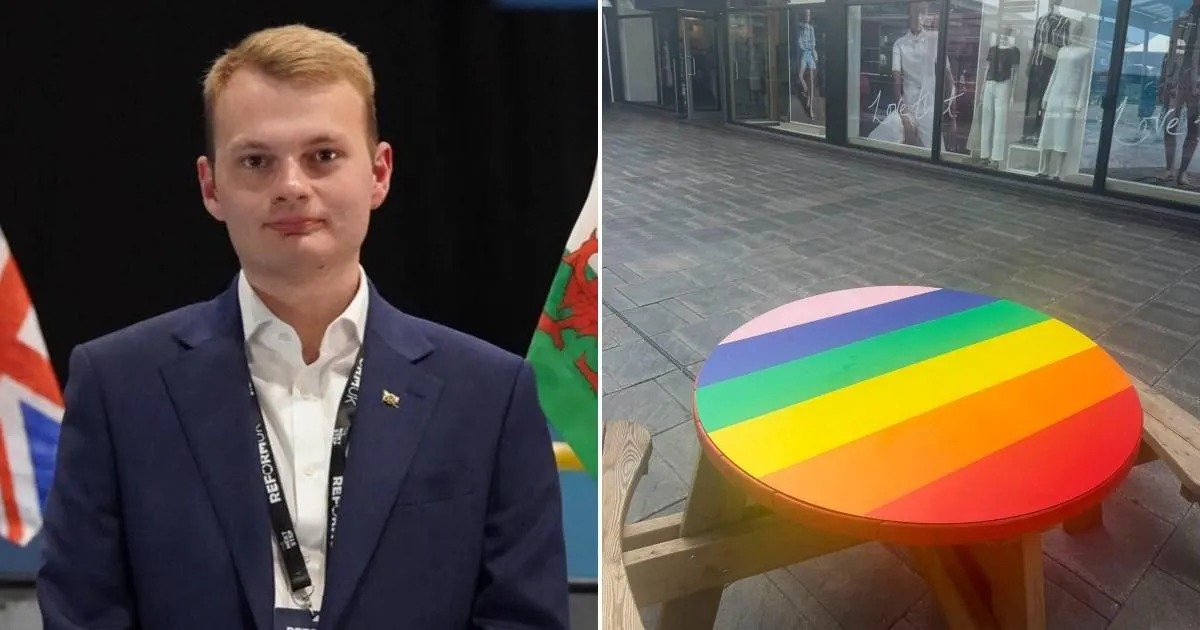
A colorful picnic bench at the McArthur Glen designer outlet in Bridgend, South Wales, has unexpectedly become the focal point of a heated cultural clash. The table, painted in the vibrant colors of the rainbow flag, was intended by its designers to be a welcoming piece of public furniture. However, for 22-year-old local councillor Owain Clatworthy, the bench represented something far more controversial. Clatworthy, a practicing Christian and a member of the Restore Britain party, took to social media to vent his frustration, posting a photograph of the bench with a caption criticizing what he described as the “latest mandatory ideology” being forced into public view.
To Clatworthy, the presence of the pride colors in a shopping center was not merely a decorative choice but an inescapable political statement. He argued that public spaces should be neutral, suggesting that the average citizen is tired of seeing their surroundings turned into “billboards” for social movements. His stance, which frames the display of pride imagery as a form of cultural imposition, quickly ignited a firestorm of criticism online. Many observers, viewing his comments as discriminatory, were swift to label him a “bigot,” arguing that a symbol of inclusivity and support for the LGBTQ+ community should not be treated as a threat to public order or personal belief.
The situation escalated when local Member of Parliament Chris Elmore intervened, turning the dispute into a broader conversation about representation and safety. Elmore did not mince words, using the incident to highlight the ongoing necessity of symbols that affirm the rights of LGBTQ+ individuals. He pointedly remarked that if providing a sense of belonging to marginalized groups is considered a “mandatory ideology,” then it is an ideology that should be welcomed. For Elmore, the bench serves as a crucial reminder that public spaces have historically been unwelcoming to queer people, and that visible signs of support are essential in a climate where hate-motivated incidents remain a global concern.
Undeterred by the backlash, Clatworthy doubled down on his position. He argued that true freedom cannot exist when specific ideologies are promoted in settings where people are simply trying to go about their daily lives. In a peculiar twist to the argument, he shared a post suggesting that the rainbow—traditionally a religious symbol in the context of his Christian faith—had been co-opted, effectively weaponizing his own theological perspective to justify his rejection of the flag’s current social meaning. This insistence on his viewpoint further polarized those following the story, drawing sharp lines between those who see the bench as a gesture of kindness and those who view it as an encroachment on their personal values.
The debate also highlights the increasingly complex political landscape of Bridgend. Clatworthy is no stranger to the spotlight, having made history as the town’s youngest-ever county councillor at the age of 20. His career has been marked by ideological transitions, moving from the Reform party—which he left following internal disputes—to his current affiliation with Restore Britain. His rapid rise and his penchant for engaging in highly charged cultural battles suggest a politician who is eager to position himself at the center of the “culture wars,” regardless of the controversy his comments generate.
Ultimately, this incident serves as a microcosm of the deeper divisions currently found in British society. It pits the desire for traditional “neutrality” in public life against the modern push for active inclusion and visibility. While the bench at McArthur Glen remains a functional piece of seating, it has been transformed by public discourse into a symbol of a much larger struggle. As the debate continues, it leaves residents and observers to wonder if there is any longer a middle ground in a society where even a coat of paint on a piece of outdoor furniture can trigger such a profound ideological divide.