



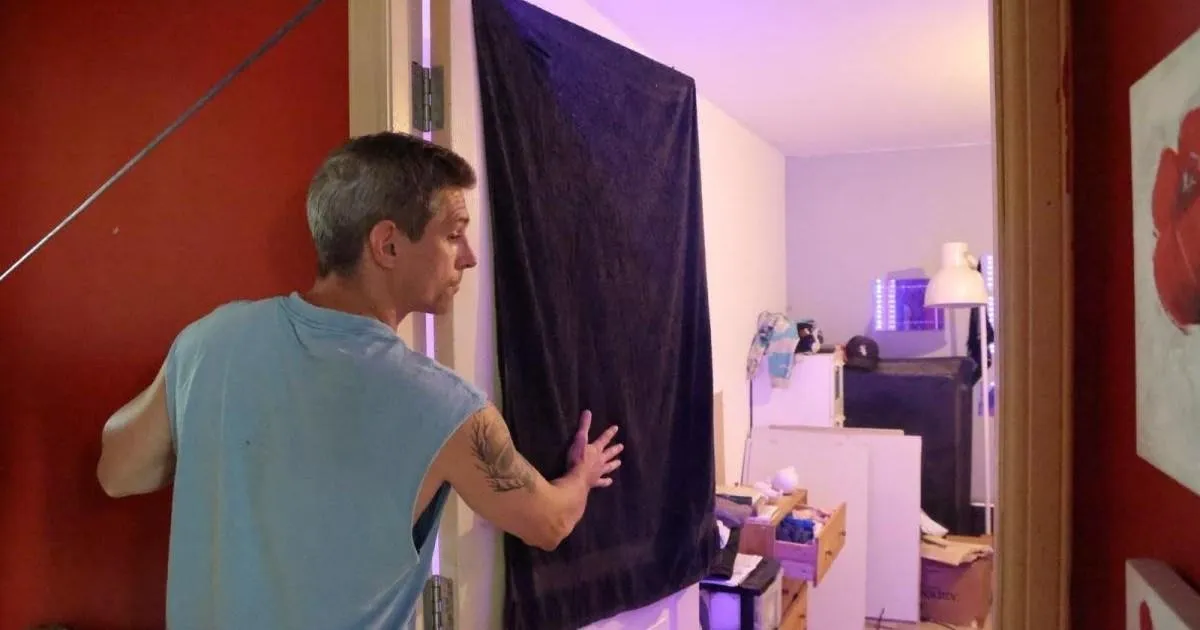
For Craig McDonald, a 38-year-old resident of Greenock, Scotland, the sanctuary of home has been transformed into a nightmarish gauntlet. What began as a simple discovery of a few insects in his bedroom has spiraled into an overwhelming infestation of thousands of wasps. These aggressive intruders have breached the structural integrity of his top-floor flat, forcing their way through cracks in the ceiling and turning his living space into a genuine health hazard. For over ten days, Craig has lived in a state of constant anxiety, unable to find rest or safety within his own four walls, ultimately forcing him to seek refuge at his mother’s home just to escape the relentless cycle of stings.
The human cost of this ordeal is heavy, but for Craig, the primary source of his distress is the safety of his two dogs and his cat. Living in a constant state of high alert, he describes the experience as “horrendous,” noting that neither he nor his beloved pets have been spared from the wasps’ painful attacks. Sleep has become an impossibility, and his physical well-being is deteriorating under the stress of the situation. The psychological toll of being driven out of one’s own home, combined with the physical agony of frequent stings, has left him feeling helpless and trapped in a situation that feels entirely out of his control.
The road to resolution has been marked by frustrating bureaucratic hurdles and questionable advice. Craig recalls that when he first reached out to his landlord, the Oak Tree Housing Association, he was met with skepticism; he was told the time of year made a wasp infestation unlikely. In a later, similarly confusing exchange, he was warned by the housing association that a noise in the loft—which he and his neighbors were concerned about—might actually be a colony of rare bats, and that he should leave the area undisturbed. This initial inaction and dismissiveness allowed the wasp population to explode, turning what might have been a minor pest control issue into a full-scale crisis.
The attempts to remediate the situation have been equally haphazard. Craig recounts a distressing encounter with a pest control contractor sent by the housing association. In a bizarre turn of events, the professional donned full protective gear while expecting Craig—who was wearing nothing more than casual trousers—to assist him in plugging gaps in the ceiling. The effort proved futile, leaving the nest intact and the wasps continuing their assault. To make matters worse, when Craig attempted to seek help from environmental health services, he was redirected back to the housing association, trapping him in a loop of administrative finger-pointing while he continued to suffer in his infested flat.
Now displaced and staying with his mother, Craig is demanding a more proactive approach from Oak Tree Housing Association. He remains firm that the current state of the property is a clear health hazard that renders it uninhabitable, and he is rightfully worried about the long-term impact on his and his pets’ health. He has made it clear that he is willing to coordinate with professionals to ensure the job is done correctly, provided the housing association takes the matter with the urgency it deserves. His primary objective is simple: he wants the nest permanently removed so he can finally stop fleeing his home and provide a safe, sting-free environment for his animals.
In response to these events, Oak Tree Housing Association has acknowledged they are aware of the situation and stated they are communicating with Mr. McDonald to resolve the matter as quickly as possible. However, they have declined to share further details, citing the private nature of the tenancy. For Craig, the official response is merely the beginning; the real test will be whether the landlord can move past the initial negligence and provide a definitive, safe solution. Until then, he remains in limbo, hoping for a return to normalcy and a resolution that finally puts an end to the agonizing siege in his own home.