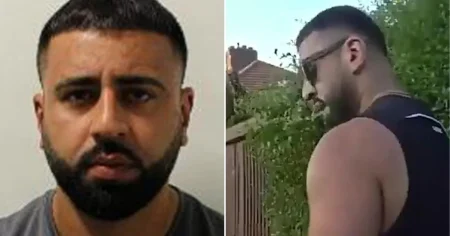

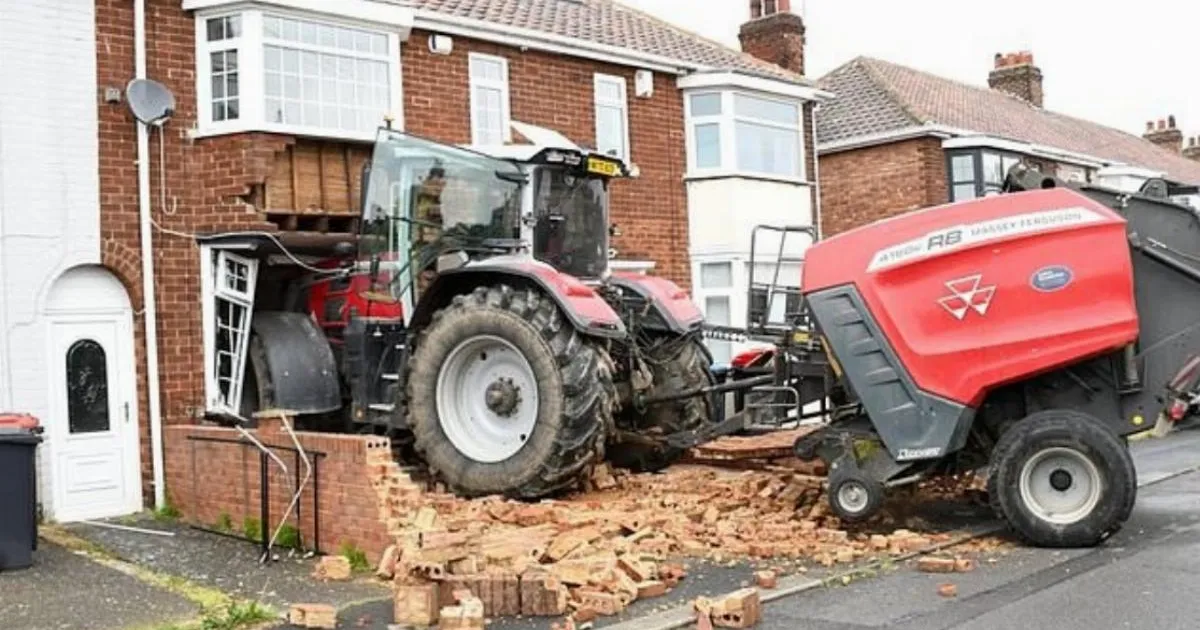
On a modest terraced street in Middlesbrough, where life is usually measured in school runs, cups of tea, and weekend DIY, a home was turned into rubble in a matter of seconds. The culprit was not a storm or a gas explosion, but a man behind the wheel of a stolen Massey Ferguson tractor, deliberately aimed at the front of a three-bedroom house. Nathan Blagg, 28, had chosen this family home as the target of his revenge, and he used agricultural machinery as a battering ram. The tractor and a hay baler, both stolen from a North Yorkshire farmer named Ian Tate, around nine miles away, were driven into the property with such force that the tractor nearly burst through the party wall into the neighbour’s home. The damage was extensive: the house essentially had to be rebuilt, the tractor needed £56,000 worth of repairs, and the £30,000 hay baler was written off. The occupants, a family who had lived there for 24 years, were not at home at the time. But Blagg did not know that. He did not know if the family were inside, and he did not know if people in the neighbouring terraces were at home either, as Detective Chief Inspector Dan Cook later made clear. This week, Blagg was jailed for seven years and two months, with a further two years on an extended licence, for a rampage born of grief, fury, and a desire to settle a score.
To make any sense of such an act, one has to go back to something deeply painful and grotesque. Blagg’s father and brother had died, and their graves had been desecrated by his adversary, Luke Lancaster. A social media video showed Lancaster urinating on the graves and kicking over a gravestone, then posting the footage for all to see. It is hard to imagine a more intimate violation: a place of mourning turned into a prop for cruel mockery, shared publicly to inflict maximum humiliation. The two men were already trapped in an ongoing feud, and the tension exploded on 21 April, when Lancaster drove his car at Blagg in Middlesbrough town centre, throwing him over the bonnet outside the Probation Service offices. Blagg told police that any violence on his part was self-defence, but the encounter did not calm him. It sharpened his rage. In the twisted calculus of revenge, Blagg and his associates decided that damaging Lancaster’s property would be a less serious response than physically harming him. His defence lawyer, Rod Hunt, articulated this strange logic to the court: “By the strange logic of the underworld, the targeting of property is less serious than, in fact, running over Mr Lancaster or treating him in the way he had been treated.” He then added the crucial reminder: “We both know the law of the land is not the same as the law of the jungle.” Gracious words, but they were not enough to stop Blagg from taking the law into his own hands.
On the day of the tractor attack in May, Blagg put that plan into action. First, he stole the Massey Ferguson tractor and the hay baler from farmer Ian Tate, who lived about nine miles from the scene. For Mr Tate, a man whose livelihood depends on his equipment, the loss was a heavy blow. “Farming is hard enough without all this,” he said, a simple sentence that captured the frustration of someone caught in the crossfire of a city feud. Blagg then drove the machinery to Priory Road and rammed it into the home. The sound of tearing brick and twisting metal must have been terrifying. The tractor nearly pushed through the party wall into the neighbouring terraced house, meaning the attack could have injured or killed innocent people on the other side of a thin brick partition. The property, already targeted in previous attacks, was empty because the family had been forced to move out of the home they had occupied for 24 years. They had already fled for safety, and yet the violence followed them, erasing the place they had known as home. The court heard that the three-bedroom house “essentially had to be rebuilt.” The tractor, a powerful and expensive machine, suffered £56,000 in damage, while the hay baler, worth £30,000, had to be written off entirely. The financial cost was huge, but the psychological cost would prove far harder to measure.
The human impact of this extraordinary act of vengeance was laid bare in the statements of the family who lost their home. A man who lived there said, “We are a hard-working family and we don’t deserve to be put through this.” The words are simple, but they carry the weight of sleepless nights, fear, and frustration. A woman who used to live in the home described a new reality of constant vigilance and secrecy. “I don’t tell anyone where I live now for fear I and my family will be violently attacked,” she said. She also faced a practical nightmare: the attack left her in limbo, uncertain whether she would ever be able to get a mortgage or home insurance again. A family home is not just bricks and mortar; it is security, memory, and the backdrop to everyday life. To have it destroyed by a stolen tractor, in an act born of a feud, is an injustice that no sentence can undo. The family had already been targeted before, which is why they were no longer living in the house. But their attempt to escape was not enough. The violence found them anyway, in the form of a wrecked house and a shattered sense of belonging. Their neighbours, too, must have been shaken. A community that once felt safe now had to live with the knowledge that a rage-fuelled man on a stolen tractor could appear on their street at any moment. The ripple effects of Blagg’s revenge extended far beyond any intended target, as such acts always do.
The legal reckoning came at Teesside Crown Court, where Blagg faced the consequences of his actions. He admitted affray in relation to the 21 April incident with Lancaster, who was himself jailed for his role that day. For the tractor attack, the court heard both the mitigating and aggravating factors. Recorder Paul Reid acknowledged that Blagg had been provoked, saying he was provoked “rightly so, by the disgusting behaviour of those who desecrated your relatives’ graves and then compounded that disgusting behaviour by posting material on social media showing this.” The judge’s words were a recognition of the emotional torment Blagg had endured. But no provocation, however vile, justifies driving a stolen tractor into a family home. Blagg was sentenced to seven years and two months in prison, with an additional two years on an extended licence, and was banned from driving for seven years. The sentence was severe, but so was the crime. And there was more. The court heard that just five days after the tractor incident, Blagg stole a Jaguar and crashed it into a lamppost. The impact sent the car spinning 180 degrees and caused serious injuries to the driver and passenger. As paramedics rushed to help, Blagg tried to drive the car away. To make matters worse, he was already disqualified from driving at the time. He admitted aggravated vehicle taking in relation to the Jaguar incident. This second act of reckless criminality painted a broader picture of a man who, when consumed by anger and poor choices, was a danger to all around him.
In the end, this is a story without winners. Blagg’s grief for his father and brother is real, and the desecration of their graves by Lancaster was a cruel, shameful act. But the response to that cruelty only multiplied the harm. A family was driven out of a home they had loved for 24 years. A farmer was left thousands of pounds out of pocket by two stolen pieces of equipment. A street was terrorised by the sound of a tractor smashing into a house. And Blagg himself, rather than finding any peace or justice, is now in prison, banned from driving, with years of his life lost. Lancaster, whose despicable actions lit the fuse, was also jailed for his part in the earlier confrontation. The law of the land, as Blagg’s own lawyer noted, is not the law of the jungle. In a jungle, the strong crush the weak, revenge is honoured, and the innocent may be trampled. In a civilised society, there are courts, laws, and processes for addressing wrongs, no matter how painful. Blagg chose the jungle, and everyone paid for it. The house on Priory Road has been rebuilt, but the family’s sense of security may never fully recover. The woman’s fear of being identified, attacked, or financially ruined will remain. The farmer’s lost equipment and income may be covered by insurance, but the sense of violation is not. And a grieving man who should have been able to mourn his family with dignity will instead spend years behind bars, a prisoner not just of the state, but of his own thirst for revenge.