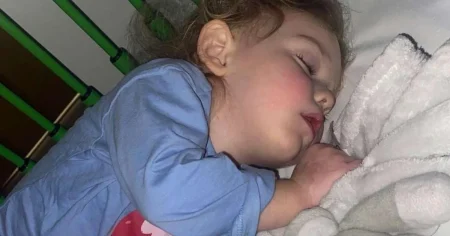

In the quiet rural village of Brantham, Suffolk, a story of devastating loss unfolded that would leave an entire community shattered and forever changed. Noah Woods was just three years old, a little boy with a bright future and a gentle spirit, when he disappeared from a playground on a seemingly ordinary Tuesday afternoon. The date was September 15, and by 3pm, Noah had been seen playing near a blue roundabout in the village play area, his laughter carried on the autumn breeze. He was with his grandfather, a day that should have been filled with simple joys and childhood adventures. But in a single, fleeting moment, the ordinary became the unthinkable. Noah slipped away, unnoticed, through a gap in the fence that bordered the playground. That gap, a tiny detail that might have gone unnoticed for years, became the focus of an inquest in Ipswich and the haunting starting point of a massive search. It is the kind of detail that keeps parents awake at night, the reminder that tragedy can find its way through the smallest openings, and that life can change in the blink of an eye. For Noah’s family, that Tuesday afternoon marked the beginning of a nightmare that would end in the worst possible way, with the discovery of his body in a lake, not far from where he had been playing. The news of his death sent shockwaves through the community, and the image of a tiny child lost in a world too big for him became a source of collective grief for people who had never met him but felt the weight of his loss deeply. In the days that followed, the fence gap was repaired, but no repair could mend the hearts of those who loved him, and the memory of that bright-eyed little boy would remain etched into the soul of Brantham forever.
Noah was not an ordinary child in every sense. He was mildly autistic and partially deaf, two traits that made his experience of the world both unique and vulnerable. For a child like Noah, the world can be a confusing and overwhelming place. Sounds are muffled, directions are unclear, and dangers that other children might recognize are not always apparent. He may not have heard the frantic calls of his grandfather or understood the urgency in the voices of the strangers who would soon search for him. On that fateful afternoon, he was playing happily near the blue roundabout, enjoying the simple pleasure of spinning and sliding, unaware that he was about to wander into the unknown. Somehow, in a way that any caregiver knows can happen in an instant, he became separated from his grandfather. Perhaps he saw something that caught his eye, a bird, a leaf, a path leading away from the noise. He found a gap in the fence, a small opening that seemed to invite him into a world beyond the safety of the playground. He slipped through it and ran, heading toward a new-build housing estate and a fishing lake known as Decoy Pond. The route took him down an alleyway, and the distance from that alley to the pond was only about 300 meters. For an adult, it is a short walk; for a three-year-old, it is a journey filled with hidden dangers. The pond itself, dark and still, offered no warning to a child who could not read the signs and did not understand the permanence of water. His family would later learn the heartbreaking details of his final moments, and the knowledge that he had left the park through that fence gap would linger in their minds, a reminder of how quickly a protected space can become a place of peril.
The search for Noah was one of the largest and most emotional efforts the region had ever seen. More than 1,300 people joined the operation, a staggering turnout that spoke to the power of community and the universal instinct to protect a child in danger. Police helicopters cut through the sky, their rotors beating a desperate rhythm as they scanned fields, woodlands, and waterways. The Coastguard deployed teams to comb the banks of rivers and ponds, while officers on foot knocked on doors and urged residents to check their gardens, sheds, and any small space where a frightened little boy might have crawled to hide. Volunteers arrived from nearby towns and villages, wearing boots and carrying torches, determined to do whatever they could to bring Noah home. They searched through the night, their flashlights creating a sea of moving lights in the darkness, their voices calling Noah’s name over and over. Doorbell footage was reviewed, social media posts were shared thousands of times, and the face of a smiling toddler became a familiar sight on phone screens across the country. The community set up a base at the village hall, where food and warm drinks were provided for the weary searchers, and where grief began to settle in as the hours ticked by without any sign of the missing boy. By the time a full day had passed, hope was beginning to fade. The reality of the situation was impossible to ignore: a small child with limited hearing, wandering in an area filled with water and wild terrain, had been alone for too long. When divers finally recovered Noah’s body from Decoy Pond, the news hit like a physical blow. The search was over, but the pain was only beginning. The volunteers who had given so much of themselves stood in silence, many of them in tears, as the realization sank in that their efforts, though heroic, had not been enough to save him.
In the midst of the overwhelming grief, Noah’s father, Rhys Woods, found the strength to speak. His words on social media were heartbreakingly simple and painfully honest: the family were “just hoping that he would be hiding somewhere obvious where someone could find him.” That sentence captured the raw, desperate hope that had sustained them through the endless hours of uncertainty. It was the hope of a parent who refuses to accept the worst, who imagines that their child is simply playing a game of hide-and-seek, waiting to be discovered. Rhys’s message resonated with parents everywhere, because it spoke to a fear that lurks in every heart: the fear of losing a child, of that moment when the world goes silent and the only thing that matters is finding them. The family had to endure not only their private anguish but also the public scrutiny of a tragedy that had captured the attention of the nation. Reporters gathered outside their home, cameras captured their every move, and strangers offered their condolences, sometimes awkwardly, sometimes with genuine warmth. A charity called Good Dads Club, which focuses on supporting fathers’ mental health, stepped in to help. They launched a fundraiser on JustGiving, and within days, more than 5,000 people had donated, raising over £80,000. The money was a practical form of support, but it was also a symbol of something deeper: an acknowledgment that dads grieve too, and that they need help and compassion just as much as anyone else. The response to the fundraiser showed that the world was watching, and that the world cared. For Rhys, knowing that so many people were thinking of his family in their darkest hour may have provided some small measure of comfort, a reminder that he was not alone in his pain.
Superintendent Pearse, the officer who had overseen the search, addressed the volunteers with a voice that cracked with emotion. His words were a tribute to Noah’s family and to the extraordinary efforts of the community. He spoke of being “overwhelmed by the outpouring of public support,” and he thanked the people who had put on their boots and joined the search, acknowledging that their dedication had meant the world to the family. It was a moment of raw humanity, a police officer allowing himself to show the grief that so many were feeling. The inquest later confirmed the tragic sequence of events: Noah had left the playground through a gap in the fence, and he had run toward the new-build housing estate and the lake where his body would eventually be found. The findings did not assign blame; they simply laid out the facts of a heartbreaking accident. But they also raised important questions about playground safety and the need for secure boundaries, especially in areas near water. The fence gap has since been closed, a small but symbolic act intended to prevent another family from experiencing the same horror. Yet for the community of Brantham, the scars run much deeper. The pond, once a place for quiet fishing and peaceful reflection, is now forever associated with the loss of a child. Flowers and teddy bears were placed at the water’s edge, and a makeshift memorial became a gathering place for those who wanted to honor Noah’s short life. The sight of those tributes, bright colors against the grey of grief, served as a reminder that even in the darkest moments, love finds a way to express itself.
Noah Woods was only three years old, but his story has touched lives far beyond the borders of his small village. It is a story about the fragility of life, the unpredictability of tragedy, and the strength of human connection. For parents of autistic children, Noah’s story is particularly haunting, a reminder of the unique challenges they face in keeping their children safe in a world that does not always understand them. For the people of Brantham, it is a memory that will never fade: the sound of helicopters overhead, the sight of volunteers walking through fields in the rain, the heartbreaking moment when the search became a recovery. But amid the sorrow, there is also a profound sense of humanity. The strangers who searched for hours without rest, the donors who gave generously from the little they had, the officers who cried openly, and the father who, in the midst of his own devastation, found the strength to thank them all. Noah’s life was short, but it mattered. His name will be remembered, not just for the way he died, but for the love that surrounded him in his final hours and the kindness that followed. The fence gap is closed now, but the gap in the hearts of those who loved him remains. May Noah rest in peace, may his family find strength in the days ahead, and may the rest of us hold our loved ones a little closer, because life is precious, and it can change in an instant.