



When Chloe Rooker first learned she was expecting a daughter in 2022, the news should have been one of the most joyful moments of her life. She had already chosen the name Daisy, a name full of softness and hope, and she imagined the future unfolding with all the ordinary milestones of motherhood. But that anticipated joy quickly turned into a fog of fear and uncertainty during her 20-week anomaly scan. The sonographer’s silence, the careful looks exchanged between medical staff, the sudden urgency of being referred to a neonatal consultant—all of it told Chloe that something was profoundly wrong. Further tests revealed that her unborn baby had ventriculomegaly, a condition in which too much fluid accumulates in the brain, alongside duplex kidneys, a structural abnormality in the urinary system. The medical professionals around her were honest, but their honesty carried a heavy weight: the likelihood of Daisy making it to full term was shrinking with every passing day, and even if she did survive, she would likely be born in significant pain. As the reality of the diagnosis settled in, Chloe found herself facing a conversation no expectant mother should ever have to contemplate. A late-term termination was raised as a possibility, and that memory still haunts her deeply. Yet even in that darkest moment, something in her refused to surrender. She asked the people in her life to stop talking to her about it, not out of denial but out of a desperate need to protect her own fragile composure. She went into what she later described as “survival mode,” feeling an extreme numbness that allowed her to keep putting one foot in front of the other. Her only goal became simple and heartbreaking: do what was best for Daisy at every stage, whatever that might mean.
For the next fifteen weeks, Chloe lived in a strange, suspended state between hope and dread. She endured bi-weekly scans and MRIs as doctors carefully monitored the fluid building in Daisy’s ventricles, trying to gauge just how severe the condition might become. Every appointment was a reminder of the fragility of the life growing inside her, and each waiting room felt like a holding cell between other people’s ordinary pregnancies and her own quiet crisis. Chloe did not cry in public. She did not want sympathy or questions. She simply wanted to keep her head above water, focusing on the next scan, the next result, the next sigh of relief or sober update. Her mind became a loop of medical jargon and maternal instinct, and she learned to function on autopilot. She later reflected that she became very external in her locus of control, feeling helpless and entirely at the mercy of whatever scan results might show. The people around her meant well, but their words felt inadequate against the enormity of what she was facing. So she withdrew, privately holding onto the small, fragile hope that her daughter might somehow prove the doctors wrong. She didn’t know it yet, but that proof was coming—in a way that was both unexpected and deeply personal. Daisy, even as an unborn baby, seemed determined to tell her mother that she was listening, that she understood, and that she had no intention of giving up without a fight.
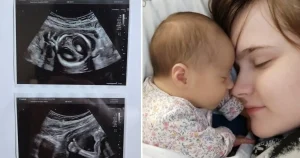
The moment of unexpected reassurance came during one of those many scans. On the way to the appointment, Chloe spoke aloud to her unborn child, her voice soft but firm with maternal conviction. “You tell them, Daisy,” she said. “You say go away, I’m fine.” It was the kind of whispered encouragement any parent might offer a frightened child, except that this child was still in the womb, unable to hear or respond in any conventional sense. But during the scan, the consultant suddenly laughed. On the ultrasound screen, unmistakably, Daisy appeared to be giving her parents a thumbs up. It was a tiny hand, perfectly formed, raised in a gesture that seemed almost impossible to interpret as coincidence. Chloe felt a swell of emotion—part shock, part wonder, part relief. “It was almost like a eureka moment,” she said, “and it did provide me comfort for some time.” In the years since, she has come to view that image as something far more meaningful than a random movement. For Chloe, it was a definite sign from Daisy that she was going to be okay, a direct answer to the words her mother had spoken just minutes before. “She basically directly quoted me, as far as an unborn child can do in someone’s womb,” Chloe marveled. That single image, frozen on a screen, became a tiny anchor of hope in the middle of a storm of medical uncertainty. It did not erase the fear, and it did not silence the doctors, but it changed something inside Chloe. It reminded her that Daisy was not just a collection of symptoms and measurements. She was a living, fighting, expressive little person who seemed to know exactly what her mother needed to see in that moment.
When Daisy was finally born, the miracle Chloe had been hoping for began to unfold in the most extraordinary way. The medical team was prepared for the worst, or at least for something far more complicated than what actually happened. Daisy had to undergo an ultrasound through her fontanelle—the soft spot on a baby’s skull—so her brain could be carefully examined. As the doctors looked at the images, they were stunned. The ventriculomegaly that had dominated every conversation, every scan, every sleepless night, had completely resolved itself. There was no fluid buildup, no apparent brain damage, no sign of the crisis that had loomed over the pregnancy. In fact, the pediatricians were so baffled that they questioned if they had scanned the right baby. Chloe recalls their amazement with a mixture of gratitude and awe. “They were expecting to be scanning a very sick baby,” she said, “and I think because of her differences in utero they were very careful to make sure her body was working properly, which I’m very, very grateful for.” For the first year of her life, Daisy was taken back to the hospital for a steady stream of tests and checkups, but they never found anything wrong. No hidden condition, no delayed development, no lingering consequence of those frightening prenatal scans. Chloe admits that she still worries every day that something might unexpectedly come up, that the uncertainty of those months has left a permanent trace in her heart. But she also looks at her daughter now—a happy, thriving three-year-old—and feels a pride so profound it surprises her. “I was deeply in love with her before she was born,” Chloe said, “and once she was born it was like she was finally by my side where she was meant to be.” The little girl who once gave her mother a thumbs up through the fog of a serious diagnosis has become the quiet proof that even the most dire predictions are not always the final word.
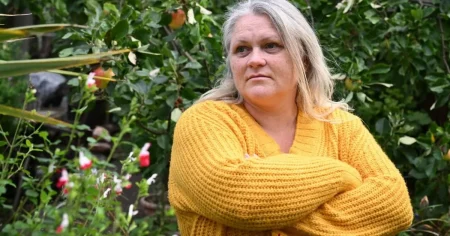
The experience has changed Chloe in ways that go far beyond the birth of her daughter. She describes herself as more resilient now, a woman who has walked through the worst kind of fear and come out the other side with her heart still intact. A psychology graduate, she has channelled that resilience into new challenges, including training for a half marathon, and she is already planning a skydive in 2027 to raise money for parents who have lost babies. It is a cause that now feels deeply personal to her, because she knows how easily her own story could have ended in that kind of grief. She has also created the @cr_share community on Instagram, a space where people can share their own stories of pregnancy and loss, and where they can feel supported both during and after the hardest moments of their lives. It grew out of her own desperate search for connection during her pregnancy. She could not find anyone going through anything similar when she was in the thick of it, and the more she talks about her experience, the more she realises how many people have a story to tell. She wants to offer other parents the comfort she never had—the sense that they are not alone, that their fears are valid, and that whatever they are feeling is part of a larger, shared human experience. She is also determined to tell her story with honesty and nuance, making clear that she is not passing judgement on anyone who has faced the impossible choice she faced. She has nothing but gratitude for the wonderful NHS, and she does not want her story to be used as a political agenda or a weapon of shame.
In the end, Chloe’s story is not simply a story about a medical miracle, though it is certainly that. It is also a story about the uncertainty and vulnerability that define so much of parenthood, and about the mysterious ways in which love can communicate itself even before a child is born. That ultrasound image of Daisy’s tiny thumbs up remains a powerful symbol for Chloe—a reminder that hope can exist alongside fear, and that sometimes our children know more than we give them credit for. She admits that her pregnancy itself was the worst time in her life, but she refuses to let it remain a negative memory. “It was the worst time in my life but I think that’s why I’m writing about it and trying to share the story to help others,” she explained. “I can’t let a bad thing stay a bad thing. I have to turn it into something more positive and I don’t want my pregnancy to be stored in my memory as a negative thing.” So she keeps speaking, keeps writing, keeps raising money, and keeps building community. Daisy, meanwhile, is alive and healthy and absolutely perfect, a living testament to the fact that even when the odds seem impossibly stacked, there is room for unexpected grace. Chloe no longer sees herself as a helpless bystander in her daughter’s story. She sees herself as a witness to a miracle, a mother who learned to trust her child even before she could hold her. And she hopes that by sharing her story, she can be a small light for someone else still wandering through their own dark and uncertain corridor. Because as Chloe’s experience shows, sometimes the smallest hand, raised in a gesture of defiant reassurance, can change everything.