


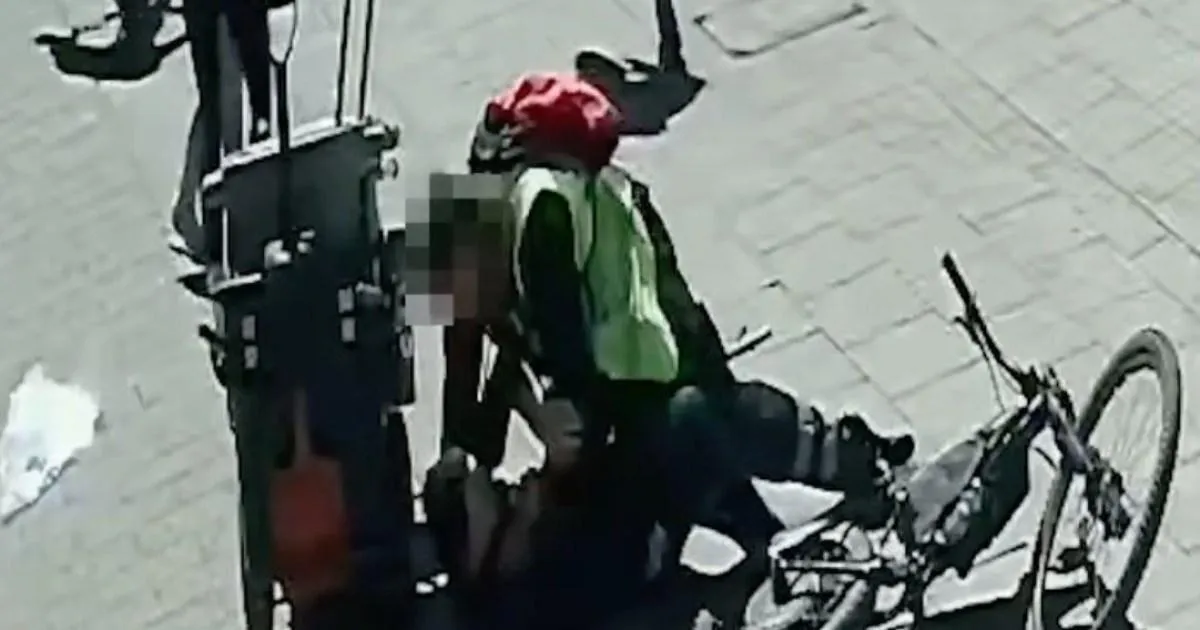
On an ordinary morning in Poplar, east London, the market would have looked like any other: a familiar rhythm of traders calling out, shoppers moving between stalls, and the low hum of a neighborhood going about its business. Among the crowd, two figures blended seamlessly into the scenery. One was a street cleaner, pushing a cart and collecting litter with the quiet efficiency of someone who had done the job for years. Another was a takeaway rider, carrying an insulated delivery bag, checking a phone, perhaps appearing to look up a customer’s address. No one would have given them a second glance. But neither was who they seemed. They were undercover officers from the Metropolitan Police, and they were closing in on a wanted man. Roy Hallissey had been a familiar presence in this market, but he was also a fugitive. He had a history of violence, a conviction for stabbing, and a machete hidden around his waist. The officers approached him from separate directions, cutting off any chance of escape. The arrest was swift and decisive. In a scene that must have looked like a carefully choreographed operation, the street cleaner and the delivery rider dropped their disguises and took hold of Hallissey. Only later, when he was searched, did the full danger become clear: a large machete was found concealed on his body, a weapon that could have caused devastating harm in the crowded marketplace.
Roy Hallissey was not a stranger to the police. He had been wanted for a long time, and his name had been on the radar of law enforcement for serious reasons. He had been convicted of a stabbing, a violent crime that had already marked him as a dangerous individual. But instead of facing the consequences and attending court for sentencing, he had failed to show up. That failure turned him into a wanted man. On top of that, he was also wanted over an alleged assault on an emergency worker, a crime that suggested a willingness to attack even those whose job was to help and protect. And if that were not enough, he had breached a criminal behaviour order that explicitly banned him from Poplar. The order had been put in place to keep him away from the area, to protect the community from his presence. Yet Hallissey kept coming back. He was known to regularly visit the market in Poplar, drawn perhaps by familiarity, habit, or the belief that he could blend in with the crowds and avoid detection. He had learned to be cautious. Whenever he spotted police officers in uniform, he would slip away, disappearing into the maze of stalls and streets before anyone could get close. His ability to evade capture was frustrating for officers, and it required a different kind of thinking to bring him to justice.
The operation that finally caught Hallissey was a testament to the creativity and patience of the Metropolitan Police. Knowing that he would flee at the sight of a uniform, the officers decided to take away his advantage entirely. They went undercover, but not in the traditional sense of detectives in plainclothes. Instead, they chose roles that were so ordinary, so much a part of the everyday landscape, that no one would think twice about their presence. One officer disguised himself as a street cleaner. The role gave him a reason to be in the area, to move slowly, to pause near Hallissey without raising suspicion. He could push a broom, pick up litter, and edge closer with every passing moment. The other officer posed as a takeaway rider, a delivery person who might be waiting for an order, checking a phone, or consulting a map. This disguise allowed him to approach from a different direction, creating a pincer movement that left Hallissey with nowhere to go. The two officers moved in from opposite sides, coordinating their approach so that Hallissey would not realize what was happening until it was too late. The market, with its noise and constant motion, provided the perfect cover. There was no dramatic chase, no shouted warnings. Just the sudden, firm hands of officers who had been watching, waiting, and planning for the moment when the trap would close. Once he was in custody, the search revealed the machete. It was not a small knife. It was a large, dangerous blade, the kind of weapon that could cause catastrophic injury. Hidden around his waist, it was accessible, ready to be used. In a crowded market, filled with families, elderly shoppers, and children, the potential for tragedy had been real.
The aftermath of the arrest brought Hallissey face to face with the legal system he had tried to escape. He was charged with a series of offences that painted a clear picture of his disregard for the law. There was the possession of a bladed article, a serious charge in any context, but particularly grave when the blade was as large as a machete and the location was a public market. There was the breach of the criminal behaviour order, proving that the earlier attempts to steer him away from Poplar had been ignored. There were driving offences, which suggested that his disregard for safety extended beyond his choice of weapon. There was the assault on police, a charge that spoke to the dangers officers face when they attempt to make an arrest. And there was escaping lawful custody, an offence that showed his determination to avoid accountability at every turn. Faced with this array of charges, Hallissey pleaded guilty. His plea meant that the victims of his crimes, and the public who had been put at risk, did not have to go through the ordeal of a trial. It was an acceptance of responsibility, even if it came late. The court scheduled his sentencing for October 7, a date that would bring a measure of closure to a case that had troubled the community. For the emergency worker he was alleged to have assaulted, for the victim of the original stabbing, and for the residents of Poplar who had lived with the knowledge that a dangerous man was moving among them, the sentencing would mark the end of a long and anxious chapter.
This story is about more than one man’s arrest. It is a reminder of the quiet, often invisible work that goes into keeping communities safe. In London, where knife crime has been a persistent and heartbreaking issue, every weapon taken off the streets matters. Every wanted criminal brought to justice sends a message that there are consequences. But the way this arrest happened is particularly striking. The officers involved did not rely on sirens or high-speed chases. They did not arrive in a fleet of police cars, announcing their presence. Instead, they chose to become part of the very environment where Hallissey felt safest. They understood that to catch someone who had learned to avoid the obvious, they had to abandon the obvious themselves. The street cleaner and the takeaway rider are not glamorous roles. They are the kind of workers that people pass by without a second thought, part of the background of daily life. But in this operation, those disguises were acts of bravery. To get close to a man carrying a machete, to approach him in a crowded space where any sudden movement could have led to violence, required courage and composure. The officers had to trust each other, coordinate their timing, and remain calm under pressure. Their success was not just a win for the police. It was a win for the community, for the market traders who go to work every day, for the families who shop there, and for everyone who deserves to live without the threat of violence lurking in the shadows.
In the end, the story of Roy Hallissey is also a story about the lengths that people will go to protect others. The market in Poplar continues to operate, as it always has. Traders still set up their stalls, customers still browse, and the rhythm of daily life goes on. But something has changed. A dangerous man is no longer walking those streets. A weapon that could have been used to harm someone is now in police custody. And the people of the area can move through their neighborhood with a little more peace of mind. There is something deeply human about the details of this operation. The idea that a street cleaner might be an undercover officer, that a takeaway rider might be watching for a fugitive, adds a layer of quiet heroism to the ordinary. It reminds us that safety is not always guaranteed by visible authority. Sometimes it comes from the unexpected, from those who are willing to look beneath the surface and play a part they never expected to play. For Hallissey, the days of avoiding justice are over. He will be sentenced, and he will have to face the consequences of his actions. For the officers involved, there is likely a sense of quiet satisfaction in a job well done. And for the rest of us, this story is a reminder that behind the everyday scenes of life, there are people watching out for us, often in ways we will never know. The machete is gone. The wanted man is caught. And a community can breathe a little easier, thanks to a pair of undercover officers who understood that sometimes the best way to catch a criminal is to become the most ordinary people in the room.