

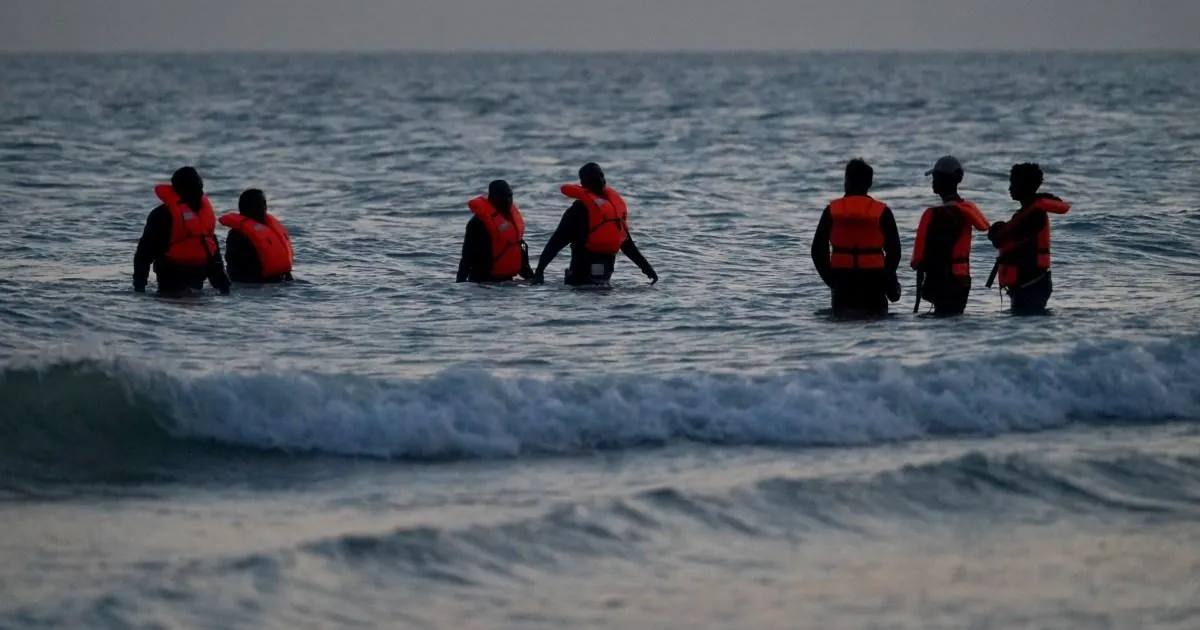
The English Channel, often viewed from the shore as a stretch of cold, grey water, transformed into a scene of life-or-death desperation earlier this week. A “mega-dinghy,” packed far beyond its intended capacity, set out under the cover of darkness with the hope of reaching the UK. However, the fragile vessel’s journey turned into a nightmare when its engine erupted into flames in the middle of the night. This incident, while thankfully resulting in no loss of life, serves as a haunting reminder of the sheer vulnerability of those who risk everything to cross one of the world’s busiest shipping lanes in search of a future they believe is safer or more secure.
For the 157 individuals on board, the middle of the Channel became a site of extreme peril. As the boat’s structural integrity failed and the fire threatened to plunge them into the frigid, dark waters, maritime rescue teams were scrambled to intervene. The rescue operation, coordinated by the French maritime prefecture, was a tense race against time. It is a testament to the coordination of these emergency services that every single person was brought to safety without injury. Yet, the relief of their survival is overshadowed by the harrowing circumstances that led them to trust their lives to a makeshift, overcrowded craft in the first place.
The incident highlights the difficult and often invisible “cat-and-mouse” game that plays out daily on the coast of Northern France. According to authorities, those attempting the crossing are often deeply wary of state intervention, fearing that being intercepted will dash their hopes of reaching British soil. Officials noted that these migrants frequently decline assistance until the situation reaches a point of absolute, life-threatening urgency. Balancing the duty to save lives with the reality that forcing a boarding on an unstable, overloaded boat could lead to a catastrophic capsizing is an agonizing operational challenge for rescue crews, who must navigate human desperation alongside technical risk.
This narrow escape occurs against a backdrop of intense, often polarized political debate. The issue of small boat crossings has become a fixture in the headlines, drawing sharp focus from policymakers and the public alike. Recent political discourse has seen calls for more aggressive intervention, including the potential deployment of naval vessels to deter crossings, while government officials emphasize the need for a “relentless” approach to dismantling the smuggling networks that profit from this dangerous trade. The intensity of this political rhetoric often feels worlds apart from the quiet, chilling reality of a burning dinghy in the middle of a dark sea.
Statistically, the narrative is shifting, yet the human cost remains constant. Official data indicates that the number of arrivals is currently down significantly—by about 43%—compared to this time last year. For those in power, these figures are a benchmark of progress, a sign that enforcement and international cooperation are beginning to yield results. Prime Minister Andy Burnham and his government maintain that while these figures represent a step in the right direction, there is no room for complacency. Behind every percentage point and every reduction in arrivals are families and individuals whose lives have been put on hold, redirected, or fundamentally changed by policies that treat the Channel as both a border and a barrier.
Ultimately, the plight of these 157 people serves as a stark humanizing anchor to an otherwise administrative and political story. Whether the numbers are rising or falling, the physical reality of a boat fire in the middle of the night reminds us that these crossings are not merely a logistical problem to be solved, but a series of individual human experiences characterized by immense risk. While the political establishment continues to argue over how best to control the UK’s borders, the people on those boats continue to brave the waves, driven by hopes that are, for them, worth the price of a terrifying, uncertain journey through the dark.