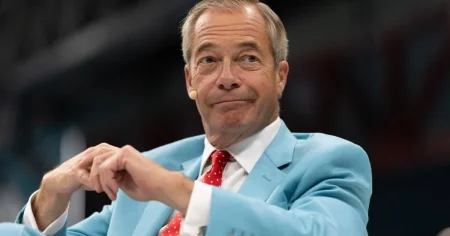

The recent clash between Green Party leader Zack Polanksi and Reform UK’s Nigel Farage highlights the toxic volatility of modern political discourse, where a swipe of a finger can ignite a national firestorm. The controversy stems from a collaborative Instagram post shared by Polanski which featured a graphic image of a man wearing a T-shirt emblazoned with a guillotine and the provocative slogan, “We’re only making plans for Nigel.” To Reform UK, this wasn’t just a social media mishap; it was interpreted as a chilling, veiled threat against their leader’s life. The situation escalated rapidly, with the party formally reporting Polanski to the Metropolitan Police, setting the stage for a tense standoff that mirrors the deeper, more aggressive divisions defining contemporary British politics.
For his part, Polanski maintains that the incident was an inadvertent error, triggered by the automated nature of “collaboration” posts on social media platforms. He explains that he accepted the request without thoroughly vetting the carousel of images attached to it, missing the offensive graphic tucked among the slides. When confronted, he staunchly refused to issue a formal apology to Farage, arguing that while he regrets the oversight, an apology implies a level of intentionality that simply wasn’t there. To Polanski, the mistake was a technical failure of digital management rather than an act of malice or an endorsement of violence, and he has since committed to increased scrutiny of his online activity.
However, the war of words intensified as both sides traded accusations of bad faith. Farage did not mince his words, asserting that if he were to broadcast something so inflammatory, he would rightfully expect to be treated as a criminal. He pressured the authorities to hold Polanski to that same standard, framing the incident as a clear case of incitement. In response, Polanski turned the spotlight back on the Reform leader, labeling Farage’s reaction “fundamentally dishonest.” He pointed out that Farage had strategically cropped screenshots of the post to make it appear as though the image was Polanski’s primary contribution, rather than a single slide in a broader collaborative upload.
The core of the dispute now centers on the performative nature of outrage in the digital age. Polanski noted that before the media frenzy began, the post had garnered fewer than 1,000 views, but thanks to the targeted amplification by his political opponents, it has since ballooned to over 3 million views. He argues that this intentional “ramping up” of the narrative by Reform UK has placed him in his own “dangerous spot,” essentially feeding the flames of public hostility. By casting the original oversight as a direct threat to life, Polanski believes his rivals are weaponizing the terminology of political violence to silence and intimidate him, even as police officials confirm they are conducting inquiries into the matter.
What unfolds here is a cautionary tale about the rapid acceleration of political conflict when social media meets traditional, combative rhetoric. As the police conduct their investigations, the underlying issue remains the lack of accountability and context in online spaces. Polanski’s struggle to prove his intent is pitted against the visceral fear and strategic opportunism of a rival party. Neither side is backing down, and the incident has effectively turned a technical blunder into a headline-grabbing confrontation. It serves as a reminder that in today’s climate, a minor operational error by a public figure can be swiftly transformed into a polarized battleground where the truth is often the first casualty.
Ultimately, this incident underscores the profound vulnerability of public figures—and the public at large—when caught in the gears of the digital outrage machine. Whether the event was a genuine, careless mistake or, as critics suggest, a symptom of underlying hostility, the aftermath proves that nuances rarely survive the transition from a smartphone screen to a 24-hour news cycle. While the Metropolitan Police continue their assessment, the political fallout continues to fester. For the average observer, it is a stark illustration of how easily modern political debate can descend into accusations of crime and incitement, leaving little room for civil disagreement or the simple, human acceptance of a genuine, if regrettable, accident.