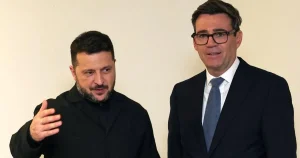


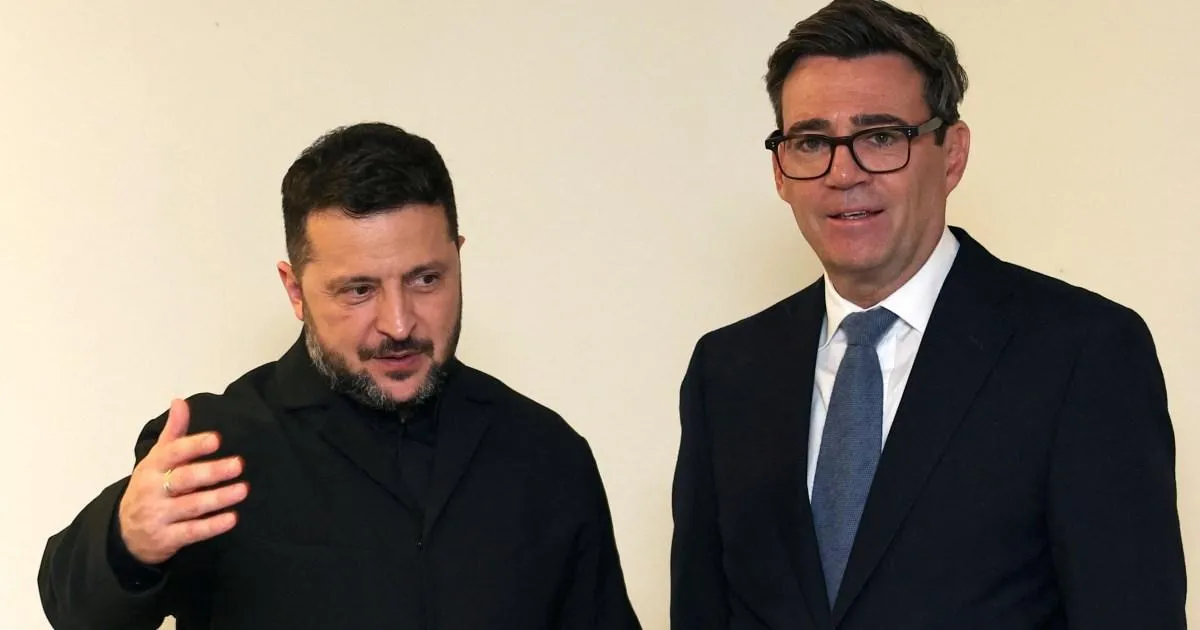
Remember Rishi Sunak’s first meeting with Joe Biden, at the White House in June 2023? Of course you don’t. I wouldn’t be surprised if even Rishi Sunak doesn’t remember his first meeting with Joe Biden. If he does, it might be because he was mistakenly addressed by Biden as “Mr President,” a few months after the president told a roomful of people celebrating Diwali that “Rashee Sanook” had just become the British PM. But the meeting itself? Dust in the wind. It wasn’t always the case that such a weight of anticipation and fear hung over occasions like this. There wasn’t always a risk the president might launch into a rambling, caustic rant that derails the whole thing. But in hindsight, I’m not sure the concerns ahead of Andy Burnham’s first in-person meeting with Donald Trump were justified. The Prime Minister arrived in New York for the United Nations General Assembly, met Ukraine’s President Volodymyr Zelensky, and then had to face the man who had made unpredictability a brand. There were plenty of reasons to be nervous, certainly. But maybe not the ones we expected. We have become so conditioned to expect the worst that we forget how often diplomatic meetings are actually dull, stilted affairs full of carefully agreed language and forced smiles. Even at the highest level, much of statecraft is performed theater. The question is whether the theater conceals something real.
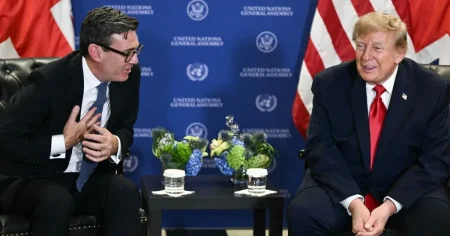
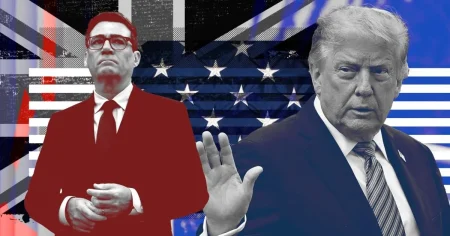
With two high-profile exceptions — Ukraine’s President Volodymyr Zelenskyin February 2025, and South Africa’s President Cyril Ramaphosa three months later — Donald Trump rarely flips out at a fellow world leader while they’re in the room. He can be icy, dismissive, or weirdly polite, depending on the day and the audience. People like Canadian Prime Minister Mark Carney and New York Mayor Zohran Mamdani, who built their careers partly on anti-Trump rhetoric, have been treated with varying levels of respect. That does not mean Trump has gone soft; he simply seems to save his worst for people who are not in front of him, or for those he decides to humiliate publicly. So it’s not a shock that the press conference with Burnham and Trump ended up being pretty civil — even if a few remarks generated their own news stories. The handshake happened, the platitudes were exchanged, and no one had to be pried off a podium. That may sound like faint praise, but in this era, surviving a Trump bilateral without actual blood on the carpet counts as a win. Acknowledging that means we can focus on the stuff beyond the superficial. Stuff like the speech Burnham gave at the UN shortly after the meeting, which provides some real insight into how he intends to lead the country. To understand why, it helps to compare him with the predecessor he replaced, Sir Keir Starmer. Two years ago, Starmer told the gathered dignitariesthat he feared a “sense of fatalism has taken hold,” with talk of“an age of polarisation, impunity, instability.” He said: “Our task is to say no. We won’t accept this slide into greater and greater conflict, instability and injustice. Instead, we will do all we can to change it.” You could fairly describe that speech as “very Starmer”: high-minded, cautious, legalistic, and perhaps a little too comfortable with the language of decline. It called for global cooperation for peace, centered on the application of international law. One word he didn’t use was“Russia.” Burnham mentioned it ten times.
In contrast, the new PM took a far more pugilistic tone, especially with the Kremlin. He told the diplomats that the UK“will be relentless in building up our hard power and deterrence,” adding:“True resilience depends on this military strength.” This was not a speech about process or institutions; it was a speech about muscle. It was about making clear that Britain is not going to drift into the same category as other faded middle powers, mouthing principles while others fight. Burnham did not mention Russia ten times by accident; he wanted the word hanging there. He wanted everyone in that room to know who the speech was aimed at. It also seemed to demonstrate how the “slide into greater and greater conflict, instability and injustice” that Starmer refused to accept is happening anyway. You can say no all you like; the slide doesn’t care. And if you are prime minister of a country that has positioned itself as a key European player, you eventually have to decide whether to be a thermostat or a thermometer. Burnham seems to have chosen thermostat, and his UN speech was the equivalent of cranking up the heat. That is a significant shift in the way Britain presents itself to the world. Starmer’s UN address came from the tradition of liberal internationalism, where the greatest dangers are seen as the erosion of norms and the weakening of institutions. Burnham’s speech came from a different place: the recognition that norms are already eroded, institutions are already under strain, and that the only language some actors understand is the language of strength. It was less a vision of how the world should be, and more a response to how the world actually is. For some, that will sound like a betrayal of values. For others, it will sound like late-in-life pragmatism. Either way, it marks a clear break from what came before, along with all the risks and reassurances that break carries.And Burnham was not speaking into a vacuum. The geopolitical background made that tone feel less like aggression and more like urgency. Polish Prime Minister Donald Tusk has warned Russia is preparing “hybrid strikes” against Nato countries that support Ukraine, while Lithuanian PM Mindaugas Sinkevičius spoke about his country’s evacuation plans yesterday. Those are not abstract think-tank scenarios; those are allies talking about real preparations for a future in which conflict does not stay neatly inside Ukraine’s borders. When a country like Lithuania starts publicly discussing evacuation plans, serious people in other capitals should stop pretendingthat the old playbook still works. That’s why Burnham’s message mattered. It is easy to stand at a podium and say that rules must be upheld. It is harder to stand there and say that the rules will only be upheld if we have enough tanks, jets, missiles, and will to use them if necessary. Burnham was saying the latter. And it’s at times like this that you feel like lying back, closing your eyes,and remembering that time Joe Biden called Rishi Sunak“Mr President.”” Not because it was profound, but because it was innocent. A mispronounced surname, a wrong title, an awkward photo-op: these were once the biggest risks of a bilateral meeting. Now we are talking about evacuation plans, hybrid warfare, hard power. The tone has shifted, and not just because one president talks more loudly than another. It has shifted because the ground beneath us has shifted. The assumptions that held up post-Cold War Europe — that peace was permanent, that borders were fixed,that war was something that happened in other regions — have crumbled in plain sight. Burnham’s UN speech was an attempt to improvise a new posture in real time. Whether it will work is another question. But at least it was a posture, and not just a wish.
None of this means the old fears have disappeared. At home, the political temperature is also rising. Burnham returns to a country where his own first Labour conference this weekend will take place against backdrop of protests that threaten to derail it. He may have had a relatively civil encounter in New York, but politics has not become kind. The same instincts that made him reach for hard-power language at the UN will be needed at home, too — because outsiders are not the only ones trying to pull the world apart. There is a restless mood among voters, and no amount of handshakes with presidents will solve that. Meanwhile, the usual absurdities continued: Argentina’s president threatened to“take matters into our own hands” over the Falkland Islands, and Trump winced as fighter jets roared above him during a military flyover. It is all there, the serious and the silly, tangled together, often in the same news cycle. That is perhaps the most human thing about politics: it never stays neatly in one register. You can move from visions of military deterrence to a mispronounced name in the space of a single breath. The leaders who manage this moment best will be the ones who understand that the world requires both hardness and humility, both strength and the ability to laugh at the absurdity of it all. Burnham’s trip to New York suggested he understands that balance, at least a little better than his predecessor did. He did not flinch in front of Trump, he did not flinch in front of the UN, and he did not pretend that the storm was not coming. Whether that is enough remains to be seen. But it is a start — and in this strange, fragile, alarming moment, a start may have to be enough.