


-
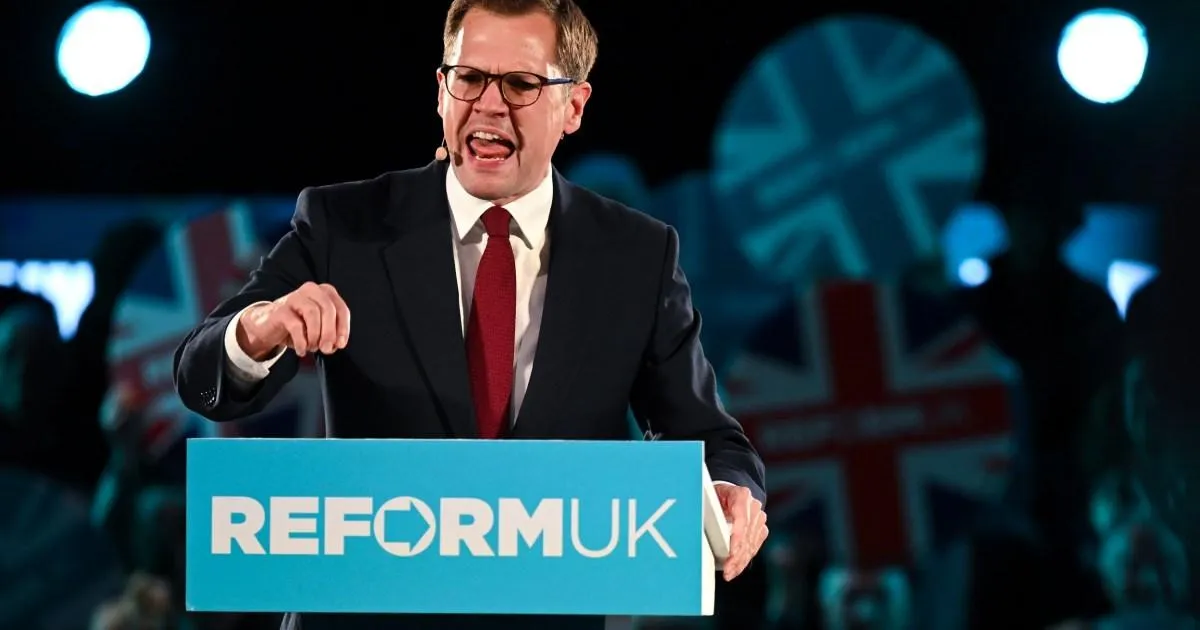
The scene unfolded in Plymouth, inside a cavernous arena where Reform UK had gathered for an event grandly titled “100 Days to Save Britain.” It was meant to be a show of strength, a moment for the party to present itself not merely as a protest movement but as the natural political home of hardworking Britons. Robert Jenrick, the party’s treasury spokesperson and a man who has increasingly positioned himself as the sharp-suited architect of Reform’s economic pitch, took to the stage with the kind of confidence that comes from believing you have the room in the palm of your hand. He wanted to make a point. He wanted to demonstrate, with vivid, visual proof, that Reform UK is the party of the working people. So he asked the audience a simple question. “Stand up,” he said, “if you work.” In his mind, he must have imagined a sea of bodies rising, a spontaneous ovation of labor and enterprise. Instead, there was a pause. A scattered shuffle. Only a handful of people got to their feet. The silence that followed was not the respectful silence of a crowd absorbing wisdom; it was the awkward, heavy silence of a rally realizing that the premise of the moment had collapsed. Jenrick, to his credit, did not freeze entirely. He tried to pivot, asking whether any business owners or entrepreneurs were present. The response was even more muted. For a long, uncomfortable stretch, the room seemed to mock the very idea that Reform UK’s base was a hive of go-getting, risk-taking wealth creators. It was only when Jenrick, with a note of desperation creeping into his voice, widened the criteria to include pensioners that the crowd finally rose en masse. The visual was unmistakable: Reform UK’s rank and file, at least in Plymouth that afternoon, were predominantly retirees.
-
The video of the moment did what such videos always do in the modern political age: it went viral, and it went viral in the worst possible way for the party. Social media users, political opponents, and even casual observers who usually pay no attention to the internal choreography of Reform UK events seized on the clip with a mixture of glee and cringe. There is something almost universally relatable about watching a speaker ask a question and then realizing, in real time, that the answer is not what they expected. It is the stuff of awkward meetings, of classroom questions nobody wants to answer, of party games that fall flat. But when the question is “if you work, stand up,” and the room barely moves, the failure is not just awkward; it is politically symbolic. Jenrick had set out to prove a thesis about Reform UK’s identity, and the audience had inadvertently disproved it within seconds. The timing of the rally made things worse. It was a Monday afternoon, which meant that many people who might have been inclined to attend such an event were, in fact, at work. The people who could freely attend a 2:30pm political rally on a weekday were, by and large, people whose working days were behind them. This was a demographic reality that Jenrick had stumbled into, but the optics did not care about demographics. The optics showed a party that claims to represent the worker, yet could barely fill a room with people who actually had jobs. The awkwardness was compounded by the fact that Jenrick had to perform a kind of verbal gymnastics to get the crowd on its feet. “If you are now drawing your pension,” he said, “stand up with them.” And with that, the room transformed. The pensioners stood, some of them probably delighted to finally be acknowledged, others perhaps quietly aware that they were being used as a prop to rescue a failed stunt. It was a moment that captured something deeper about the state of British politics, where image and reality collide, and where a speaker’s best-laid plans can be undone by the simple, stubborn truth of who is actually in the room.
-
The mockery came thick and fast, and much of it was devastatingly witty. One commenter observed that asking people to stand up if they work was “not the best question to ask at 2.30pm on a Monday.” Another noted, with a shrug, that Jenrick “had to go onto pensions as hardly anyone stood up. What an embarrassment.” A third, impersonating Jenrick, imagined the desperate escalation: “If you work, stand up! Oh, errr, if you’ve ever worked…stand up! If you are or ever have been married to someone that has ever worked, stand up. There we go…” The joke was funny precisely because it felt true. Jenrick’s initial question had failed, his entrepreneur question had failed even harder, and only by expanding the definition of work to include past work, or the work of one’s spouse, could he get the room to comply. For a party that has spent years branding itself as the “real party of workers,” the clip was a gift to its critics. Reform UK has built much of its appeal on the idea that it understands ordinary working people better than the Conservative Party, which it often describes as out of touch, or Labour, which it accuses of pandering to the unions and the benefit system. The party’s policy platform, at least on paper, is aggressively pro-worker in a traditional sense: tax cuts, support for small businesses, an end to what it calls “Benefits Britain,” and a general sense that the people who get up early and do a hard day’s work are the ones who have been betrayed by Westminster. But the Plymouth rally suggested a different story. The audience, or at least the portion of it that Jenrick could see, looked less like a cross-section of working Britain and more like a gathering of comfortably retired voters. There is nothing wrong with pensioners, of course. They have earned their rest, and their votes matter. But the image of a political party claiming to speak for the worker, while struggling to find actual workers in its own audience, is the kind of contradiction that opposition parties can exploit and that floating voters might remember.
-
The political website PoliticsJoe was quick to twist the knife, posting a wry observation that Jenrick had given an “impassioned speech to a room full of benefits claimants.” It was a sharp, slightly unfair joke, but it hit a nerve. Reform UK has made attacking the welfare system a central part of its message, promising to crack down on what it portrays as a culture of dependency. The party’s rhetoric often lumps together different kinds of benefits, from unemployment payments to disability allowances to housing support, into a single, sinister category of “handouts.” But state pensions are also, technically, benefits. The majority of the crowd that eventually stood up were pensioners, and therefore recipients of a state benefit. The irony was not lost on the commenters. Here was a party that had built its identity on the idea that Britain had become a “handout nation,” yet its own supporters were, in many cases, receiving a weekly payment from the state. To be fair, there is a meaningful distinction between a contributory benefit like the state pension, which people pay into over decades, and means-tested welfare payments for those who have never worked. But political nuance rarely survives contact with viral mockery. The clip did not allow for careful distinctions between “good” benefits and “bad” benefits. It simply showed a Reform UK speaker, at a Reform UK event, surrounded by people who were not working and who were, at least in the broadest sense, receiving money from the government. For a party that has promised to end “Benefits Britain,” it was an awkward look. It also raised a deeper question about Reform’s actual constituency. If the people who turn out to hear Reform’s message are predominantly older, retired, and reliant on state pensions, then the party’s economic message may be aimed at a demographic that is not quite the same as the working-age, wage-earning, tax-paying worker it claims to champion. The pensioners in Plymouth may well have supported tax cuts, but they were unlikely to be the ones directly benefiting from a policy designed to reward those who go out to work every morning.
-
As if the work question were not enough, the rally also produced another embarrassing moment, this time involving Reform UK’s leader, Nigel Farage. Farage, who has spent decades in politics and should know the geography of the United Kingdom as well as anyone, accidentally referred to Plymouth as Portsmouth. The crowd responded with a mixture of boos and laughter, which was perhaps the most honest reaction available. It is one thing to misspeak, but to confuse two different cities in the southwest of England, at a rally in one of those cities, is a particular kind of gaffe. Farage, to his credit, seemed to take it in stride, but the moment added to the sense that the event was not going entirely to plan. Farage also used the rally to announce a headline policy: if Reform UK were to form a government, those working in Britain’s armed services would pay no tax. It was the kind of bold, attention-grabbing promise that Reform specializes in, designed to appeal to a patriotic, pro-military audience. But it was somewhat overshadowed by the earlier embarrassment, and by the larger narrative of the day, which was less about policy and more about the awkward question of who, exactly, Reform UK really represents. Outside the Plymouth Arena, groups of pro-refugee protesters had gathered, making their presence felt with chants and placards. The contrast could not have been starker. Inside, a political party was trying to present itself as the party of the working man, with tax cuts and a hard line on immigration and welfare. Outside, activists were making the case for compassion and openness. The two groups seemed to inhabit different worlds, even though they were separated only by a wall and a security cordon. For the protesters, Reform UK’s message was a threat. For the people inside, the protesters were probably evidence of everything that was wrong with the country. The rally, in that sense, was a microcosm of a deeply divided political landscape, where the same set of facts could be interpreted in completely opposite ways.
-
The longer-term significance of the Plymouth gaffe may be less about Jenrick’s embarrassment and more about what it reveals regarding Reform UK’s trajectory. The party has spent the last few years trying to position itself as the true voice of working-class Britain, a role it believes the Conservative Party has abandoned. It has adopted the language of the workplace, promising to reward effort, to cut taxes on income, to defend the interests of those who “play by the rules.” But the viral clip from Plymouth suggests a gap between the party’s rhetoric and its actual base. The people who attend Reform rallies, who cheer for Farage, who laugh at his jokes, and who stand up when asked about their pensions, are not necessarily the same people who are currently clocking in and out of jobs. They are often older, often retired, and often motivated by issues like immigration, culture, and a sense of loss about the country they grew up in. There is nothing wrong with that. Pensioners have every right to be politically active, and their concerns are legitimate. But there is a real political problem for a party that claims to be the party of workers while drawing its most enthusiastic crowds from those who have left the workforce. The clip also raises a practical question: if Reform UK is serious about winning over working people, it might need to hold its rallies at times when working people can actually attend, and it might need to think more carefully about the optics of asking a room full of retirees to stand up and represent the labor force. The moment was a gift to Reform’s opponents, but it was also a warning. Political parties can survive gaffes. They can survive policy controversies. What they struggle to survive is a visual contradiction that undermines their core message. Jenrick’s question was meant to be a triumphant moment, a proof point. Instead, it became a meme. And every time the clip is shared, every time someone laughs at the room full of pensioners, the idea of Reform UK as the party of working people takes another small hit. On a Monday afternoon in Plymouth, the party learned that you cannot always control the story. Sometimes, the crowd tells the truth for you.