


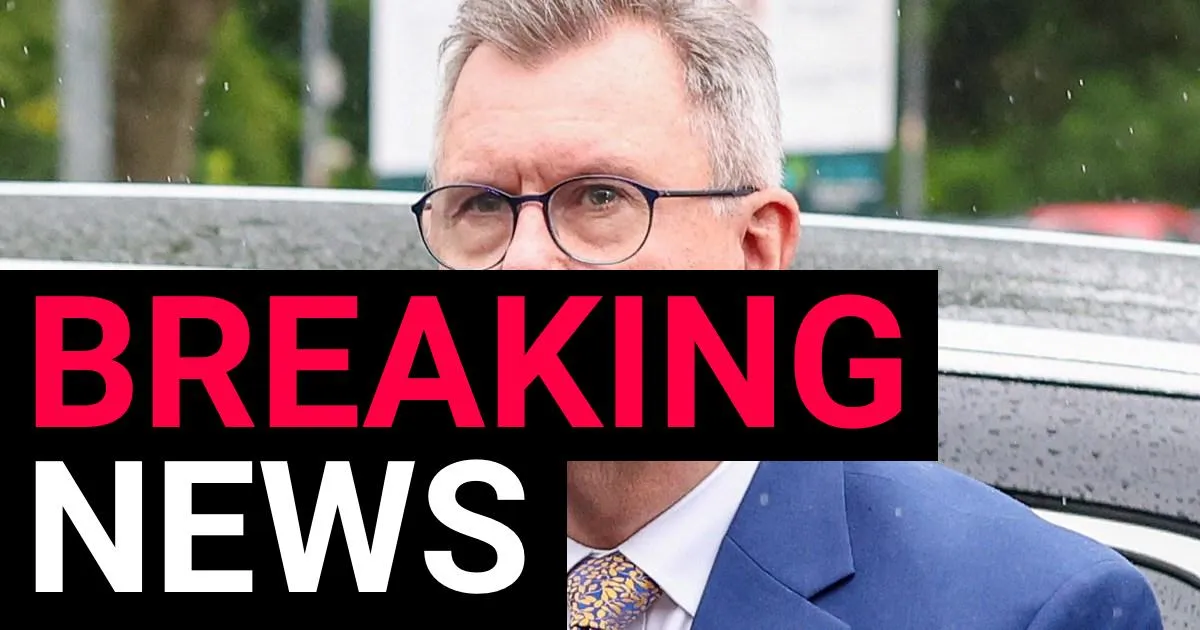
It is hard to imagine a more complete and shocking fall from grace. Jeffrey Donaldson, a man who once stood at the very heart of British political power, who led the Democratic Unionist Party and sat as a Member of Parliament, is now a convicted sex offender beginning a 15-year prison sentence. Last week, that sentence was handed down for a series of child sex offences against two victims, crimes that took place over more than two decades. But even as the world absorbed that devastating verdict, another, even more disturbing allegation has emerged. The former MP, now aged 63, has also been accused of raping a woman in the Houses of Parliament in 2016. This new accusation has been referred to the Metropolitan Police by the Police Service of Northern Ireland, and Donaldson is expected to be interviewed by detectives. For anyone who has followed his long and prominent career, the contrast between the public image of statesmanship and these private, deeply painful allegations is almost impossible to reconcile. Yet for the survivors involved, this is not a story about political intrigue; it is a story about power, vulnerability, and the slow, agonizing pursuit of accountability.
The details of the alleged 2016 incident first surfaced through a report in the Belfast Telegraph in July, and they are deeply unsettling. According to the woman’s claims, the assault took place in the DUP offices inside Parliament, a place that should symbolise democracy and safety, not fear and violation. She alleged that Donaldson tried to get her to drink vodka shots in his office, then attempted to kiss her and put his hand up her skirt. At the time, this was described as a sexual assault allegation. Now, it has emerged that the same woman has gone further, alleging that Donaldson raped her. The Metropolitan Police confirmed that they received a report on Tuesday 13 October, referred to them by the Police Service of Northern Ireland. The force stated: “The allegation relates to one victim who is being supported by specialist officers. The investigation is in its early stages. No arrests have been made and enquiries are ongoing.” These words are measured and careful, as they should be, because this is now a live criminal investigation. But behind the formal language lies a very human reality: a woman who has apparently carried the weight of this memory for years, who has found the courage to speak, and who now must wait to see whether the legal system will believe her and act on her behalf.
This new accusation adds another layer of gravity to an already devastating series of events. Donaldson was, until relatively recently, one of the most influential politicians in Northern Ireland and the wider United Kingdom. He was a key figure in the DUP, a man who played significant roles during some of the most delicate political negotiations in the region’s recent history. He served as First Minister candidate, leader of his party, and an MP for Lagan Valley. In public, he appeared as a disciplined, serious, and religiously conservative figure, someone who stood firmly for traditional values. That is what makes these allegations so profoundly jarring. The same man who presented himself as a moral leader is now facing a series of accusations involving sexual violence and abuse. It is a reminder that public personas are exactly that: personas. They are constructed, polished, and presented, and they do not always reflect what happens behind closed doors. For those who have survived abuse, this disconnect is tragically familiar. Abusers often occupy positions of authority and trust. They hide in plain sight, protected by reputation, status, and the unwillingness of others to believe that someone so powerful could do something so terrible.
The sentence handed down last week relates to offences committed between 1985 and 2008, a staggeringly long period of abuse that spanned more than two decades. Donaldson was found guilty of a series of child sex offences against two victims, including one count of rape. The 15-year prison sentence reflects the severity of these crimes and the devastating impact they have had on the survivors. The abuse took place during years when Donaldson was building his political career, climbing the ranks of unionism, and becoming a familiar face in the media. While his public life flourished, his victims were living with the consequences of his actions, often in silence. Their courage in coming forward, in enduring the scrutiny of a trial, and in telling their stories in court cannot be overstated. It is a deeply painful process, particularly when the abuser is a well-known public figure. Survivors often face skepticism, intrusive questions, and the terrifying prospect of not being believed. That they persisted, and that a jury or judge found him guilty, is a meaningful step toward justice, even if the scars of abuse never fully heal. Donaldson is now seeking to appeal the convictions, which may prolong the pain for everyone involved, but the initial verdict and sentencing still stand as a powerful acknowledgment of the truth.
It is important to remember, however, that this latest allegation of rape from 2016 is still under investigation. No arrests have been made, and Donaldson has not yet been formally interviewed, let alone charged, in relation to this specific claim. The principle of due process must apply. Everyone, including Donaldson, is presumed innocent until proven guilty in a court of law. But the existence of the allegation itself, and the fact that police are taking it seriously enough to investigate, speaks to a broader cultural shift that has been slowly gaining momentum for years. More and more, survivors of sexual violence are finding their voices, and more and more, institutions are being forced to listen. Parliament, as an institution, has not been immune to this reckoning. There have been previous allegations and scandals involving members of both Houses, and this case will inevitably renew questions about the culture within Westminster, the treatment of visitors and staff, and the safeguards that are meant to protect people who enter those historic buildings. A woman who has alleged that she was sexually assaulted and raped in the very heart of British democracy deserves not only to be heard but to have her claims thoroughly and sensitively investigated. Specialist officers are now supporting her, which at least shows that the initial response is being handled with the seriousness it warrants.
Ultimately, this is a story about the long and painful road to justice. It is about a former leader whose reputation lies in ruins, but it is also about survivors who have had to relive their trauma in public, in the press, and in courtrooms. It is about the courage it takes to speak truth to power, particularly when that power is embodied in a man who once occupied the highest echelons of government. And it is about institutions, whether Parliament or the police, that must work hard to ensure that allegations are treated with respect and rigor. There are no easy answers here. The legal process will take its course, and only time will tell what the outcome of the Met investigation will be. But regardless of what happens next, the fact that these allegations are being taken seriously, that a woman is being supported, and that a man formerly at the pinnacle of political influence is now facing justice for crimes against children, represents a significant moment. It reminds us that no one is above the law. It reminds us that power does not erase accountability. And it reminds us that behind every headline, there are real human beings, carrying real pain, hoping that someone, finally, will believe them. For the survivors, this may be the beginning of a new chapter, not one that erases the past, but one that finally acknowledges it.