

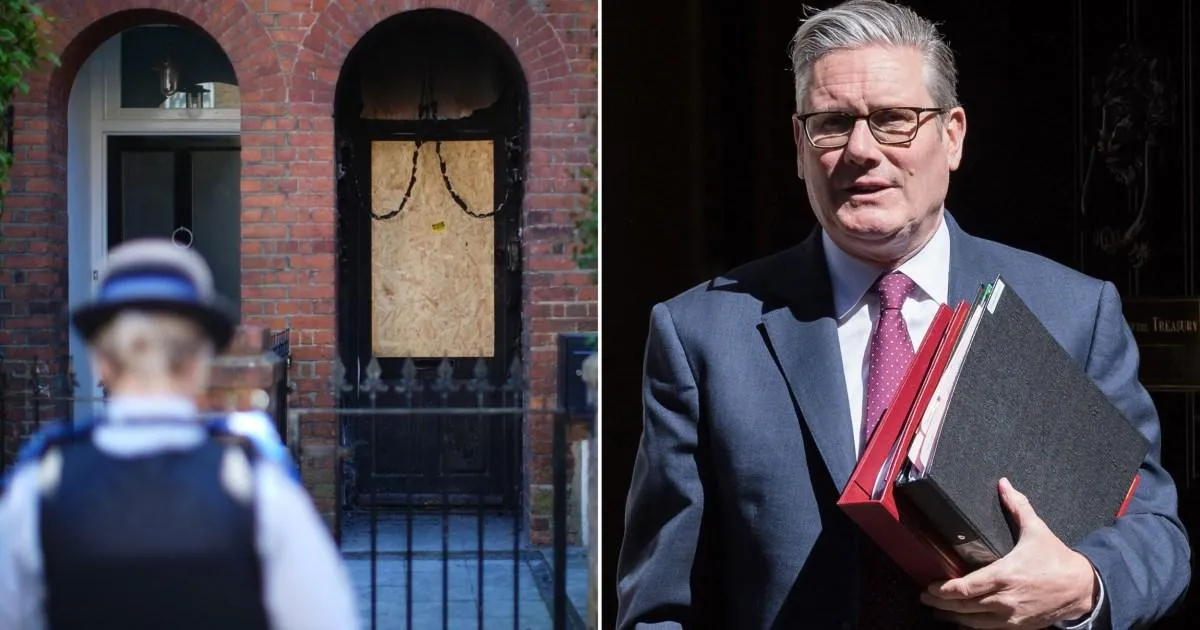
There is something uniquely chilling about a fire set in the dark, not by accident, and not for money in the usual sense, but as a signal. A burned-out doorway on an ordinary residential street becomes more than debris and charred paint; it becomes a statement, a violation, a warning written in smoke. That was the reality for the people connected to Sir Keir Starmer in May of last year, when a spree of arson attacks targeted properties linked to the then-prime minister. The image of that scorched entrance, captured in a photograph, is not just a picture of damage but a snapshot of a strange, unsettling episode in modern British politics. Now, months later, one of the men responsible has been removed from the country. The Home Office has confirmed that Stanislav Carpiuc, a 28-year-old Romanian national, has been deported from the UK after serving a prison sentence for his part in the attacks. Carpiuc had been convicted alongside his accomplice, Roman Lavrynovych, and their case exposed a shadowy web of conspiracy, cryptocurrency and suspected Russian involvement. But behind the geopolitics and the Telegram accounts, there were real families, real neighbours and real fears, all of which deserve to be remembered as we reflect on the outcome.
The attacks themselves were brazen and frightening precisely because of how normal and close-to-home they were. Over the course of just five days in May, fires were set at three different locations associated with Starmer, and it is only by luck that no one was seriously hurt. It began on May 8, when a car that Starmer had previously owned was discovered on fire on a street in Kentish Town. The vehicle was being destroyed, flames licking out into the night, and for anyone living nearby it must have felt confusing and alarming. Just three days later, on May 11, another fire was found at a block of flats in nearby Islington, the same area where Starmer had lived several years earlier. Then, on May 12, the situation escalated even further. A fire was set at the entrance of a home in Kentish Town that belonged to Starmer but was rented out to his sister-in-law, Judith Alexander. That detail matters. This was not just an attack on a public figure, it was an attack on a family member, a woman whose home was someone else’s property but her refuge, her everyday life. Imagine waking up to flames at your front door, knowing that you were targeted because of your family connection. The terror of that moment cannot be overstated. Fire is one of the most ancient and primal of human fears, and when it is deliberately lit, it carries a message of pure intimidation. That the attacks happened within days of each other suggests both confidence and recklessness, a willingness to repeat the crime until someone was caught or someone was harmed.
When police and prosecutors finally brought the case to court, the full picture began to emerge, though many questions still remain. Carpiuc was convicted of conspiring with others to damage property by fire, and in June of this year he was sentenced to two years in prison. His accomplice, Roman Lavrynovych, who was just 21 years old at the time of sentencing, received a much harsher punishment of seven years. The judge, Justice Garnham, described Lavrynovych as essentially acting as a pawn for some unknown cause, putting the lives of people asleep in their beds at risk. That phrase, “people asleep in their beds,” cuts through everything. It reminds us that these were not abstract targets or symbolic addresses, but places where human beings lived, breathed, dreamed and tried to rest. A third man, Petro Pochynok, a 35-year-old Ukrainian citizen, was cleared of the same charge, a reminder that the justice system earned its keep by examining evidence carefully rather than simply looking for scapegoats. Carpiuc, having served his time, has now been deported from the UK. A Home Office spokesperson delivered a stern statement, saying that the conviction and imprisonment of these men should serve as a clear warning to anyone blinded by the promise of money from strangers. “You will be caught and face severe consequences,” the spokesperson said. The message was unmistakable: the British state does not take kindly to foreign interference, sabotage, or attempts to intimidate its leaders through violence.
Yet the most disturbing twist in this whole saga is not the fires themselves, but who was allegedly behind them. After the convictions, it was revealed that the attacks were directed by a mysterious handler believed to be linked to the Russian state. This is where the story moves from crime to espionage, from arson to hybrid warfare. A Telegram account with the name “El Money” was in contact with Lavrynovych, offering him payments in cryptocurrency in exchange for carrying out the crimes. This is a technique that should feel disturbingly familiar in the modern world: anonymous online handlers using encrypted platforms, paying off vulnerable or greedy individuals with untraceable digital assets, and letting them take the physical risks while the masterminds stay hidden far away. According to a BBC News investigation, that Telegram account was linked to a 23-year-old diplomat whose father was a senior Russian official. That revelation is staggering if it is true. It suggests that people with actual diplomatic status, people who should be working within the rules of international relations, were allegedly involved in directing a petty arson campaign against the leader of a major Western democracy. It is the kind of plot that feels like it belongs in a Cold War thriller, but it happened in the real world, on the streets of London, with fire engines and police tape and frightened residents. The absurdity of it all is matched only by its sinister implications. These were not highly trained operatives carrying out a sophisticated operation; they were young men, apparently dazzled by the promise of cryptocurrency, willing to set fire to buildings for a handler they may never have met.
For Carpiuc, the consequences have been relatively short-lived compared to his accomplice. His two-year sentence, followed by deportation, means he will now begin his life anew, likely back in Romania or wherever he chooses to go, while the scars of his actions remain in the UK. It is worth pausing to consider what his punishment means. Deportation is often seen as a quiet, administrative kind of justice, a removal rather than a spectacle. But it carries symbolic weight. It says to the international community that the UK will not tolerate people coming here to commit acts of sabotage, regardless of whether they were paid by evil barons or foreign spies. The Home Office spokesperson’s words were carefully chosen: “This was an abhorrent attack.” And it was. It was also, in a strange way, a pathetic attack, a handful of fires set by pawns, directed by a ghost, all for the sake of a political gesture that achieved nothing. Starmer was not harmed. The country was not destabilised. The fires were put out. The criminals were caught. And now one of them is gone. But to focus only on the justice outcome would be to miss the human cost. The residents of those buildings, the neighbours who saw smoke rising at night, the firefighters who rushed to the scene, the family members who had to wonder whether they were being targeted, all of them carry a little piece of this story with them. For Judith Alexander, the home she lived in may never feel quite as safe again. The burned-out doorway may have been repaired, but the knowledge that someone deliberately set it alight because of who owned the property is the kind of thing that stays in the mind long after the smoke clears.
What should we take away from this quietly remarkable episode? First, we should recognise the vulnerability of democracy itself. Political leaders are not untouchable monarchs; they live in houses, they park cars on streets, they have families with ordinary lives. This is what makes them relatable, but it also makes them targets. The attempt to intimidate Starmer through arson was an attack not just on one man, but on the very idea that political disagreement should be resolved through votes, debate and law, not fire and fear. Second, we should be alive to the changing nature of threats. The image of a foreign power using local criminals, online messaging and cryptocurrency to launch physical attacks is a new and dangerous form of warfare. It is cheap, deniable and hard to trace. It turns desperate or greedy young men into weapons, and it blurs the line between crime and conflict. The fact that the alleged handler was linked to a diplomat’s family only deepens the concern, because it suggests official or semi-official involvement at some level. Third, we should hold on to the quiet faith that justice, even when imperfect, still has a heartbeat. The police investigated, the prosecutors charged, the courts convicted, and the Home Office deported. This is how a society pushes back against intimidation. It is not glamorous or dramatic, but it is real. And in the end, the arsonists failed. They failed to harm the prime minister, failed to terrify the public into submission, and failed to remain in the country they tried to terrorise. The doorway in the photograph is still standing, scarred but resolute. The same could be said of the community around it. A fire can burn wood and paint, but it cannot burn down a society that refuses to be broken. As we close this chapter, we should remember the ordinary people who were caught up in an extraordinary scheme, and we should thank the first responders, the investigators and the judicial system that brought a strange case to a conclusion. The flames may have been set by men acting for dark purposes, but the aftermath was handled with the very values they were trying to undermine: transparency, accountability and an unwavering commitment to the rule of law.