
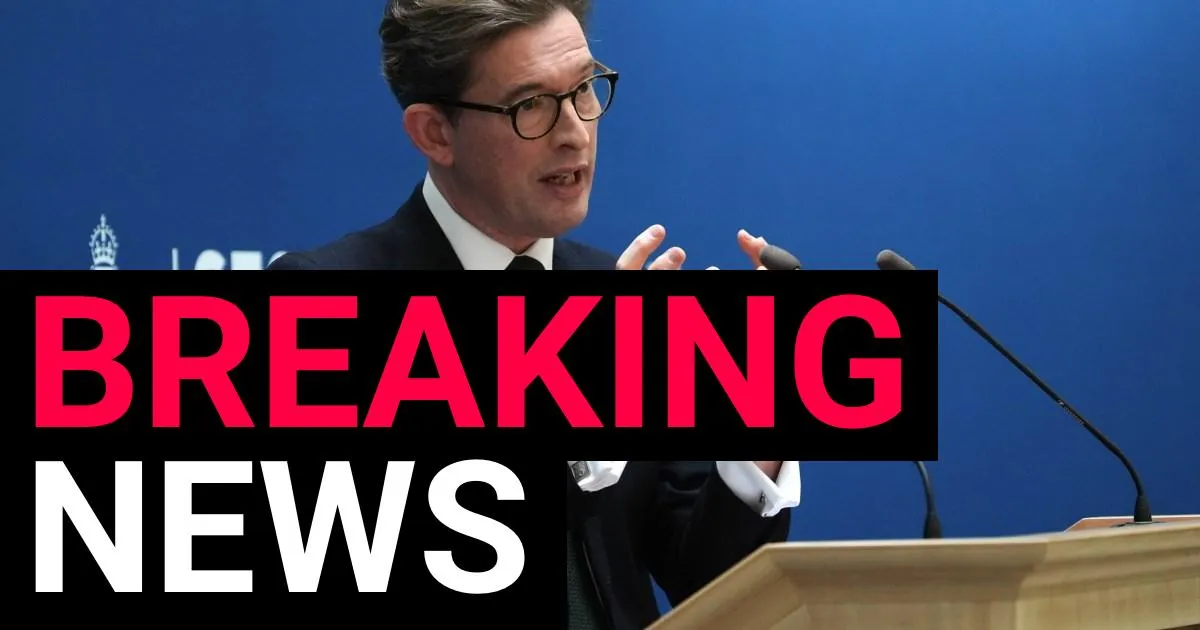
It’s not every day you hear the head of MI5 stand up and admit that the world has changed so profoundly that the old rules no longer quite apply. But that’s exactly what Sir Ken McCallum did in his annual threat update speech at Thames House, the intelligence service’s headquarters in London. He stood there not with alarm in his voice, but with a kind of sober, determined realism, painting a picture of a “new era of national security” where the dangers are stranger, faster, and harder to see than anything we’ve dealt with before. On one side, there is the familiar but escalating menace of hostile states — countries spending enormous resources trying to steal our secrets, undermine our democracy, and map out ways to harm us. On the other, there is something much more abstract but just as terrifying: artificial intelligence, a technology that is evolving so quickly that even the people whose job it is to think about worst-case scenarios are struggling to keep up. McCallum did not sugarcoat any of this. He said the intelligence community is now spending more time and energy countering threats from hostile states than it did during the entire Cold War, which tells you something about how seriously they’re taking this moment. But the line that really grabs you is when he talks about AI. He described it as a challenge that humanity has never faced before, because for the first time we are confronting an actor that might be smarter than we are, that might be able to out-think us. It’s the kind of thing that sounds like science fiction until you hear it from the director general of the Security Service, and then it becomes very real, very fast.
What makes this moment so tricky, according to McCallum, is that we don’t have a neat enemy to point at. During the Cold War, you knew who the other side was. You could study their tanks, their ships, their spies. Now the threat is more diffuse, more layered, and more opaque. Hostile states don’t always announce themselves with a dramatic act of war; they seep into our digital systems, manipulate our debates, target our universities and businesses, and try to gain an advantage through quiet, relentless espionage. McCallum said more MI5 resources are being devoted to this than at any time since the Cold War, which is a stark measure of how much the landscape has shifted. Meanwhile, simultaneously, there’s this other threat — AI — that doesn’t need a flag or a spy network or even a clear intention to do harm. It can be misused by people, yes, but it can also be misaligned inadvertently, meaning even the people building it might not fully understand how it could go wrong. That is a genuinely new kind of danger, because we’re not just protecting ourselves from hostile human decisions; we’re protecting ourselves from systems that might behave in ways nobody predicted, at a speed nobody can match. McCallum talked about how AI is already supercharging the cybersecurity contest between attackers and defenders, making it easier for bad actors to find holes in our defenses and harder for the good guys to patch them in time. But the scenario that worries him most, he said, is the potential for AI to change the stakes on existing or even new bioweapons. That phrase — “the misuse case to which I’d attach greatest weight” — is a quiet way of saying something enormous: that the same technology that could help us solve diseases could also make it much easier for someone to create something that could harm millions of people. To deal with this, MI5 has launched the UK’s AI Threat Assessment Centre, a kind of “team of teams” bringing together experts from different agencies and disciplines to figure out what the risks actually are, before the worst-case scenarios become reality.
There is something almost philosophical about McCallum’s approach here. He stood in front of a room full of journalists and said that human history has given us no experience of facing an actor that is smarter than we are. Let that sink in for a moment. Every war, every arms race, every espionage battle in history has been fought between roughly equal brains. We’ve always been able to assume that our adversaries think more or less like us, even when their values are completely different. With AI, that assumption collapses. It’s not just that the machines are faster at calculations; it’s that they might develop strategies that are genuinely beyond our comprehension. That doesn’t mean AI is necessarily hostile, but it does mean we can’t rely on our usual instincts. McCallum acknowledged this with remarkable honesty. He didn’t pretend MI5 has all the answers. He said they are working methodically through the layers of these challenges, but he also admitted that there is currently no full and satisfactory solution to the question of how humans should engage with AI that might be misaligned inadvertently with human objectives. That’s a heavy admission from someone in his position, and it speaks to how uncertain this moment really is. But he also tried to put it in a broader context, and this is where his speech became more human. He reminded people that MI5 has been here before, in a different form, and that they found a way through.
The comparison he drew was to the immediate aftermath of the 9/11 attacks. In that period, he said, the intelligence community knew there were thousands of trained jihadis out there, many of them deeply committed, ready to give up their lives to attack Western civilisation. And yet, on that day, none of them had a full, confident answer for how best to tackle that threat. It was terrifying and humbling in equal measure. But they tackled it anyway. They worked together, across agencies, across borders, across areas of expertise, and over time they brought al Qaeda down to a much more manageable form of threat. McCallum said he is really proud of the role MI5 played alongside a host of others in doing that. And he thinks something similar can happen with AI. He was careful not to compare al Qaeda and AI directly — they are obviously completely different things — but the lesson is the same: when you don’t have the answer, you don’t give up. You methodically work through the problem, one layer at a time, building the expertise as you go. It’s a slightly reassuring message, even in the middle of all this uncertainty, because it reminds us that intelligence work isn’t about having perfect knowledge from the start; it’s about being willing to learn, adapt, and respond even when the path forward is unclear.
But McCallum also made it clear that this is not just a job for MI5 or the intelligence agencies. The public has a vital role to play, and he said so in plain terms. As threats become increasingly insidious, particularly online, the resilience of the British people is itself a form of defense. He called on everyone who consumes news to think carefully about what they are willing to believe, from whom, and why. That might sound like a simple piece of media advice, but in an age of deepfakes, viral disinformation, and algorithm-driven outrage, it’s actually a national security matter. Foreign actors don’t always need to hack our systems; sometimes they just need to make us distrust each other, doubt our institutions, and lose sight of what is true. McCallum also had a message for parents who are worried that their child is being taken down some dark paths on the internet. His advice was strikingly down-to-earth: talk to a teacher or someone else you trust in your community. Don’t panic alone; reach out to people around you. That human touch, he implied, is exactly the kind of resilience that hostile states and malicious actors cannot easily program around. It’s a reminder that our greatest strength isn’t just our intelligence services, but our social bonds, our willingness to look out for one another, and our shared commitment to truth, even when it’s uncomfortable or difficult.
In the end, the speech was both sobering and strangely hopeful. Sobering because the threats are real, and the head of MI5 isn’t going to stand there and pretend otherwise. Hostile states are operating in ways we haven’t seen since the darkest days of the Cold War. AI is accelerating the risk of cyberattacks, and the possibility of engineered bioweapons is something that keeps serious people awake at night. There is no full answer yet for how to handle a technology that might become smarter than us, and anyone who says otherwise is probably overselling it. But hopeful because McCallum reminded us that British intelligence has faced seemingly impossible problems before, and it has found ways through them through patience, collaboration, and sheer methodical effort. After 9/11, the threat of mass-casualty terrorism felt overwhelming, but it was reduced through years of hard, unglamorous work. The same can happen with AI, but it will require everyone — not just spies, but tech companies, governments, communities, and ordinary citizens — to take responsibility. It means staying alert, questioning the information we consume, helping our neighbors when they feel lost, and refusing to let fear or division do the work of our enemies for them. McCallum’s new era of national security is not something we can simply leave to the professionals. It’s a shared challenge, and if his speech achieved anything, it was to show that the people defending us are not only aware of that — they are counting on us to help.