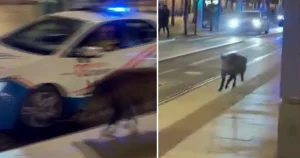


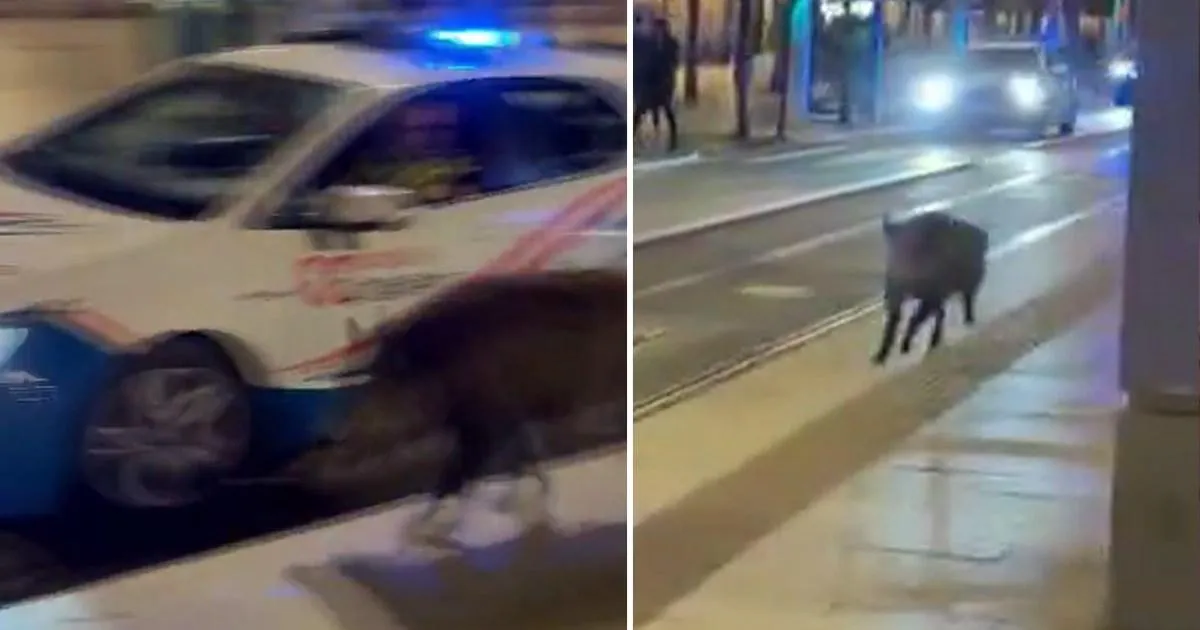
It began, as many strange stories do, with a city at the height of a festival. Zaragoza was glowing under the last night of the Fiestas de Pilar, a week-long celebration in honor of the Aragonese capital’s patron saint. For seven days, the streets had been filled with processions, music, dancing, and the warm buzz of people who had no reason to go home early. The air smelled of churros and wine and late-night conversation. Then, just after midnight, that gentle chaos turned into something far more strange. A wild boar—large, dark, and panicked—burst out of the shadows and ran straight through the center of the city. It charged at a woman outside a bar, knocking her over and leaving her with minor injuries, then kept going as though the whole world were chasing it. In a way, the world was. Police cars appeared within seconds, their lights swirling across old stone walls and modern shopfronts. Officers shouted through megaphones, telling everyone to take care, but the boar paid no attention. It ran down tram lines, hooves clattering on the metal rails, past church towers and cafés and astonished people who still held drinks in their hands. Some screamed. Some laughed. Some pulled out their phones, because that is what we do now, even in the middle of something we cannot quite believe. The boar didn’t know it was being filmed. It didn’t know it was a story. It only knew it needed to escape, and there was nowhere to go.
The chase twisted through Zaragoza like a strange, unscripted parade. The boar ran along the city’s busiest roads, darting between taxis and late-night buses, forcing drivers to slam on their brakes. It passed some of the city’s most recognizable sights, showing no interest in any of them. Officers in patrol cars tried to corner it, but the boar seemed to have a talent for slipping away at the last second. It would stop, look back, and then sprint off in another direction, leaving the police to reverse and redirect. Locals who had been standing outside bars became an audience, watching from a safe distance as the animal outfoxed the authorities again and again. At times it was almost funny—a pig giving the police a workout in the middle of the night. But there was an edge to the laughter. A wild boar is not a stray dog. It has sharp tusks, raw strength, and no understanding of traffic, danger, or human rules. When it ran toward a group of people, the laughter stopped and became a collective gasp. Some residents leaned out of windows in dressing gowns, wondering if they were still dreaming. Children asked if it was a very big dog. No one had a good answer. The boar, meanwhile, kept running, not out of malice but out of pure animal terror. It was not trying to hurt anyone. It was just trying to find a way back to a world that made sense, a world of trees and dirt and open space. But all it found were walls, lights, and shouting.
Then came the moment that turned the night from a bizarre chase into an almost unbelievable memory. The boar found an open doorway and slipped inside an entertainment venue, a nightclub or bar that was still packed with revellers. The music was loud, the bass was shaking the floor, and colored lights were sweeping across a crowd of dancers. The boar appeared in the middle of them like a guest who had taken a wrong turn into a costume party. Dancers screamed and scattered. Drinks went flying. Some people froze completely, unable to make sense of the dark animal that had suddenly appeared on the dance floor. For a few seconds, the boar seemed just as confused as they were. It stood there, ears back, body tense, looking at the flashing lights as if they were some kind of strange storm. Then it moved, charging through the maze of tables, speakers, and high stools. It was not dancing, of course, but the image of a wild pig on a dance floor was so ridiculous that people would later tell the story with a kind of horrible comedy in their voices. Emergency services soon arrived and had to go into the club after it. It was not an easy rescue, because there was no easy way to catch a frightened boar in a space full of obstacles. The crowd pushed back to the walls, some still holding their drinks, watching as officers tried to corner the animal without causing more panic. The boar had gone from the streets of a city to the heart of human entertainment, and neither side knew how to end the encounter.
But every story has an end, and this one was not happy. After the chaos, after all the shouting and sirens and attempts to calm the animal, authorities decided that there was no safe way to capture it alive. The boar had already injured a woman. It was panicking, it was surrounded, and it was dangerous. In the end, they euthanized it. It was not a decision made out of cruelty, but out of necessity. The animal had no place to go, no forest waiting for it, no quiet path back to the wild. It had crossed too far into a human world, and that crossing cost it everything. Later, staff from the environmental firm FCC arrived in a van and removed the boar’s remains, as if the whole adventure had been just another task on a checklist. For the people who watched from doorways and windows, the sight of the van driving away was quietly devastating. There was no triumphant return to nature, no celebration of a captured animal being released into the hills. There was only the knowledge that a living creature had wandered into the wrong place and paid for it with its life. The festival continued, because festivals always continue. The sun eventually rose over Zaragoza, but the memory of the boar—running, hiding, stepping onto a dance floor, and dying—did not fade easily.
The bigger question, the one that lingered after the crowds went home and the streets were cleaned, was why this happened at all. Across Spain, wild boar sightings in urban areas have become more common, and climate change is one of the main reasons. Droughts and heatwaves are shrinking the natural food supplies that wild boars have always relied on. Acorns, roots, small creatures, and all the hidden things that once made up their diet are becoming scarcer and less predictable. Hungry animals are forced to look for food in new places, and cities offer plenty: open bins, discarded snacks, gardens, golf courses, and even friendly humans who think they are helping. In holiday areas along the southern Costa del Sol, wild boars have become a common sight, wandering near beachfront bars and hotel swimming pools. They have adapted their behavior too. Traditionally nocturnal, they now move through towns and resorts after dark, learning the rhythms of human life in order to survive. Conservationists have been warning for years that this is not a passing trend. It is a new reality. The wild boar in Zaragoza was not an alien or an accident. It was a refugee from a changing landscape, pushed out of its home by forces that no single city can control. The boundary between wild and urban has never been a solid wall, but it is now becoming so porous that stories like this will only become more frequent.
Zaragoza will remember this night, not because of the festival’s official events, but because of the wild boar that ran through its streets and onto a dance floor. It is tempting to laugh at the absurdity, and many people did. But the deeper lesson is not a joke. It is about the choices we make as our world changes faster than we can prepare for. We cannot keep pretending that nature belongs only in national parks and remote forests. Nature is already among us, driven by hunger, drought, and the loss of everything it once understood. The boar did not choose to be in that nightclub. It was pushed there by a chain of events that includes rising temperatures, shrinking habitats, and expanding cities. The tragedy is not just that the animal was killed, although that is sad enough. The tragedy is that we are often left with no better options because we have not thought ahead. If cities like Zaragoza want to avoid more scenes like this, they need to look at the root causes. That means managing waste more carefully, creating safe corridors for wildlife, using non-lethal deterrents, and teaching people how to behave when a wild animal appears. It also means taking climate change seriously, because every dry season and every lost patch of forest brings the wild closer to our door. The boar that died on the edge of a dance floor was not a villain. It was a reminder that we share the earth with creatures who are struggling to survive, and that our choices can either give them a chance or leave them no way out. Next time, it might not be a boar. But the question will be the same: will we be ready to meet them with compassion and intelligence, or will we only chase them down and clean up the aftermath?